
In the modern hospitality landscape, the journey of opening a restaurant, bar, or café has evolved far beyond hushed conversations with investors, quiet architectural planning, and traditional press releases. Today, forward-thinking operators are swinging open the virtual doors long before the first cocktail is poured or the opening menu is printed. Across platforms like TikTok, Instagram, YouTube, and Substack, a growing movement of culinary entrepreneurs is transforming the often-arduous construction and permitting process into gripping episodic entertainment.
This behind-the-scenes phenomenon represents the final installment of the series "Getting on the Map," presented by Apple Maps, which explores how the most creative bars and restaurants are marketing themselves to stand out in an increasingly crowded and competitive hospitality scene. By documenting everything from electrical wiring and speaker installations to agonizing permitting delays, these business owners are fundamentally rewriting the rules of hospitality marketing.
Consider the debut of Susu’s, a new neighborhood bar in Brooklyn. In a video that quickly amassed more than 103,000 views and a wave of enthusiastic comments on Instagram, a familiar face welcomes the digital public inside. "Hey, I’m Mike," the video opens, featuring Michael Bishop-Myers, a longtime New York City bartender preparing to launch his very first establishment. Subsequent clips show Bishop-Myers sorting through prospective menus against a backdrop of active construction, with power drills echoing across the in-progress bar counter and workers carefully adjusting wall art. Earlier posts gave audiophiles a treat by detailing the installation of the venue’s robust sound system, featuring twelve Klipsch speakers and a powerful Powersoft amplifier.
This hyper-transparent approach is capturing the attention of tens of thousands of viewers who find a strange, addictive charm in the raw mechanics of a hospitality buildout. The strategy is far from isolated. Back in 2022, Chicago chef Jacob Potashnick utilized TikTok to meticulously chronicle the arduous process of building his fine-dining establishment, Feld. When the restaurant finally opened in 2024, it did so with an already-invested digital community cheering it on. That early transparency paid off in extraordinary ways; Feld has since earned a coveted Michelin star and a prestigious James Beard Award for Best Chef in the Great Lakes region, milestones that Potashnick now weaves into his ongoing content. Similarly, Vancouver’s Cowdog Coffee, launched by content creator Joe Lee, pulled back the curtain by sharing its entire construction journey on social media to build early momentum.
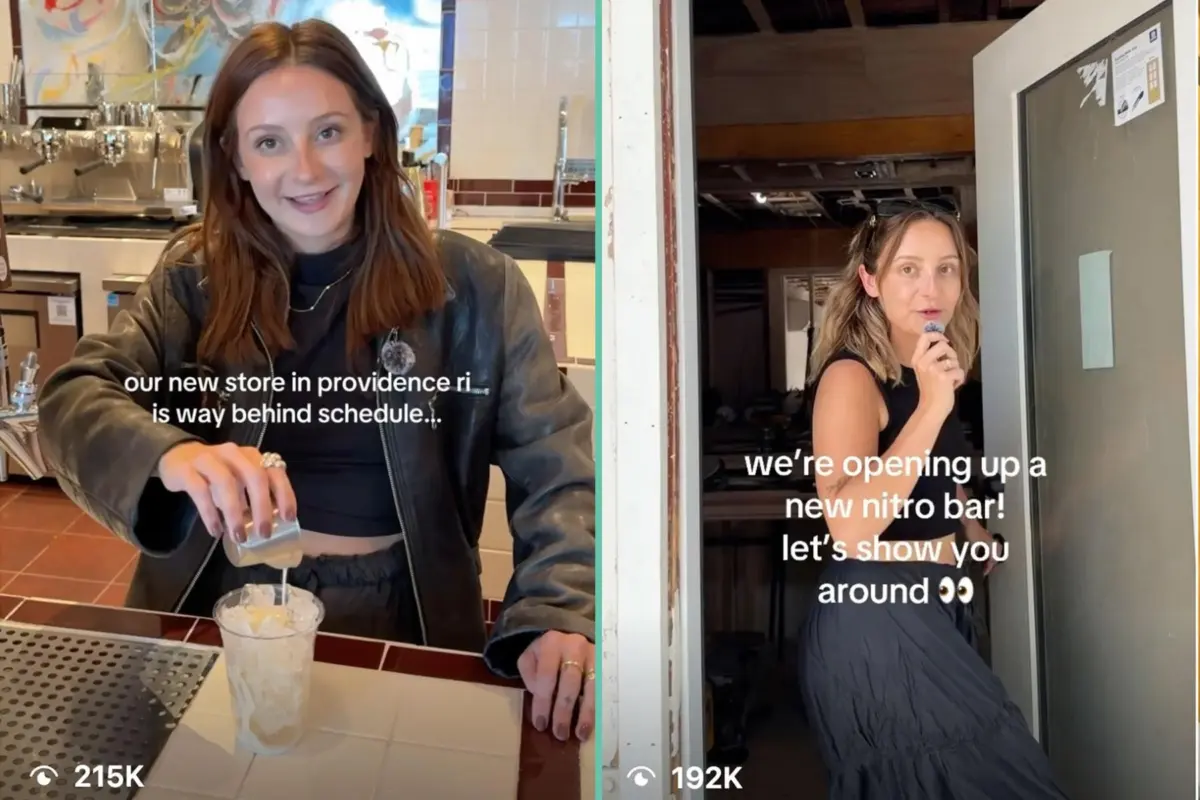
In Providence, Rhode Island, The Nitro Bar has long operated at the bleeding edge of social media innovation within the food and beverage sector. Led by owner-turned-social-media-personality Audrey Finocchiaro, the brand is famous for eccentric, unvarnished staff interactions and comedic explorations of the daily absurdities of running a coffee business. Finocchiaro has expanded this blueprint by taking her audience along for the ride as she brings The Nitro Bar to New York City, documenting the expansion through long-form YouTube videos. Viewers watch her navigate high-stakes interior design meetings and tour cavernous production spaces, turning routine business logistics into compelling narratives.
This shift mirrors what social media strategist Rachel Karten, author of the industry publication Link in Bio, has described as creating a "my show is on" mentality around a physical business. Speaking alongside Finocchiaro at an industry panel, Karten noted that in this dynamic, the business owner acts as the host, the staff functions as the cast, and the venue serves as the permanent set. Finocchiaro herself has often described her philosophy as treating the coffee shop not merely as a commercial storefront, but as its own distinct persona—someone that customers can realistically root for and desire to befriend.

The crossover appeal of this content becomes clear when viewed through the lens of modern entertainment consumption. It functions effectively as a hybrid of HGTV home-renovation programming and the Food Network, tailored specifically for consumers whose dining habits are increasingly steered by parasocial relationships. By letting the public witness the blood, sweat, and concrete dust poured into a project, a business owner transforms from a distant entrepreneur into a relatable character whom audiences actively want to support.
Perhaps the most extreme and widely discussed example of this trend belongs to Sammy Nussdorf, who documented the arduous journey of opening his high-end New York City grocery store, Meadow Lane. According to an analysis by Grub Street, Nussdorf’s social media chronicle spanned more than 430 days, multiple regulatory and permitting snafus, and nearly 700 individual TikTok posts. By the time Meadow Lane finally opened its doors in late 2025, Nussdorf had achieved a level of notoriety and public familiarity comparable to a reality television star. The protracted "will-it-open-or-won’t-it" narrative gave the grocery store’s launch the undeniable cliffhanger appeal of prime-time television.
"I think the more disclosure, the more unveiling of the curtain behind a private business, the more interested people are," Nussdorf reflected in an interview with The New York Times. That unfiltered strategy proved to be an immensely powerful marketing engine. When Meadow Lane finally debuted, it drew massive crowds with lines stretching down the block, capturing attention far beyond the local neighborhood and turning a hyper-local bodega into a national talking point.
This heightened level of disclosure spans the broader culinary world, facilitated by the rise of short-form video platforms and direct publishing tools like Substack that allow operators to bypass traditional gatekeepers. Chefs like Bill Allison in Stockholm have cultivated dedicated online followings simply by sharing the unglamorous nuts-and-bolts realities of daily restaurant life. Meanwhile, the newly opened New York City restaurant Legion chose a text-first route, publishing a serialized Substack chronicling their pre-opening phase titled The Opening Files. In past eras, a prospective restaurateur would have relied entirely on traditional food journalism to judge whether the public cared about the painstaking logistics of sourcing dishware or negotiating commercial leases; today, entrepreneurs can test those hypotheses and build their audience directly.
Even legacy media outlets are leaning heavily into the trend. Last year, Curbed published a multi-part series following restaurateur and author Eddie Huang as he worked to open the venue that would become the reimagined Baohaus. Huang’s dispatches offered rare, unvarnished insights into touring commercial spaces, dealing with broken negotiations, and confronting the stark financial realities of restaurant rent concessions and municipal permits.
Ultimately, the driving force behind this digital shift is remarkably simple: people are inherently curious, and modern platforms have mastered the art of delivering a front-row seat to the daily drama of the hospitality world.