
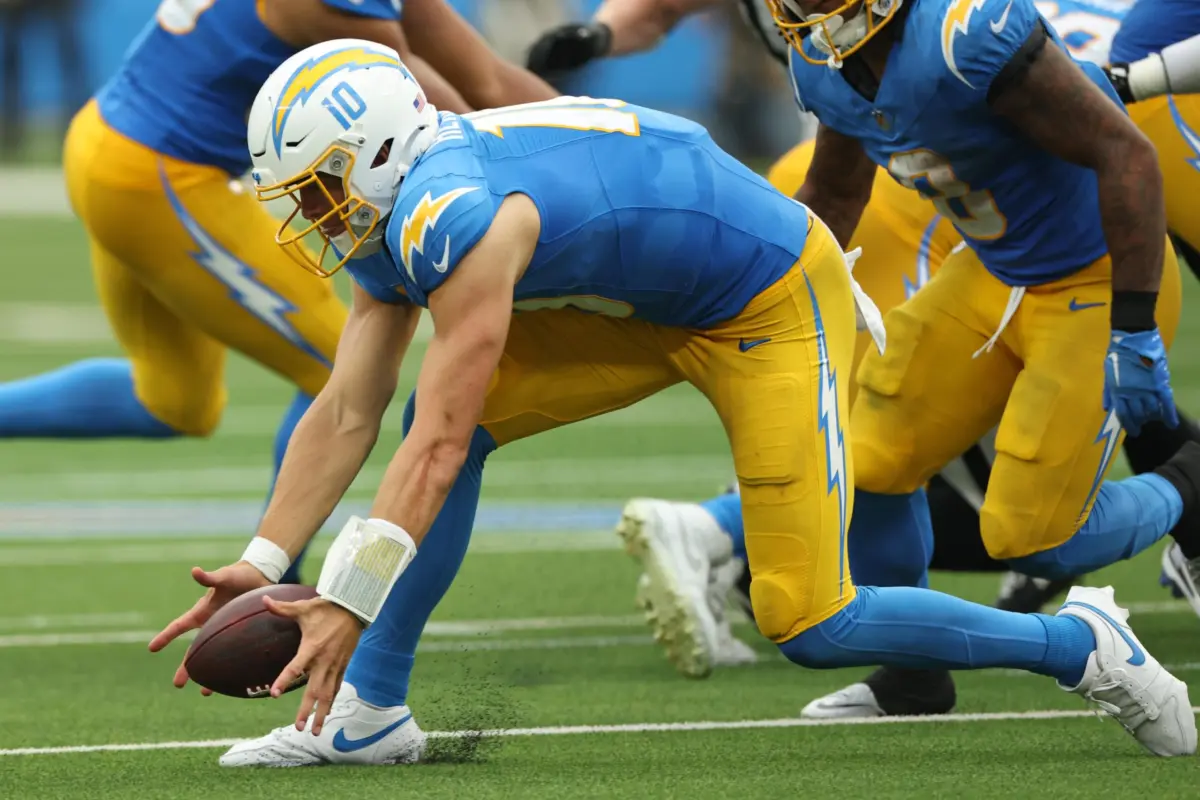
It has been a remarkably difficult start to the 2026 NFL season for the Los Angeles Chargers, a franchise that once again entered the autumn months riding a wave of high expectations and heavy media praise during the offseason. Instead of validating that optimism, the team has stumbled out of the gate in a fashion that is not only alarming for its immediate competitive prospects, but genuinely historic in the most unwanted way possible.
A pair of identical defeats to open the campaign puts their dreadful 0-2 record into a stark, almost unbelievable context that stretches back nearly a century into the earliest, dustiest archives of professional football history.
The trouble began in Week 1, when the Chargers welcomed the Arizona Cardinals to town and suffered a sobering 26-14 defeat. This was not a loss to an established juggernaut or a reigning division champion; rather, it came against a Cardinals franchise that held the third-overall pick in the 2026 NFL Draft last spring and limped through the 2025 campaign with a meager 3-14 record. For an L.A. squad billed as a rising contender, dropping a home opener to one of the previous year’s bottom-dwellers was a bitter pill to swallow.
Yet, rather than using that setback as a wake-up call to course-correct, the Chargers managed to replicate the exact same nightmare scenario one week later. On Sunday, Los Angeles welcomed the Las Vegas Raiders to SoFi Stadium for a second consecutive home game, offering the fanbase another golden opportunity to right the ship against a familiar archetype of an opponent. Much like the Cardinals, the Raiders had struggled immensely during the previous season, finishing the 2025 campaign with an identical 3-14 record and holding the absolute top pick in the 2026 NFL Draft.
When the final whistle blew on Sunday afternoon, the scoreboard bore an eerie and depressing resemblance to the week prior: Las Vegas 26, Los Angeles 14.
If supporters were searching for a single snapshot to encapsulate the frustration and futility of the afternoon, they did not have to look far. The game was littered with missed assignments, stalled drives, and an overall lack of execution that left both fans and analysts scratching their heads.
By dropping a pair of home games to teams that held top-three picks in the previous draft and finished 3-14 a year ago, the Chargers achieved something truly rare—and historically bleak. They surrendered a pair of 26-14 scorelines to teams they were heavily favored to beat, leaving themselves staring up from the bottom of the standings with an uninspiring 0-2 differential.
Unfortunately for the beleaguered Chargers faithful, things get much, much tougher from this point forward. The schedule makers did not hand out any early favors, and the road ahead looks like a gauntlet designed to test the absolute breaking point of a struggling roster.
The team must pack its bags for a treacherous trip to Buffalo to take on the red-hot Josh Allen and the Bills in Week 3. Following that daunting cross-country matchup, a similarly hostile environment awaits in Week 4 when the Chargers travel to the Pacific Northwest to face the Seattle Seahawks. If the team fails to find its footing quickly, the schedule only intensifies with upcoming games against the division-rival Denver Broncos and Kansas City Chiefs, alongside contests with the Los Angeles Rams, the Houston Texans, and the Baltimore Ravens.
Whispers of an unthinkable 0-9 start have begun to circulate among cynical observers and anxious fans. While such a projection might feel outlandish or overly pessimistic at this early stage of September, a deeper dive into the statistical archives suggests that the Chargers are already treading in unprecedentedly perilous waters.
The historic nature of the team’s ineptitude on Sunday was highlighted by the analytical minds at OptaStats, revealing a statistical oddity that links the modern, multi-billion-dollar Los Angeles Chargers directly to the nascent, barnstorming days of the 1920s NFL. Specifically, the data pointed toward a franchise that has not existed for nearly a century: the Racine Tornadoes.
This amusing and rather bizarre piece of historical trivia naturally sent researchers down a fascinating rabbit hole on Monday morning, uncovering the bizarre lineage of long-forgotten football history. The Racine Tornadoes actually began their competitive life as the Racine Regulars all the way back in 1915, operating as the very first semi-professional football team in the state of Wisconsin. In those early, decentralized days before a unified national league took firm root, the Regulars played regional games against various independent clubs across Illinois and Indiana.
As historical currents shifted, the team transformed in 1916, becoming known as Racine Battery C after a large contingent of its players enlisted together in the First Wisconsin Reserve Artillery Battery C during the height of the First World War.
Like many athletic endeavors of that era, the team was forced to take a hiatus while its members served overseas. It eventually reorganized in 1919, returning to the gridiron with financial sponsorship from the local chapter of the American Legion, as well as a rather unique benefactor: William Horlick, the president of his family’s pioneering malted milk company.
Horlick held a place in history as the original patent holder of malted milk. Alongside his brother James, he founded the Horlick Food Company back in 1873. Together, they spent years developing a soluble dried milk product before finally securing a United States patent for their creation.
Their innovative dried milk product was officially trademarked as "malted milk" in 1887. In a quirky historical footnote that feels too strange for fiction, history buffs can take comfort in knowing that Horlick and his associates thankfully passed on their initial, far less appetizing idea for a name. Their original working title for the product was "Disastoid"—a moniker that thankfully never caught on, as it completely lacks the smooth, comforting ring associated with malted milk.
Returning to the gridiron narrative, the landscape of professional football shifted dramatically in 1922 when the American Professional Football Association officially changed its moniker to the National Football League and began admitting a wave of new franchises, including the Racine Legion.
Among the early stars of that Racine squad was a quarterback named Milton "Mitt" Romney. Romney had previously served as the team captain at the University of Chicago before joining the Legion, though his tenure in Racine was relatively brief before he departed for the Chicago Bears. For trivia enthusiasts, this was indeed the exact same Romney family lineage that later produced former Utah Senator Mitt Romney.
The Racine franchise experienced the financial and logistical instability typical of early pro football, opting to sit out the 1925 season entirely. However, they returned to the league for the 1926 campaign under a newly minted identity: the Racine Tornadoes.
Their final season in the league started with a fleeting glimmer of hope when they managed to win their inaugural game. Unfortunately, that success evaporated almost instantly. The Tornadoes proceeded to drop four consecutive contests—a dismal stretch that mirrors the historical obscurity the modern Chargers inadvertently brushed against this past weekend—before the franchise was forced to disband entirely in late October of 1926 due to an increasingly untenable financial situation.
To sum up the bizarre parallel for baseball fans and sports historians alike, the overarching sentiment was perhaps best captured by researcher Bernd Buchmasser, who contextualized the unfolding modern disaster through the lens of early-century athletic heartbreak.
Ultimately, exploring the peculiar legacy of "Disastoid," the short-lived Racine Tornadoes, and the winding roads of early 20th-century football provides a stark reminder of how long professional sports have been capable of producing baffling starts. But for the 2026 Los Angeles Chargers, history lessons offer little comfort. As they stare down a brutal upcoming schedule and attempt to salvage a season spiraling rapidly out of control, the team must find immediate answers before an already difficult start transforms into a full-blown historic catastrophe.