
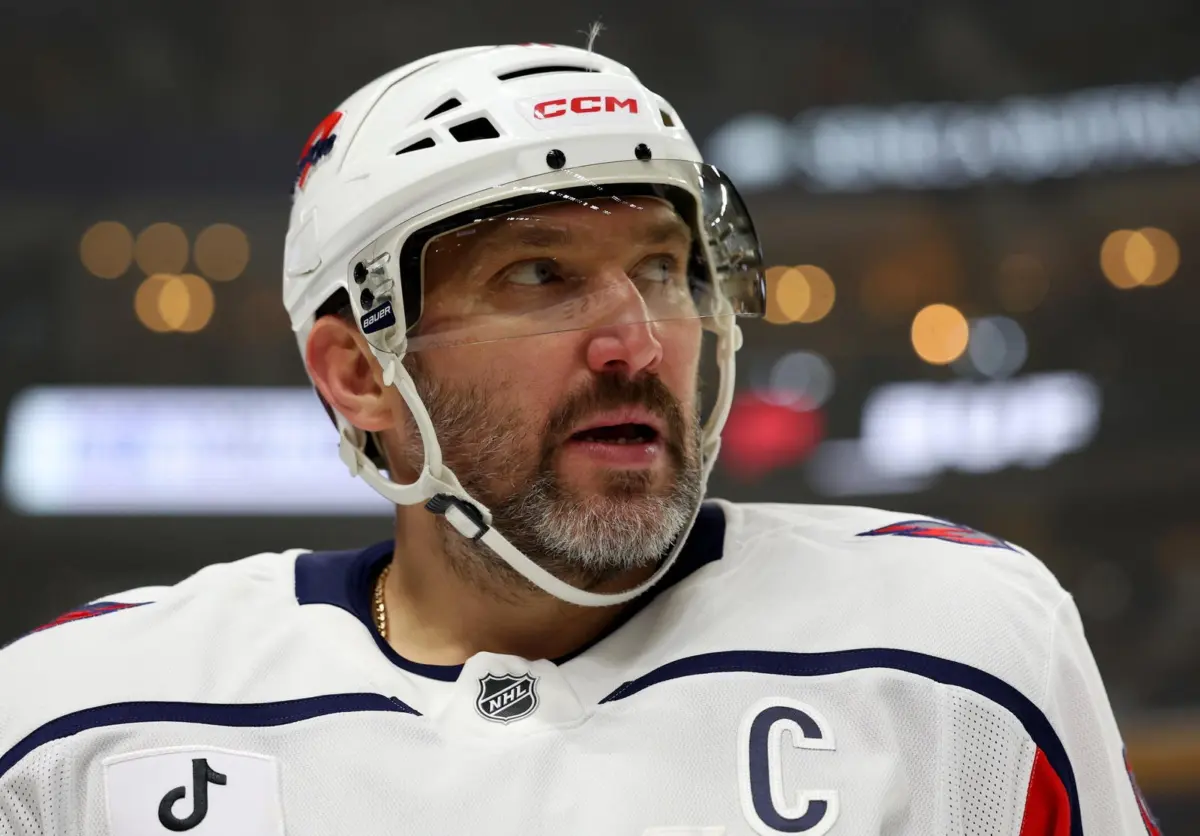
For years, Washington Capitals star Alexander Ovechkin has been rightfully regarded as one of the greatest goal-scorers of all time, standing shoulder-to-shoulder with hockey legends in the record books. But as dangerous as he remains on the ice, the Russian superstar has been playing a far more perilous game off it—one with profound, real-world implications that extend far beyond the rink. And with every new political maneuver, that game edges closer to doing irreparable harm to his otherwise stellar Hall of Fame legacy.
The latest chapter in this ongoing controversy unfolded when Ovechkin appeared in a promotional advertisement for a Russian political party closely aligned with Russian President Vladimir Putin. For those who have followed the forward’s career closely over the past decade, the decision was hardly out of character. Ovechkin has publicly supported Putin and aligned himself with pro-Kremlin political initiatives long before Russia launched its full-scale invasion of Ukraine.
With this latest, overt show of political backing, however, Ovechkin has opened himself up to entirely fair and legitimate criticism. It has sparked a widespread debate across the hockey world, prompting many to argue that it is well past time for him to be held responsible for his actions. As one of the most popular and visible figures in the National Hockey League, his decision to lend his massive platform and celebrity status to a government backing a war of aggression cannot simply be brushed aside as a private matter.
Ovechkin can no longer have it both ways. He cannot repeatedly retreat behind the convenient shield of being merely a hockey player and not a politician, only to turn around and willingly appear in targeted political campaign advertisements. He cannot claim that he desires global peace and the safety of innocents while simultaneously throwing his public support behind his country’s senseless war. He can no longer feign innocence, lean on feigned ignorance, or hide comfortably inside the insulated bubble of professional hockey.
Nor can the Washington Capitals franchise continue to issue passive responses without facing scrutiny themselves. The organization recently issued an official statement in response to the intense backlash that both the franchise and its long-time captain received following his appearance in the political advertisement.
"Alex Ovechkin is a Russian citizen who lives in Moscow with his family during the offseason and will live there following his retirement," the team said in its carefully worded statement. "This summer, while in Russia, he was asked by his country to participate in a video campaign. As the longest-tenured athlete in Washington, D.C. and a pillar of the community, his focus and ours is on the season ahead and the continued impact he makes on the ice and in our city."
Despite the organization’s attempt to compartmentalize Ovechkin’s off-ice political activities from his on-ice responsibilities, cracks have begun to show within the franchise’s leadership. Washington Capitals general manager Chris Patrick recently went further than any team employee has publicly ventured in the past. Speaking to ESPN’s Robert Klemko, Patrick offered what came as close to a direct rebuke of Ovechkin’s actions as the franchise has ever seen, admitting that "I doubt we’d be standing where we’re standing right now if he had run it by us."
That candid admission from the general manager paints a picture of a front office caught off guard and distinctly unhappy with the public relations firestorm created by their star player. Yet, it also highlights the cautious, kid-glove approach the franchise has historically taken with its golden goose.
Ovechkin, who notably still maintains a photograph of himself alongside Vladimir Putin as his official profile picture on Instagram, may have received a free pass from large segments of the sports world in the past. But this time, observers note, he has seriously and publicly erred. This issue is not going to simply blow over or fade away with time—nor should it, given the gravity of the geopolitical conflict involved.

Had the Capitals organization taken a much firmer, uncompromising stance against their superstar’s political alignments years ago—either by formally asking Ovechkin to publicly denounce the ongoing war or, at the very absolute least, strongly encouraging him to remain neutral—they might have successfully prevented this latest avoidable debacle from taking place.
It is important to note that fair-minded critics hold no ill will against Russian NHL players simply based on their nationality. The vast majority of Russian hockey players currently competing in North America maintain a clear boundary and have no involvement in domestic Russian politics. Fans do not see enthusiastic endorsements of Vladimir Putin from Los Angeles Kings star Artemi Panarin, Boston Bruins defenseman Nikita Zadorov, or Tampa Bay Lightning standouts Nikita Kucherov and Andrei Vasilevskiy.
In fact, some Russian players have chosen to use their voices to speak out against the climate of fear and the devastating impacts of the conflict. "I think it’s important for me to speak personally," Nikita Zadorov said in a candid 2023 interview addressing the political landscape. "I think hopefully I can change something in this world. It just sucks what’s going on over there right now. I think it’s just important to be vocal."
Some commentators and fans routinely argue that they do not want politics mixing with sports, viewing athletic competition as a much-needed escape from the grim realities of the outside world. In many ways, sports have always functioned as a sanctuary from global turmoil.
However, every public act carried out by a major global figure possesses, in some form, a political dimension. By deliberately choosing to ignore an issue of this monumental humanitarian and political magnitude, individuals in positions of influence effectively take a passive political stance. Therefore, the notion that Ovechkin is making these calculated decisions with zero understanding of the political implications that accompany them is entirely preposterous.
Ovechkin can try all he wants to claim in brief, carefully managed statements that he simply wants peace and love for all people. Yet, actively appearing in a state-aligned propaganda advertisement is a remarkably contradictory way to demonstrate that desire.
It is entirely understandable why some loyal fans will continue to look past these controversies, choosing to see Ovechkin strictly through the lens of a hockey hero who has thrilled crowds for nearly two decades. That is part of the enduring nature of sports culture, which naturally lionizes exceptional athletes and places them upon pedestals of immense cultural importance.
Ultimately, however, what an athlete chooses to do once they occupy that elevated platform is entirely up to them. From the perspective of many observers, analysts, and fans watching from the outside, Ovechkin can no longer be viewed as a simple hero, and he deserves no further excuses for his actions. He has made abysmal off-ice choices of his own free will, and now he must face accountability for those choices—regardless of the lasting damage they may inflict upon his public reputation and his historical standing in the game.