
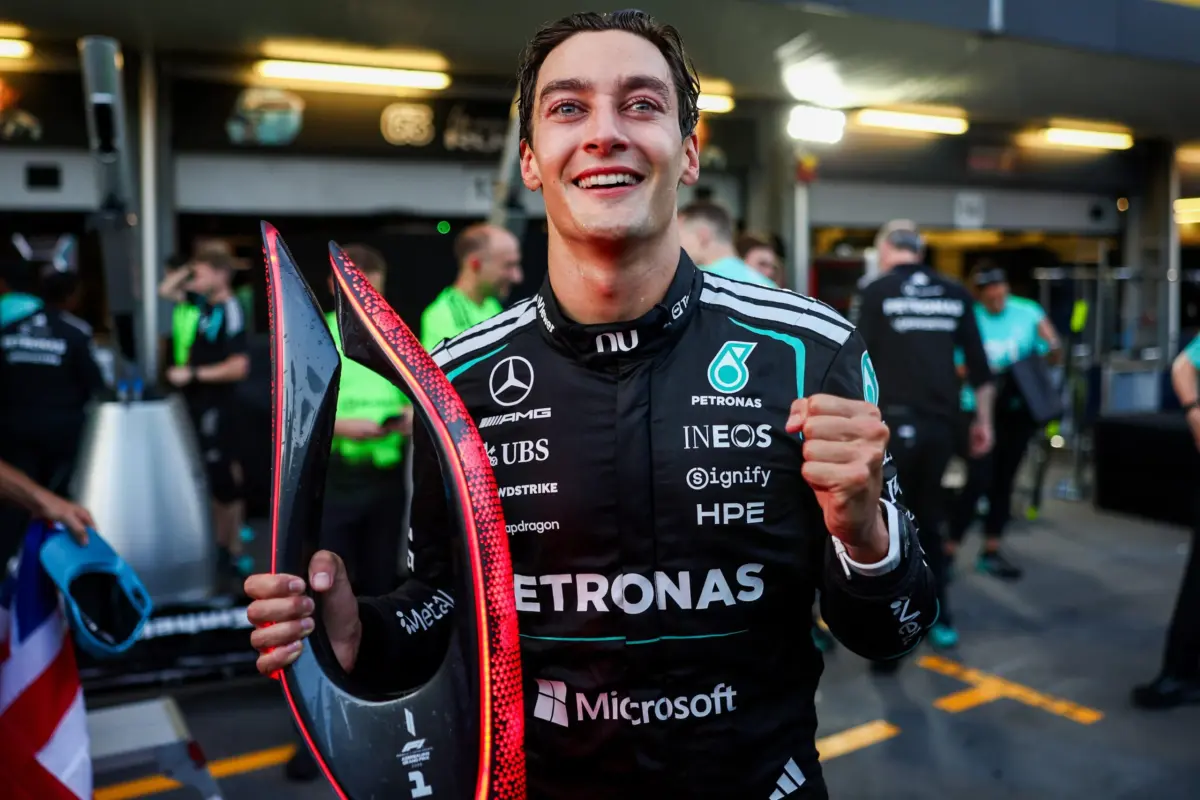
George Russell’s dominant and flawless performance at the Azerbaijan Grand Prix has firmly vaulted the Mercedes driver back into the heart of the 2025 Formula 1 World Drivers’ Championship mix. With a masterclass weekend on the streets of Baku, Russell sliced into the standings deficit and now trails teammate Kimi Antonelli by 66 points. With eight grand prix weekends remaining on the grueling global calendar, the championship battle has taken a dramatic twist, injecting fresh intrigue into the final stretch of the season.
Beyond breathing new life into his title aspirations, Russell etched his name into the history books by completing a rare and prestigious Formula 1 milestone: the elusive "Grand Slam." In doing so, the British driver joined an elite, historic fraternity of motorsport legends, achieving a level of utter dominance that few drivers across the decades have ever managed to replicate over a single race weekend.
The accomplishment has naturally sparked renewed discussion across the paddock about what it truly takes to achieve absolute perfection in Formula 1, and where Russell now stands alongside the sport’s most decorated names.
What is an F1 Grand Slam?
While sports fans across North America might associate the term with the climax of a baseball postseason, a Formula 1 grand slam represents an entirely different tier of athletic and mechanical dominance. Known in traditional racing circles and by its French moniker, the Grand Chelem, achieving this feat requires a driver to execute a clean sweep of every major competitive metric available during a single grand prix weekend.
For a driver to officially accomplish an F1 Grand Slam, they must fulfill four distinct criteria: they must secure pole position during Friday’s qualifying session, lead every single lap of the race from start to finish, set the absolute fastest lap of the race, and ultimately take the checkered flag to win the grand prix.
During the Azerbaijan Grand Prix weekend, Russell methodically checked every single one of those boxes, securing the very first Grand Slam of his Formula 1 career. His campaign began in earnest on Friday when he outpaced the rest of the grid during qualifying to lock in pole position. He then backed up that qualifying pace on Saturday by commanding the race from lights out, controlling the rhythm, managing tire wear, and leading every lap around the challenging Baku street circuit.
The exclamation point on his weekend came deep into the grand prix on Lap 49, when Russell uncorked a blistering flyer that was officially recorded as the fastest lap of the race, boasting an average speed of 205.981 miles per hour. Despite relentless pressure in the closing stages, Russell held his nerve to cross the finish line and win the race by a razor-thin margin of just one-tenth of a second over Red Bull Racing’s Max Verstappen. That breathtaking finish cemented a historic weekend that has completely reshaped the narrative of the championship battle.
Who has accomplished an F1 Grand Slam?
By achieving a clean sweep in Azerbaijan, Russell became the 29th driver in the rich history of Formula 1 to accomplish a Grand Slam. It is a testament to the sheer difficulty of the feat—which requires a combination of raw speed, supreme reliability, tactical perfection, and a touch of fortune—that fewer than thirty drivers have managed it since the world championship began in 1950.
With his addition to the roster, Russell also stands as one of just seven active drivers on the current grid who boast at least one career Grand Slam on their resume, highlighting the elite company he now keeps among his contemporaries.
The historical list of Grand Slam achievers spans every golden era of the sport. At the very top of the leaderboard sits legendary British driver Jim Clark, whose remarkable tally of eight career Grand Slams remains the gold standard in Formula 1 history, a record that has stood the test of time against generations of challengers.
Following Clark at the summit of this exclusive club are multiple-time world champions Lewis Hamilton and Max Verstappen, both of whom have accumulated six career Grand Slams apiece through periods of immense individual dominance. They are followed closely by Italian trailblazer Alberto Ascari and German icon Michael Schumacher, who each secured five Grand Slams during their respective eras of supremacy.
A tier below them sits a legendary quartet of drivers who each captured four Grand Slams: 1960s maestro Jim Clark’s compatriot and rival Jackie Stewart, Brazilian icon Ayrton Senna, British powerhouse Nigel Mansell, and German four-time champion Sebastian Vettel. Moving further down the statistical ledger, Brazilian star Nelson Piquet recorded three Grand Slams during his career.
A select group of drivers managed two Grand Slams apiece, including Argentine five-time champion Juan Manuel Fangio, Australian pioneer Jack Brabham, Finnish flying-man Mika Hakkinen, and 2016 world champion Nico Rosberg.
The remainder of the 29-driver list consists of competitors who achieved a single Grand Slam over the course of their careers, representing some of the most respected names in motorsport history. That diverse group includes Mike Hawthorn, Stirling Moss, Jo Siffert, Jacky Ickx, Clay Regazzoni, Niki Lauda, Jacques Laffite, Gilles Villeneuve, Gerhard Berger, and Damon Hill.
Alongside Russell himself, the modern era is represented by a handful of drivers who have tasted similar statistical perfection. Kimi Antonelli, Oscar Piastri, Charles Leclerc, Fernando Alonso, Max Verstappen, and Lewis Hamilton round out the active drivers who carry a career Grand Slam into the closing rounds of the championship.
With Russell now firmly inscribed onto this prestigious roster and closing the gap on teammate Kimi Antonelli at the top of the points table, the remaining eight race weekends promise a tense, high-stakes battle for the ultimate prize in motorsport.