
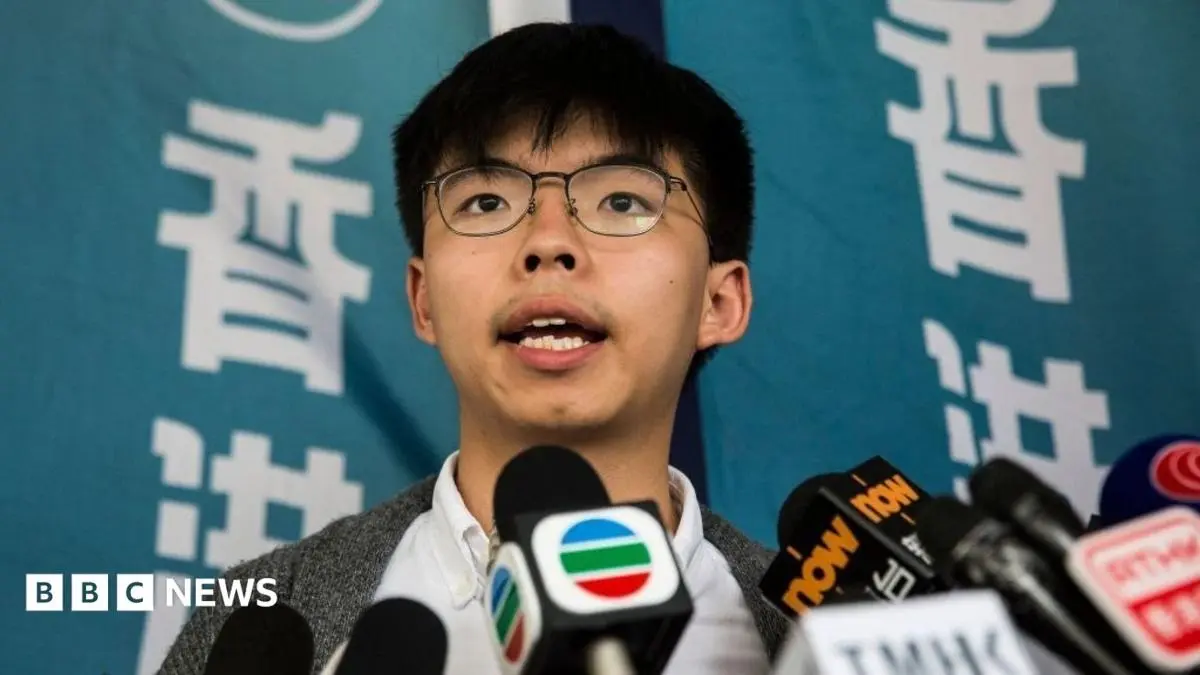
Prominent Hong Kong pro-democracy activist Joshua Wong, who turned 30 last month, has been handed a 10-year prison sentence in his latest trial under the territory’s national security legal framework. The ruling represents the newest judicial development for Wong, who has spent significant portions of his adult life behind bars due to political activism that began when he was still a teenager. Appearing before the court on Thursday for the formal sentencing, Wong learned that the judge had ordered two months and two days of the new 10-year term to be served concurrently with his ongoing prison sentence. Prior to the filing of these latest foreign collusion charges—to which he formally pleaded guilty earlier this year in September—Wong had been scheduled for release from prison early next year.
The atmosphere inside and around the court complex on Thursday reflected the intense interest that has consistently surrounded legal proceedings involving Hong Kong’s most prominent political figures. As Wong walked into the courtroom, observers noted a distinct physical change in his appearance. Dressed in a dark blue long-sleeved shirt, khaki trousers, and his signature black-rimmed glasses, the activist looked noticeably slimmer compared to his previous public court appearances. Despite the solemnity of the occasion and the lengthy term handed down, Wong maintained a calm demeanour inside the dock. Upon taking his place, he offered a nod in greeting toward the members of the packed public gallery. Throughout the hearing, as the presiding judge systematically read out the detailed legal rationale behind the sentencing decision, Wong remained attentive, taking notes intermittently from his seat.
Outside the judicial building, a large crowd of Hong Kong residents gathered hours before the proceedings began. Dozens of citizens had queued for extended periods in the hope of securing one of the limited seats allocated to the public inside the gallery. The gathering of onlookers occurred amid a heavy police presence, with law enforcement personnel deployed around the perimeter of the court building and patrolling nearby streets to manage the crowd and maintain security.
The legal allegations that brought about Thursday’s sentence centered on claims that Wong engaged in international lobbying efforts against Chinese authorities. According to statements made by prosecutors in court, Wong conspired with a network of fellow political campaigners, including self-exiled activist Nathan Law, to actively lobby foreign powers. Prosecutors stated that these efforts were aimed at persuading foreign governments to impose sanctions and economic blockades against Beijing. The court heard that the specific activities cited by the prosecution took place over a five-month period between July and late November 2020. Wong did not contest the charges during his court appearances earlier in the autumn, having entered a formal guilty plea to the national security collusion offenses in September.
The political ties between Wong and Nathan Law extend back to the formation of organized youth activism in Hong Kong. Together, the two activists were co-founders of Demosisto, a now-defunct pro-democracy political party that advocated for democratic reform in the territory. Following the court’s ruling on Thursday, Hong Kong’s Chief Executive, John Lee, issued a formal public statement directly addressing the case and taking a firm stance against the actions of both Wong and Law.
In his official statement released shortly after the sentence was delivered, John Lee described Wong and Law as being "among the primary culprits responsible for undermining Hong Kong’s prosperity and stability." The chief executive emphasized the severity of the offenses, asserting that their actions had far-reaching consequences for both local society and national governance. Lee stated that the conduct of the two activists "not only severely undermined national sovereignty, security, and development interests, but also directly prejudiced the well-being of the general public and the stability of society."
Thursday’s sentencing marks another milestone in a decade-long path that transformed Wong from a student activist into an internationally recognized public figure, and ultimately into a primary target of the city’s national security apparatus. Wong’s initial rise to global prominence began in 2014, when he emerged at the forefront of a massive civil disobedience movement known as the "Umbrella Movement." As a teenager leading student strikes demanding democratic electoral reforms for the selection of the city’s leader, Wong’s image became widely recognized around the world. By the end of the 2014 demonstrations, he had firmly established himself as one of the most visible faces of Hong Kong’s pro-democracy movement.
In 2016, building upon the momentum of the Umbrella Movement, Wong expanded his political work by co-founding Demosisto alongside Nathan Law and Agnes Chow, another prominent youth activist who has since gone into exile. The political party sought to channel youth-led civil activism into electoral politics and broader advocacy. Over the following years, all three co-founders became central figures in Hong Kong’s political debate, though each would eventually face severe legal consequences or be forced to leave the territory as the legal and political landscape evolved.
Despite his international visibility and frequent media coverage, Wong often expressed discomfort at being cast as the sole figurehead of Hong Kong’s political resistance. Throughout his years of public organizing, he pushed back against the label of "protest leader," insisting that the movement was decentralized and driven by collective participation rather than top-down directives.
This perspective on leadership was articulated by Wong during an interview with The Financial Times in November 2019, conducted during the height of widespread anti-government demonstrations across Hong Kong. Addressing the nature of the protests, Wong sought to clarify his role within the broader movement. "We have a lot of facilitators in this movement and I’m one of them," Wong told the publication. He emphasized the organic structure of the demonstrations, adding, "Instead of having a top-down command, we now have a bottom-up command hub."
The structural environment for political organizations in Hong Kong changed fundamentally in 2020 following Beijing’s introduction and enactment of the National Security Law (NSL). The legislation criminalized acts categorized as subversion,