
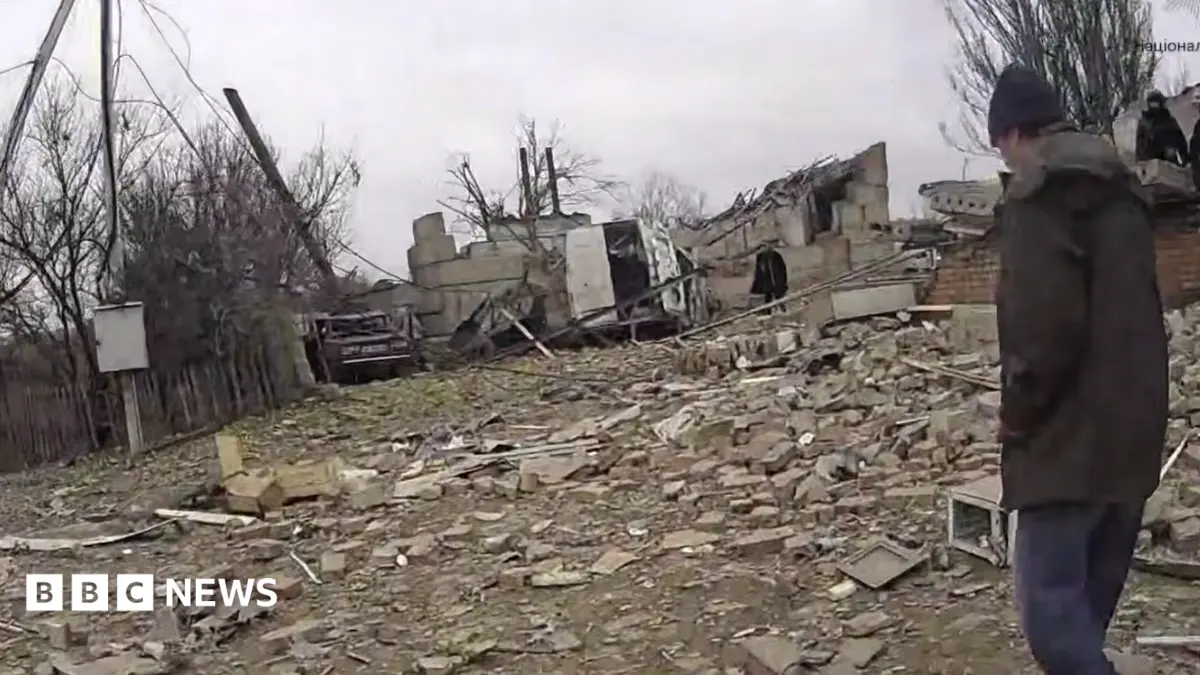
Harrowing bodycam footage released by Ukraine’s national police on Wednesday has captured the violent reality of a Russian aerial bomb attack on the village of Komyshuvakha in Ukraine’s southern Zaporizhzhia region, recording the frantic moments before and during a direct strike on an underground shelter packed with fleeing civilians and emergency responders.
The video footage offers a rare, first-person view of the aftermath of an initial aerial strike on the rural settlement, also referred to as Kamyshuvakha. In the opening sequences of the recording, local residents are seen in a state of visible shock, standing near severe structural devastation and staring helplessly at piles of rubble where homes and community infrastructure once stood. Severely damaged buildings, their walls collapsed and roofs torn apart by explosive blast waves, surround the survivors as law enforcement officers navigate the debris to render assistance and evaluate the damage.
The initial chaos captured in the video quickly gives way to renewed panic as a clear voice from a military official crackles over a two-way police radio, warning the law enforcement team on the ground that additional glide bombs have been launched by Russian forces and are tracking directly toward Komyshuvakha. Recognizing the immediate threat of a secondary strike, an officer on the scene immediately turns to the gathered civilians and directs them toward safety.
"Quickly [go] to the shelter!" the police officer instructs the local residents, urging them away from the open streets. The bodycam camera follows as residents move rapidly down a stairwell into a reinforced underground shelter situated at least two floors beneath the surface. The officers follow closely behind to ensure the evacuation of the area is complete. However, just seconds after the civilians and officers reach the lower levels of the subterranean bunker, a massive detonation strikes the immediate structure overhead. The force of the impact shakes the camera violently before the audio and video recording abruptly cuts to black.
Ukrainian authorities confirmed that the targeted underground shelter was located adjacent to a local school. At the time of the bombardment, the educational facility was being actively utilized as a community hub for the distribution of essential humanitarian aid to residents affected by the ongoing war.
Independent visual verification conducted by open-source intelligence journalists at BBC Verify corroborated the authenticity and location of the law enforcement video. BBC Verify confirmed that the bodycam sequence was filmed at the exact same site featured in separate video material released earlier by Ukraine’s State Emergency Service (DSNS). The DSNS footage, which documented the aftermath of the Monday attack in Komyshuvakha, showed rescue workers surveying extensive destruction and depicted a massive crater carved into the ground near the ruined school complex.
Reacting to the release of the footage on Wednesday, Ukrainian President Volodymyr Zelensky issued a direct statement on social media outlining the scope of the assault on the Zaporizhzhia village. According to Zelensky, Russian forces dropped a total of nine aerial guided bombs onto Komyshuvakha during the operation. He explicitly accused Russian forces of conducting a deliberate, multi-stage strike designed to maximize human casualties among both civilians and first responders.
"First, they hit people who came to receive humanitarian aid, and then rescuers and police officers who arrived at the scene," Zelensky stated.
The Ukrainian president expressed deep disappointment over the international response to the tragedy, criticizing what he viewed as inadequate global condemnation of targeted strikes on humanitarian sites. "Unfortunately, there has been very little reaction from the world to this insane attack," Zelensky added, describing the strike as another instance in a continuous pattern of "thousands" of war crimes committed by Russian forces since the outbreak of the war.
The Russian military has not issued any public statement or official commentary regarding the specific strikes on Komyshuvakha, the destruction of the humanitarian aid hub, or the police bodycam footage released by Kyiv. Moscow has consistently denied targeting civilian infrastructure throughout the invasion launched by Russian President Vladimir Putin in February 2022.
The graphic evidence of battlefield violence emerged alongside major diplomatic maneuvers involving top Ukrainian, American, and European officials. On Wednesday, President Zelensky made an unannounced, surprise visit to Spain, participating in strategic discussions while simultaneously maintaining direct communication with key international figures overseeing potential peace negotiations.
Zelensky revealed that he engaged in an extensive, hour-and-a-half-long consultation with Steve Witkoff and Jared Kushner, who are serving as peace envoys for U.S. President Donald Trump. The Ukrainian leader characterized the 90-minute discussion as having covered strategic issues "in great detail," coming ahead of scheduled high-level diplomatic meetings in the Middle East.
The discussions with the American envoys serve as a prelude to upcoming trilateral negotiations involving delegations from Ukraine, Russia, and the United States. Those three-way talks are scheduled to take place on November 10 and 11 in Abu Dhabi, the capital of the United Arab Emirates. The Abu Dhabi summit marks a significant attempt to re-engage direct diplomatic channels, which have remained officially suspended since February.
The geopolitical background surrounding the upcoming talks in the United Arab Emirates is defined by a marked escalation in Russian aerial tactics. Since the initial suspension of trilateral talks earlier this year, Russian forces have intensified heavy missile and glide-bomb attacks against Ukrainian civilian centers and military positions. This strategy has exploited severe logistical pressures facing Kyiv, as Ukrainian air defense forces have virtually exhausted their inventory of Western-supplied interceptor missiles needed to counter incoming high-altitude glide bombs and ballistic threats.
Despite the scheduled resumption of talks in Abu Dhabi, political and military analysts maintain highly cautious expectations regarding the likelihood of immediate diplomatic progress. Observers suggest that given the persistent disparity in strategic demands between Kyiv and Moscow, major breakthroughs toward a lasting ceasefire or peaceful resolution remain unlikely during the upcoming UAE summit.
Concurrently with the conversations involving American peace envoys, Ukrainian officials held separate high-level talks in Belgium. Zelensky reported that his diplomatic and security team conducted a "meaningful" session in Brussels with representatives from a broad international coalition, including the United States, the European Union, France, Great Britain, Germany, NATO, and the World Bank.
The primary focus of Wednesday’s meetings in Brussels centered on framework preparations for Ukraine’s long-term "post-war reconstruction," evaluating the financial and economic mechanisms required to repair shattered infrastructure across the country. Zelensky indicated that the multilateral consultations in the Belgian capital would extend into Thursday, with the secondary phase of talks focusing specifically on establishing binding "security guarantees" to safeguard Ukraine against future military aggression.
The contrast between the diplomatic efforts in European capitals and the destruction captured on police cameras in Zaporizhzhia underscores the ongoing volatility on the ground. As delegates prepare for upcoming negotiation tracks in Abu Dhabi and continue structural planning in Brussels, front-line settlements like Komyshuvakha remain under constant threat from heavy aerial bombardment.