
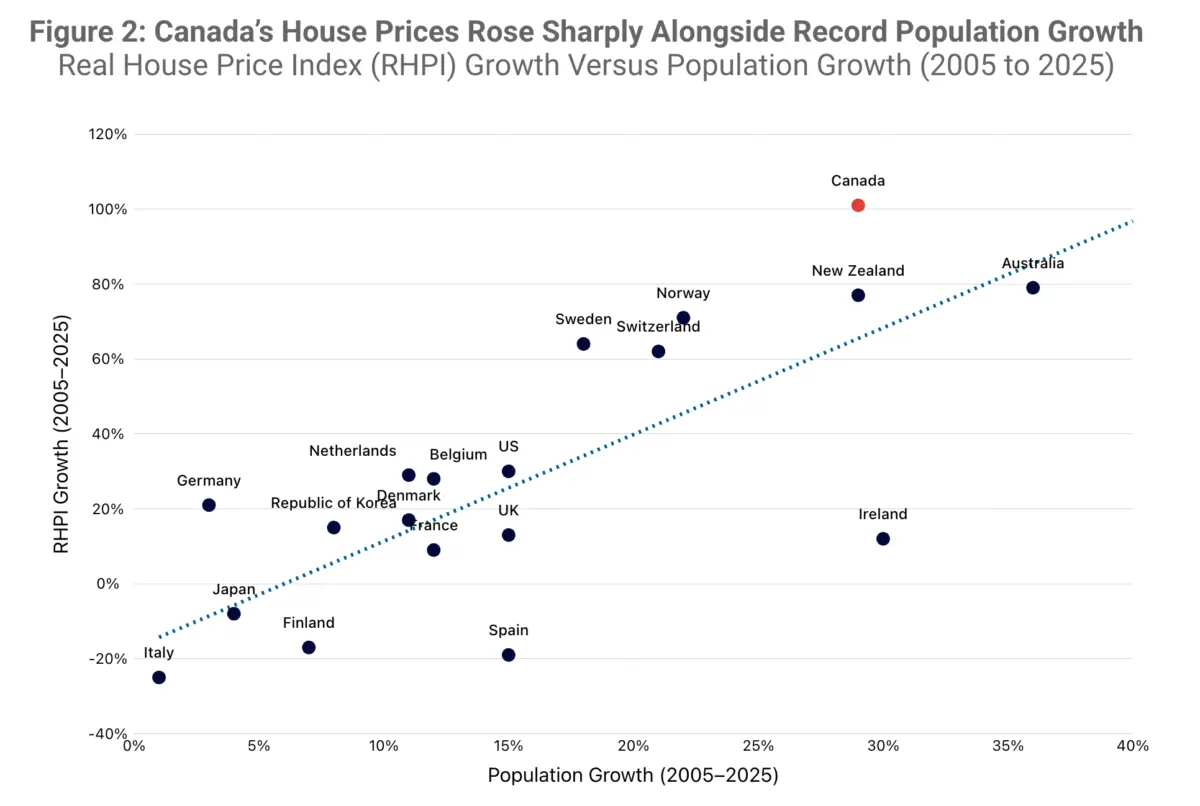
Canadian house prices have more than doubled since 2005, significantly outpacing most developed nations over the same period. According to comprehensive new research released by the Canada Mortgage and Housing Corporation (CMHC) on October 20, a potent combination of robust population growth, rising household incomes, and prolonged low borrowing costs drove housing demand far ahead of the country’s capacity to build new homes, severely eroding affordability across the board.
The newly published report takes a sweeping look at why Canadian home values have escalated more sharply and persistently than those in comparable international economies. It reveals that the nation’s relatively constrained housing stock, paired with a chronic, long-term imbalance between supply and demand, has created an exceptionally vulnerable market landscape. Furthermore, Canada enters these pressures with fewer homes per capita than the vast majority of its international peers, exacerbating the impact of any sudden surges in demand.
Aled ab Iorwerth, deputy chief economist at CMHC, highlighted the structural nature of the problem in a statement accompanying the research. He noted that the core issue extends beyond simple price appreciation, pointing instead to a fundamental velocity mismatch. Canada’s primary housing challenge is not just that home prices rose, but that demand grew faster than supply for a much longer duration than in many comparable countries, setting the nation apart on the global stage.
Canada Stands Apart From International Peers
To understand how far Canada has deviated from historical norms, the CMHC report evaluated housing market trajectories across various developed economies over the past two decades. The findings show that Canada, alongside Australia and Sweden, experienced relatively modest housing market downturns during the turbulent global financial crisis of 2008 and 2009. Following this brief period, all three countries saw sustained, long-term price growth that extended right through to 2022.
The landscape looked starkly different in other major economies. The United States and the United Kingdom, for instance, endured severe market corrections and deep crashes following the financial crisis, with their housing sectors requiring several years of readjustment before beginning a gradual recovery around 2012. Meanwhile, European nations like France and Germany recorded much more moderate, stable growth patterns, while Italy and Japan experienced extended, multi-year periods of stagnant or outright declining property values.
The research suggests that even if Canada had suffered a dramatic market correction on par with the United States during the 2008 financial meltdown, its house prices would still rank comfortably among the fastest-growing in the entire international comparison group. While population growth certainly plays a role in explaining this divergence, the CMHC report emphasizes that it is far from the sole driving factor.
A closer examination of peer nations reveals that Canada, Australia, New Zealand, Norway, and Sweden all experienced highly similar economic conditions and robust population growth over the past twenty years. Yet, after adjusting for inflation and population changes, Canada recorded by far the steepest increase in house prices among that group.
Urbanization trends similarly fail to tell the full story. Despite being slightly less urbanized overall than Australia, Norway, and Sweden, Canada still managed to record stronger house price growth than each of those nations, pointing to deeper structural bottlenecks within the Canadian planning, zoning, and construction sectors.
Population Growth Outpaces Construction
The widening chasm between housing supply and demand in Canada became particularly acute during the second half of the 2010s. During this era, housing demand was relentlessly stoked by surging population growth, alongside higher average incomes and historically low interest rates that made borrowing cheap and fueled competitive bidding in markets large and small.
As the report underscores, rapid population growth is only part of the story. Demand was simultaneously supported and amplified by broad economic factors, including climbing incomes and low interest rates that gave buyers more purchasing power just as inventory dwindled.
Despite this mounting pressure, Canada’s annual rate of housing construction remained remarkably stagnant as a proportion of its existing housing stock. Government and industry data show that national construction rates increased only marginally from 1.2 per cent of the total housing stock in 2011 to 1.3 per cent in 2022.
Although both of those figures managed to exceed the broader average tracked by the Organisation for Economic Co-operation and Development (OECD), they paled in comparison to international peers. Fully 11 out of 17 comparator countries managed to record much larger increases in their domestic construction rates over that exact same timeframe.
Australia, for example, consistently maintained a significantly higher housing supply growth rate of approximately 1.7 per cent annually. Other nations, including Ireland and New Zealand, similarly recorded stronger and more responsive increases in residential construction activity to meet incoming demand.
The most dramatic structural break in Canada’s market occurred after 2021, when the historical gap between population growth and housing completions widened into a chasm. Statistical models from the report indicate that in the peak years of 2023 and 2024, Canada added nearly five new residents for every single home completed. By contrast, Australia recorded a much lower peak ratio during the same period, while Sweden maintained a ratio well below one, reflecting a far more balanced equilibrium between demographic shifts and residential development.
More recently, that soaring Canadian ratio has fallen sharply, settling at approximately 1.53 residents per completed home. The CMHC suggests this recent downward shift may reflect subsequent adjustments and recalibrations in federal immigration levels and intake targets.
Fewer Homes Per Capita
Compounding the supply-demand mismatch is Canada’s foundational baseline inventory. The research highlights that Canada possesses fewer dwellings per 1,000 residents than the vast majority of comparable developed countries, falling well below the broader OECD average.
The CMHC suggests that nations like Sweden and Norway were fundamentally better positioned to absorb sudden waves of population growth over the past decade simply because they entered the period with larger, more robust housing stocks relative to their population sizes. In contrast, Canada entered the growth phase running a structural deficit in housing density, leaving its market acutely sensitive to any macroeconomic shifts or demographic influxes.
Summarizing the overarching trajectory of the market, the report concludes that Canadian house prices have risen faster, higher, and far more persistently than in most comparable developed nations, driven by a chronic failure to scale construction in tandem with demographic realities.
Looking ahead, the CMHC has indicated that this study is only the first phase of a broader analytical effort. The housing agency plans to release a subsequent, separate review in the near future examining how 10 specific countries have successfully managed to increase their housing construction rates. That upcoming research will explore a variety of policy mechanisms, including financial incentives, sweeping municipal planning reforms, construction sector innovations, and the strategic deployment of public land to jump-start development.