
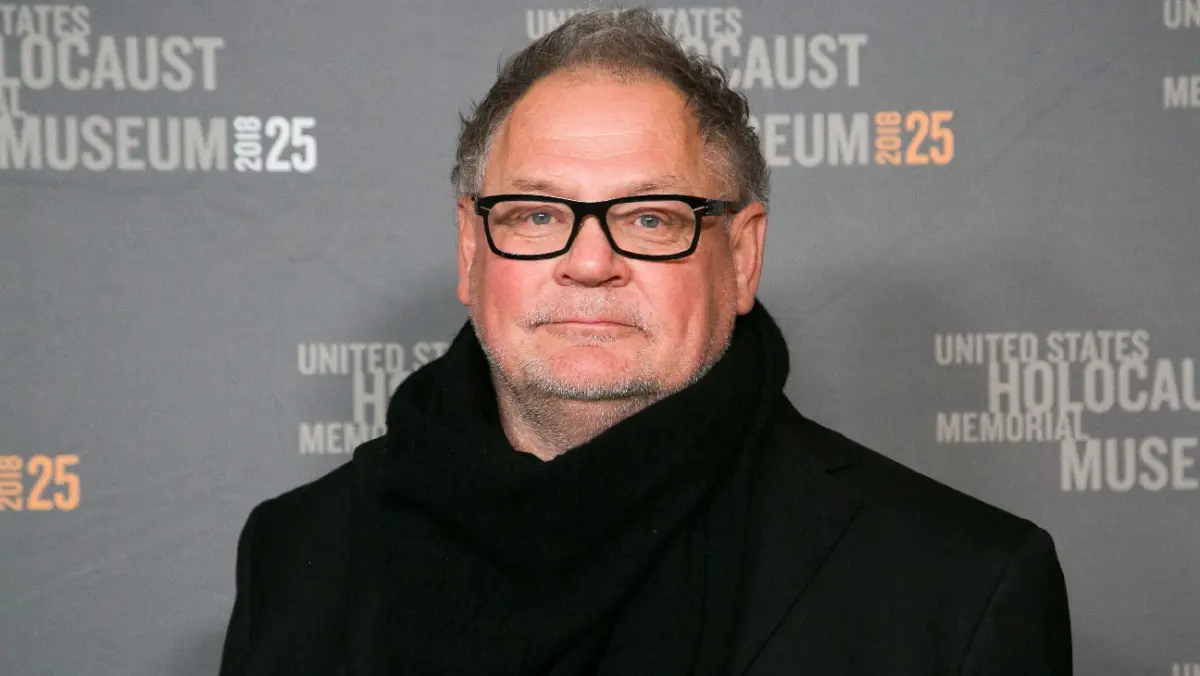
Like nearly every great cinematographer of his generation, Janusz Kamiński is Polish. And perhaps as much as any single artist working in the medium today, he has fundamentally taught Hollywood how to see.
Recipient of The Hollywood Reporter’s 2026 Visionary Award for excellence in cinematography, presented at the Camerimage festival, Kamiński’s journey from a gray, coal-heated Polish town to the upper echelons of American cinema is a testament to resilience, artistic instinct, and a lifelong pursuit of light. Growing up in Ziębice, a small town where the world was perpetually drained of vibrant color, Kamiński remembers an environment defined by its austerity.
“Although we didn’t feel it was bleak, it was bleak,” Kamiński recalls, noting the absence of billboards and advertisements, the dark streets, and the people dressed uniformly in somber tones. During the winter months, houses were heated with coal, leaving a persistent smoke hanging heavy in the air. “The air had this thickness in it, like a fog, because of the coal particles.”
Yet within that grayness existed a profound sense of longing. Poland, as he describes it, is an inherently lyrical country, steeped in a distinct melancholy and a persistent wish for something beyond the horizon. Traveling theater troupes occasionally passed through, and the local cinema offered a tantalizing portal to a wider world.
“We were exposed to work that we didn’t experience in real life, but we wanted to experience,” Kamiński says. “The primary reason I left home is because of the theater and movies, and a life of color.”
In 1981, Kamiński left Poland as a political refugee, driven by a deep fascination with American cinema. Arriving in Chicago speaking no English, he spent his first two years mastering the language before enrolling part-time at Columbia College. In an introductory filmmaking class, students were randomly assigned roles within a five-person group: writer, actor, director, producer, and cinematographer.
“We had to each pick: One would be the writer, one the actor, one the director, one the producer, and one the cinematographer,” he recalls. “We literally picked straws. I got cinematography. I was 22.”

It proved to be a transformative moment of serendipity. Looking back, he found an immediate, captivating connection to the craft of image-making. The flickering motion of 16mm black-and-white film held an undeniable allure, wrapped in questions of focus, exposure, and narrative coherence. When a professor encouraged his work and told him he had genuine talent, it marked a turning point.
“This is not a sad story, but it was the first time anyone ever told me I was good at something,” Kamiński reflects. “In Poland, when I grew up, nobody’s parents said that kind of thing. It was: You have food, you eat, you’re good.”
Since his classmates all aspired to direct, Kamiński eagerly stepped behind the camera for their student projects, packing a station wagon with equipment every weekend. He also picked up commercial work as a camera assistant, electrician, and grip, earning $250 for a single monthly spot—enough to cover his $280 rent. As an immigrant with no familial safety net in the United States, self-reliance was an absolute necessity.
In those early days, The Hollywood Reporter became an unexpected career catalyst. The magazine routinely published back-page listings of upcoming film productions and location shoots. Scouring those pages, Kamiński bypassed major studio blockbusters to target independent and lower-profile productions, calling producers directly to pitch his cinematography portfolio. That resourceful approach successfully secured his first two feature film credits.
Recognizing that Chicago primarily served as a secondary outpost for California-based productions, Kamiński set his sights further west. Encouraged by his girlfriend’s application on his behalf, he was accepted into the American Film Institute in 1986. Arriving in California with no car, he rented a modest space within walking distance of the campus.
Work soon followed through networking connections. A classmate’s husband, a working cinematographer, needed a key grip for a Roger Corman film, and Kamiński took the job. When the production’s gaffer abruptly quit, Kamiński stepped into the lighting role, continuing to shoot second-unit footage and independent features while completing his studies.
His definitive breakthrough arrived via a demo reel. Through a connection with Diane Keaton’s assistant, his student film reel reached the acclaimed actor and director, swiftly landing him a job shooting Wildflower, a period television movie starring Patricia Arquette and Beau Bridges.

That project caught the attention of Steven Spielberg, who was producing Class of ’61, a television pilot about West Point cadets on the eve of the Civil War. Although the series was ultimately not picked up, Spielberg was deeply impressed by Kamiński’s work. Upon wrapping the pilot, the director invited him to a meeting that would change the trajectory of both men’s careers.
“He says, ‘I’d like you to film my next movie. I’m doing a black-and-white movie called Schindler’s List. Would you be interested?’” Kamiński recalls.
Spielberg first departed to direct Jurassic Park, a massive undertaking that kept him in post-production for eight to nine months. Throughout that lengthy window, Kamiński held onto the promise of the upcoming project, though skepticism from others lingered until production actually commenced.
The collaboration took Kamiński back to his native Poland, where he utilized the stark gray light and smoky atmosphere of his youth to help reshape how Hollywood visualizes historical narratives. The creative process with Spielberg was remarkably intuitive, requiring little in the way of prolonged stylistic debate.
“We knew it would be shot in Poland and be black-and-white, but we didn’t have a deep, in-depth conversation about how we’re going to make this movie,” he notes. Seeking to strip away any visual artifice that might distance audiences from the raw narrative, they abandoned traditional filmmaking tools like cranes, dollies, and Steadicams in favor of handheld camera work.
Schindler’s List earned Kamiński his first Academy Award for Best Cinematography, followed years later by a second Oscar for Saving Private Ryan. For the latter, the screenplay featured a remarkably sparse description of the historic Normandy invasion: “Now the troops land at Normandy. That’s it.” That brevity required Kamiński to invent an entirely new visual language to match the raw emotion, scale, and chaos of the location, resulting in the iconic, desaturated, and intensely kinetic handheld aesthetic that redefined the modern war film.
Kamiński’s willingness to experiment with perspective was further demonstrated in Julian Schnabel’s The Diving Bell and the Butterfly, which chronicled the life of a man suffering from locked-in syndrome who could view the world through a single functioning eye. Translating sparse book and script descriptions into a compelling cinematic reality, Kamiński manipulated focus lenses to drastically blur the field of vision while allowing specific focal details to emerge with sharp clarity—work that earned him the Golden Frog honor at Camerimage in 2007.

Despite certain recurring aesthetic preferences—such as strong backlighting, characters caught half-light within shadows, and the atmospheric use of smoke—Kamiński maintains that he does not adhere to a single signature look. Instead, his guiding philosophy is that film must follow function. He deployed cold blues and metallic shadows to evoke the technological dystopia of Minority Report, retro pastels and smooth tracking shots to capture the swinging 1960s atmosphere of Catch Me If You Can, and grainy, muted earth tones for Munich to emulate the grit of a 1970s conspiracy thriller.
Spanning over thirty years and more than twenty films, the partnership between Kamiński and Spielberg stands as one of the most significant artistic collaborations in the history of American cinema. Their work together marks a pivotal second phase in Spielberg’s career, transitioning the director away from the glossy, classical Hollywood lighting and bright colors of his earlier blockbusters toward a grittier, more naturalistic style suited for complex, morally ambiguous storytelling.
Rather than claiming personal credit for Spielberg’s artistic evolution, Kamiński views the partnership as a matter of timing and mutual readiness.
“Steven was not ready to do Schindler’s List until he was ready,” he says. “He was moving that way and I entered his life at the right point where he was able to accept the aesthetics I gave him and embrace them. I think what he saw in me was someone new with a new point of view, someone who wasn’t biased by Hollywood, with a fresh approach. He saw me as a partner. And I saw him as a partner.”
That enduring partnership continues with Spielberg’s latest project, Disclosure Day, where Kamiński embraces a notably restrained visual register. As he grows older, he finds himself drawn toward simplicity, opting for a more relaxed and reserved visual approach. For the contemporary sci-fi thriller concerning alien phenomena, he pursued a naturalistic aesthetic defined by austerity, utilizing direct, slightly green-tinted window light with subtle background flares—visual echoes of the austere images of his Polish childhood.
Looking ahead, Kamiński is preparing to reunite with Spielberg on the director’s first-ever Western, slated to shoot next year. As he conceptualizes the expansive landscapes, his imagination continues to draw from the geography of his early years.
“We used to go to this region in the Sudeten Mountains, where it was just beautiful, rolling hills, looked like parts of Montana,” he reflects. While those natural elements exist across America, he observes that filmmakers who immigrate from elsewhere often perceive familiar topography through a uniquely different lens, proving that diverse global perspectives remain essential to the vitality of American cinema.