
The Tallinn Black Nights Film Festival (PÖFF) is reaffirming its steadfast commitment to Ukraine as it prepares for its milestone 30th anniversary edition. Ever since the full-scale invasion of the country by Russia in 2022, the prominent Estonian festival has stood firmly with Ukraine, weaving Ukrainian films into its lineup, presenting works-in-progress, and hosting dedicated Ukraine-themed panels through its prominent industry strand, Industry@Tallinn & Baltic Event.
"We are obliged to do everything possible to help and support the Ukrainian film industry at this difficult time, but even more so the Ukrainian people," PÖFF founder and CEO Tiina Lokk said when the initiative first launched in 2022. Now, as the festival celebrates its landmark third decade, the popular "Standing With Ukraine" film showcase makes its highly anticipated return.
"Ukraine is fighting not only for Ukraine, but also for Europe and the democratic world," Lokk tells THR. "And so we are going to support Ukraine and stand with Ukraine as long as needed. It is important for Ukraine to remain very visible and to keep its culture. And it is very important for every country."

Marge Liiske, head of Industry@Tallinn & Baltic Event, emphasizes that the festival’s dedicated industry platform continues to keep a sharp focus on the ongoing war. "We have been very supportive of Ukraine since the 2022 full-scale invasion by Russia and have always reflected that in our program, both for the festival and the industry events," she tells THR.
Liiske and Triin Tramberg, PÖFF’s new artistic director, stress that the organization will continuously highlight Ukraine alongside other nations defending crucial democratic principles. "Throughout our program, we’re supporting countries that are fighting for their rights and for their democracy," Tramberg tells THR. "We also have to understand where we are located. Standing With Ukraine is really important for us as a region, and it speaks to our audiences and our communities, including Ukrainians who live here. It is important to have this moment where they see their own cinema."
This year’s PÖFF Standing With Ukraine strand features nine diverse and compelling feature films, many of which are simultaneously screening across various other competitive and special festival sections.

Slava: Shooting With Music
- Directors: Jacqui Morris, David Morris
- Festival Section: Special Screenings
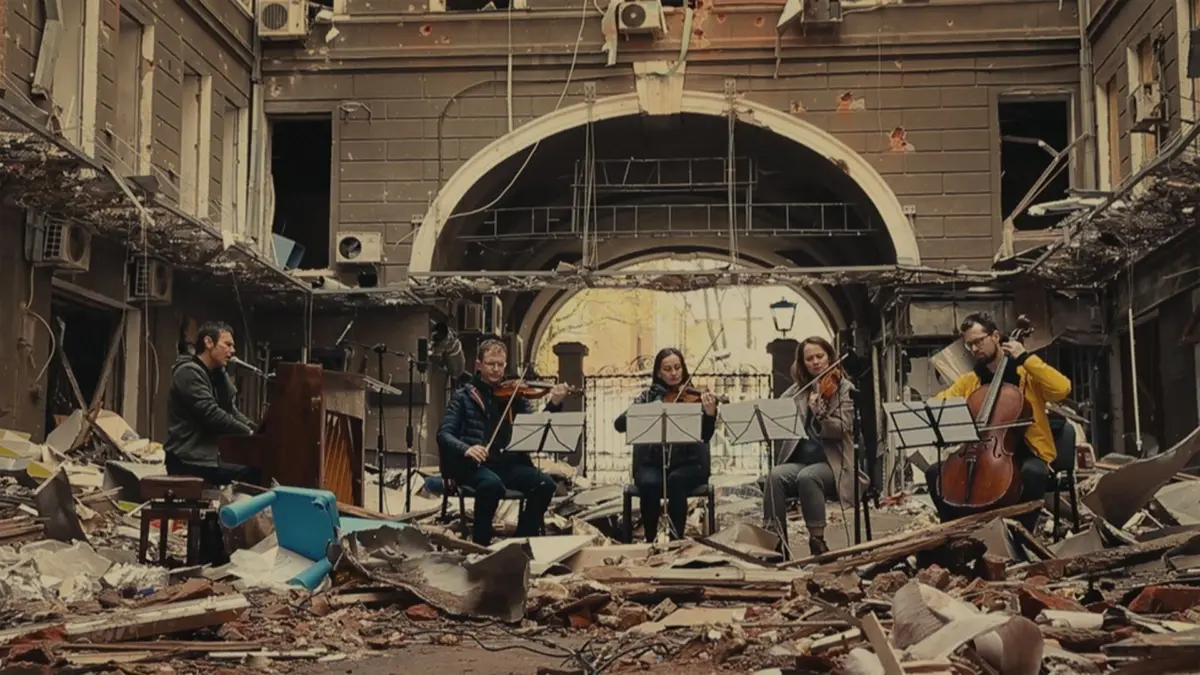
Silence the guns and let the music play! This world premiere explores the immense power of music and culture on a broad societal scale.
"Sviatoslav Vakarchuk is the lead singer of Okean Elzy, Ukraine’s most successful rock band. He is a former politician and activist who has a PhD in theoretical physics," reads the film’s official synopsis. "Slava has been compared to Bruce Springsteen and Paul McCartney, and his songs are an important part of Ukrainian identity, part of the country’s cultural DNA. He is now channeling his talents to liberate his country."
After performing more than 200 concerts for frontline troops, Vakarchuk decided to take his band on an extensive worldwide tour to bolster the morale of Ukrainian refugees living abroad. An international coalition of artists, including Coldplay, stepped forward to support the endeavor. The synopsis highlights: "Another reason for the tour was to leave a lasting legacy in the minds of the rest of the world of Ukrainian culture — a unique culture Russia has been trying to eradicate for centuries."

Vesna
- Director: Rostislav Kirpicenko
- Festival Section: Baltic Film Competition
Honoring the dead becomes a perilous endeavor during wartime, as vividly demonstrated in this gripping drama. Set in a town in southeastern Ukraine under Russian occupation, burying the deceased has been strictly forbidden. The church of a young priest is converted into a morgue for executed civilians, prompting the clergyman to quietly resist. At great personal risk, he secretly returns the bodies to their grieving families, forming an unlikely bond along the way with an 11-year-old boy who serves as a silent witness to his quiet rebellion.
The narrative places a profound emphasis on the psychological and emotional dimensions of warfare that stretch far beyond physical battlefields. "Lithuanian-born Ukrainian director Rostislav Kirpicenko uncovers cynicism, blackmail, and the brutal cruelty of the merciless attackers," notes the PÖFF website.
The film forces viewers to ponder the agonizing dilemmas faced by ordinary locals: whether to fight back, obey and adapt to a brutal new reality, or succumb to betrayal. As the festival notes emphasize, "The mightiest impact here is heartbreaking authenticity, showing how Ukrainians are surviving the ongoing occupation."

I Rarely Wake up Dreaming
- Director: Isabelle Stever
- Section: Standing With Ukraine
War inevitably alters the landscape of love, but how does the abrupt transition from peace to full-scale invasion impact a queer couple in Ukraine, particularly when these geopolitical upheavals coincide with a personal gender transition?
IRarely Wake Up Dreaming made a significant impact during its world premiere at Locarno, sparking vital conversations among audiences and critics alike. The film closely follows the relationship between Olya and Oleh, which is severely tested when a gender transition opens the door to legal marriage while simultaneously unearthing complex personal and national identity struggles.
To Die to Live
- Director: Yuliia Hontaruk
- Festival Section: Doc@PÖFF Baltic Competition
Yuliia Hontaruk’s poignant documentary introduces viewers to three men whose lives undergo monumental shifts over more than a decade. In 2014, with no prior military experience, they volunteered to serve on the front lines. Returning home two years later, they struggled to reintegrate into ordinary civilian life as the psychological and physical scars of war strained their family dynamics.

"It is a brutal truth that is not always easy to capture on film," the PÖFF summary notes. "And then the men have to go back to war. Their previous experience was merely a preparation for what would happen in February 2022, when Russia launched a full-scale invasion. They are back on the front line, now fully aware of what this does to them." Hontaruk followed the trio for 12 years, crafting a fragmented cinematic style that effectively mirrors their fractured lives and enduring trauma.
Wings
- Director: Ana Rocha de Sousa
- Section: Standing With Ukraine
Can you ever truly remove the trauma of war from a person’s life simply by removing them from a war zone? In other words, does living in physical peace equate to enjoying peace of mind?
Wings is a narrative drama shot in both Ukraine and Portugal by creative teams from both nations, drawing direct inspiration from the real-life experiences of a Ukrainian family who fled the conflict to find refuge in Portugal. The film offers a deep dive into the lasting psychological impacts of displacement while exploring the tentative paths toward renewed hope.

Living On
- Director: Nerijus Milerius
- Festival Section: Doc@PÖFF Baltic Competition
Art therapy at a veterans’ theater, yoga sessions, hair salons, para-archery, and scaling mountain peaks form the backdrop of another major Ukraine-focused world premiere heading to Tallinn.
Lithuanian philosopher and director Nerijus Milerius demonstrated his solidarity with Ukraine by volunteering to drive vehicles loaded with medical aid directly to the front lines. Between August 2024 and June 2026, he documented his perilous journeys across 15 missions, utilizing this firsthand footage for his fourth feature film.
"He records daily life under attack and hears dark humor in Kyiv, Kharkiv, Odesa, Kherson and other bombed areas where he needed a fixer even to gain access," reads the festival’s official description, which highlights how "Milerius captures Ukrainians’ resilience and spirit."

Slava
- Director: Denis Sobolev
- Section: Standing With Ukraine
Distinct from the documentary about the rock star, this political thriller is rooted in actual historical events from the 1960s. It chronicles Slava and Yaroslav Stetsko as they launch an extensive international information campaign utilizing media outlets and public protests across the United States and Europe. Their core message exposes the KGB and the USSR as the orchestrators of political assassinations carried out beyond Soviet borders.
The narrative centers on a politically charged trial in Karlsruhe, West Germany, where Bohdan Stashynsky, a confessed KGB agent, stands trial for the murder of Stepan Bandera, a controversial far-right Ukrainian politician. While authorities attempt to frame the proceedings as a routine criminal case, the activists strive to prove that Moscow is actively exporting state-sponsored political violence abroad. As the Kremlin issues direct threats and friends urge the activists to soften their rhetoric, the stakes escalate dramatically.
Camouflage
- Director: Mykyta Gibalenko
- Section: Standing With Ukraine
Themes of identity and the disruption of war, explored in several festival selections, take a distinct form in this feature, which originally premiered at the Venice Film Festival.

The story follows 22-year-old Vitaly, who leaves Ukraine to study German, parting ways with his sister and his mother—a schoolteacher deeply shaped by the Soviet era. Once settled in Munich, Vitaly finally feels liberated to embrace his true identity and live authentically. However, a year later, Russia invades Ukraine. Driven from their home by the conflict, his mother and sister seek refuge with Vitaly in Munich, setting the stage for an emotional reckoning as they discover his new life and identity.
Traces
- Directors: Alisa Kovalenko, Marysia Nikitiuk
- Section: Best of Docs
Concluding the festival’s lineup of powerful Ukrainian cinema is an awards-season contender that emphasizes how silence is not always golden. In Traces, six Ukrainian women who survived sexual violence and torture during the Russian war bravely break their silence to speak out.
Iryna Dovhan, a former captive-turned-activist, documents the testimonies of women impacted by war-related atrocities. Through her ongoing work, the documentary weaves a complex portrait of collective trauma while simultaneously carving out a dedicated space for hope.

The film celebrated its world premiere in the Panorama section of the Berlin International Film Festival, where it captured the program’s best documentary audience award, before being selected as Ukraine’s official submission for the Academy Award for best international feature film.