
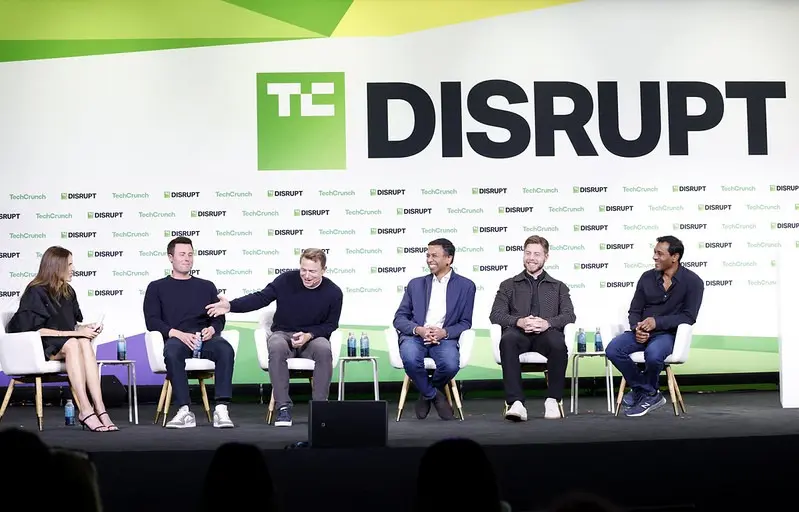
The players sometimes change, but the playbook remains remarkably defiant. When TechCrunch sat down with four of Benchmark’s general partners three years ago, three of those individuals have since moved on from the storied venture capital firm. The firm’s capital commitments have experienced a rare shift as well. This summer, Benchmark announced a staggering $2 billion deployed across two funds—marking only the second time in the firm’s 31-year history that it has veered away from raising a far smaller, tightly constrained vehicle.
Yet, during a high-profile appearance at TechCrunch Disrupt, the venture firm’s current five general partners—Peter Fenton, Eric Vishria, Chethan Puttagunta, Ev Randall, and Jack Altman—convincingly portrayed a close-knit, highly aligned team that has no intention of accelerating its investment pace, even as many of their industry rivals step hard on the accelerator. While the broader tech world speeds up, Benchmark continues to invest at the measured pace it has maintained for decades: just two or three new bets per year per partner. The world may be drowning in an endless stream of real-time information, but their Monday partner meetings still operate entirely without an agenda. And while macroeconomic indicators frequently point toward impending market trouble, the partners remain largely unbothered, viewing many of the prevailing warning signs as mere products of social-media-fueled hysteria.
Gathered together on the Disrupt stage, the five general partners offered a rare, unfiltered look inside one of Silicon Valley’s most elite and idiosyncratic investment houses.
Adapting the Core Without Losing the Craft
Benchmark has clearly evolved in recent years, notably expanding its core fund and launching a massive new growth fund. Addressing how the firm manages to adapt without diluting its foundational identity, Peter Fenton pointed to the enduring nature of their early-stage work.
"The craft that hasn’t changed is the core fund: working closely with founders at the beginning," Fenton explained. "It’s usually a 10-to-15-year commitment, working shoulder to shoulder, and that doesn’t scale. There’s also been inflation. We held the core fund at $500 million for 20 years, and it has just inflated to be consistent with the existing economy, which we hadn’t done and that was probably a tactical error on our part."
Addressing the addition of a $1.25 billion growth fund, Fenton described it as a natural expansion of their mandate that grants the firm permission to back successful companies beyond the early stage. Previously, lacking a growth vehicle was a significant limitation. A number of opportunities that came across Benchmark’s desk historically would have returned anywhere between 10x and 1,000x to the firm, but they were strictly constricted by their exclusive early-stage focus.
When asked whether the firm plans to make a large number of bets with that massive growth fund, Fenton emphasized the diversity of thought within the partnership, noting that he personally favors the intense focus of a highly concentrated portfolio. Drawing on a recent J.P. Morgan paper detailing the "agony and ecstasy" of concentration, Fenton noted that if the fund ultimately proves successful, just one or two core investments will generate 90% of the returns, suggesting the growth vehicle will likely back only four to six, or perhaps seven to eight, companies in total.
Finding the Right Fit in a Small Partnership
For newer partners like Ev Randall—who previously worked at Founders Fund, Bond, and Kleiner Perkins—Benchmark offers a distinctly different cultural environment. Every venture firm, Randall noted, is ultimately a collection of its people and how they operate together. While some firms are heavily hierarchical, employing 50- or 60-person investment teams with rigid processes divided into product groups, Benchmark maintains a small, flat partnership.
"Very early in my career, I was drawn early to small partnerships because they allow a higher level of throughput and fidelity in your conversations, where you don’t feel like you’re making decisions through some Byzantine corporate structure," Randall said. "You’re going out on the field together, like a sports team going out on the field together."
Randall stressed that finding the right peers—people not only liked but genuinely admired—is a rare attribute in venture capital. That deep mutual respect was an immediate draw for Jack Altman, who joined the firm in February. Only a year prior, Altman had raised a $275 million fund for his own firm in what he famously told the Wall Street Journal took just one week. Despite running a popular podcast and finding success as an independent investor, Altman felt drawn to Benchmark’s unique ethos.
"I did the podcast with these guys at the start of this year, and during that podcast, obviously we talked about the commitment to being a small fund, but more than that, what I heard was that they want to be the first people who founders call, they want to be concentrated, and they just care," Altman recalled. In a market as frenetic as today’s, Altman admitted he would struggle trying to figure things out entirely on his own, making Benchmark’s collaborative, high-caliber environment the ultimate place to learn.
The Agenda-Free Monday Ritual
The firm’s unconventional operational style is perhaps best embodied by its weekly Monday partner meetings, which famously run without a formal agenda.
When the topic was raised on stage, Chethan Puttagunta joked that Jack Altman had actually tried to introduce an agenda, to which Altman playfully confirmed he had one prepared for the following Monday.
Eric Vishria described the lack of structure as an organically evolving conversation. In a period of rapid technological transformation, the partners constantly evaluate what is newly possible compared to six months prior, discussing the companies they are meeting, the ideas piquing their interest, and the dynamics playing out inside board meetings. Because there are only five partners, they do not need to systematize the process. Following the Disrupt session, for example, the partners planned to have dinner with an entrepreneur who built a multi-hundred-billion-dollar company—someone Benchmark is not even invested in—purely to stretch and challenge their own thinking.
Furthermore, operating without an agenda provides the necessary space to be reactive. If a portfolio founder urgently needs help securing an executive or a strategic partnership, all five partners can immediately place themselves at the entrepreneur’s disposal.
This flat structure extends to investment decisions. When asked if any single partner can unilaterally kill a deal, Puttagunta noted that the firm simply does not have rigid rules around vetoes. Altman echoed this sentiment, admitting he initially waited to see how his colleagues handled things because the firm’s low-volume model negates the need for cumbersome CRMs or formal voting processes.
"Because it’s so rare, the lack of structure is a huge asset," Altman said.
Fenton added that Benchmark consciously avoids an aggressive, "Shark Tank"-style environment. Instead, the partners approach investment opportunities with a sense of awe regarding market possibilities. When a polarizing entrepreneur enters the room, the partners pay close attention to that friction, noting that if someone in the room fundamentally dislikes a founder, Benchmark is likely not the right partner for them.
Navigating AI Volatility and Competitive Pressures
As companies grow faster than ever, venture capitalists frequently feel pressured to increase their investment frequency to avoid missing out. However, Puttagunta insisted that Benchmark’s pace remains entirely consistent. The firm accepts that it will never be part of every successful company. Instead, their job is to identify exceptional entrepreneurial strengths and find a way to work with those specific founders, regardless of capital requirements or deal structures.
This close partnership model inevitably brings up questions regarding portfolio conflicts, particularly as fast-growing AI startups rapidly expand into each other’s territory. Vishria acknowledged that while the firm maintains strict confidentiality and goes to great lengths to avoid the kind of intense direct conflicts seen among rival companies elsewhere in the industry, startup evolution is a harsh reality. Companies naturally pivot, change, and drift into neighboring spaces as founders aggressively attack the vast surface area unlocked by artificial intelligence.
"As the cost of coding new products effectively goes to zero, founders see a surface area and they want to attack the surface area, and so I think it’s probably going to happen more, where you start to run into each other," Puttagunta explained. "But there’s a way to maintain that relationship and be respectful."
Reflecting on his early days at the firm, Jack Altman noted that his transition into Benchmark was seamless, largely because his partners actively countered any performance anxiety. After diving into sectors ranging from chips and robotics to infrastructure, Altman was advised by his senior partners not to stress over his initial deal, recognizing that venture capital is governed by power laws where early bets rarely dictate a career’s success.
Heretical Bets and Public Market Realities
Benchmark’s willingness to embrace unconventional ideas was underscored by Eric Vishria’s discussion of Cerebras, the AI chip company the firm backed in its early spring 2016 round. At the time, the investment represented Benchmark’s first hardware bet in a decade. Vishria recalled that on the eve of the founders’ pitch to the full partnership, Peter Fenton told him the investment went against everything he had learned in venture capital. Yet, following Monday’s pitch, Fenton completely flipped.
"Andrew and his co-founders are heretics," Fenton said, describing the unorthodox thesis that led to the investment. "What they were saying was unorthodox, and you see it today, with people dumping on the stock because it’s polarizing. That’s exactly where we have to be as investors. If it’s consensus, why is there a startup?"
Addressing Cerebras’s volatile stock performance following its public offering—where shares priced at $185, spiked to $350, and later returned closer to $185—Vishria pointed out that extreme peak-to-trough volatility is common across high-growth tech companies. Being a public company requires immense psychological resilience from both executives and employees, who must focus on executing fundamentals while updating the public markets every twelve weeks.
Weighing in on the broader macroeconomic climate and the recent bankruptcy filing of chatbot platform Character.AI, Ev Randall dismissed fears of an overarching AI crash. He argued that public equity narratives are frequently distorted by hyperactive echo chambers on social media platforms like X. According to Randall, the underlying ecosystem remains fundamentally healthy, driven by massive enterprise demand where portfolio companies struggle simply to secure enough compute to serve eager customers at strong gross margins. The real issue, he suggested, is the toxic market volatility driven by unverified data points and rumors optimized for digital clicks.
The San Francisco Center of Gravity
Finally, addressing whether geographic location remains a prerequisite for startup success in the AI era, the partners acknowledged that San Francisco has firmly re-established itself as the gravitational center for talent, capital, and customers.
While acknowledging successful outlier companies built elsewhere, Fenton noted that historical probability distributions heavily favor San Francisco due to the dense ecosystem effect created by successful past companies and ambitious executives. Randall added that virtually every non-San Francisco-based company he has met with over the past 18 months either maintains a local office, splits time between cities, or actively plans to relocate to the Bay Area.
"Iron sharpens iron," Randall concluded. "If you want to be around peers who are going to make you the best version of yourself, it’s hard to think of a city that does that better than San Francisco in the current era that we’re in now with AI here."