
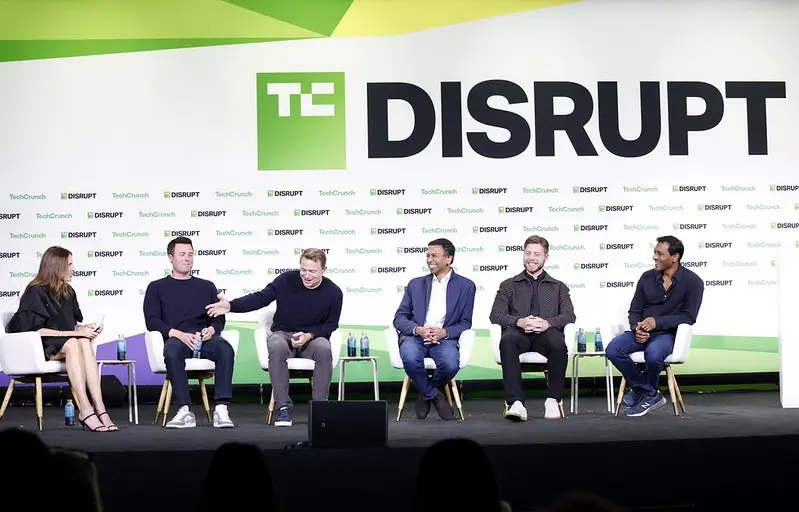
The players sometimes change, but the core ethos remains remarkably rigid at Benchmark, one of Silicon Valley’s most storied venture capital firms. Three years ago, a conversation with four of the firm’s partners revealed a shifting landscape, with three of those individuals having since moved on from the organization. The capital commitments supporting the firm have also evolved significantly. Earlier this summer, Benchmark announced a staggering $2 billion deployment plan split across two distinct funds, marking only the second time in its 31-year history that the firm has veered away from its traditional strategy of raising much smaller vehicles.
Yet, during an appearance at TechCrunch Disrupt, Benchmark’s five general partners presented a united, close-knit front that firmly rejected the "pedal-to-the-metal" mentality gripping many of their industry rivals. While the broader tech world accelerates at a dizzying pace, Benchmark continues to invest at its historically deliberate rhythm: roughly two to three new bets per year, per partner. In an era where information overload dictates corporate culture, their Monday partner meetings still operate entirely without an agenda. And despite economic forecasts pointing toward potential turbulence ahead, the partners remain largely unfazed, viewing many of the prevailing market warning signs as little more than manufactured hysteria fueled by social media echo chambers.
Gathered together on stage, Benchmark’s general partners—Peter Fenton, Ev Randall, Jack Altman, Chethan Puttagunta, and Eric Vishria—offered a candid look inside the mechanics of their partnership, discussing fund evolution, artificial intelligence market dynamics, public market volatility, and the enduring gravitational pull of San Francisco.
Adapting the Core Without Losing the Craft
Benchmark has undeniably undergone structural changes, highlighted by an expanded core fund and the introduction of a new growth fund. Addressing how the firm intends to adapt these elements without eroding its foundational identity, Peter Fenton emphasized that the foundational craft of the core fund has not shifted. Working closely with founders at the earliest stages typically demands a 10-to-15-year commitment, operating shoulder-to-shoulder in a manner that fundamentally does not scale.
At the same time, Fenton acknowledged the undeniable reality of economic inflation. The firm maintained its core fund at $500 million for two decades before finally inflating it to better align with the broader modern economy—a move he candidly described as a past tactical error.
Regarding the newly established $1.25 billion growth fund, Fenton explained that it represents a natural expansion of their mandate. The ecosystem has effectively granted Benchmark permission to venture beyond early-stage enterprises. Previously, operating without a growth vehicle meant missing out on downstream opportunities that could have returned anywhere from 10x to 1,000x to the firm, constrained as they were by an exclusive early-stage focus.
When asked whether the firm plans to make a conservative handful of bets with the massive growth pool, Fenton noted the diversity of thought within the partnership. Citing a recent JPMorgan paper on the agony and ecstasy of a concentrated portfolio, Fenton pointed out that if a fund of that magnitude succeeds, one or two stellar investments will ultimately generate 90% of the overall returns, suggesting a tightly held portfolio of roughly four to six, or perhaps seven to eight, total investments.
Building a Small Partnership in a Wild Market
For newer additions to the firm, such as Ev Randall—who joined late last year following stints at Founders Fund, Bond, and Kleiner Perkins—the appeal of Benchmark lies directly in its structural intimacy. Randall noted that every venture firm is ultimately defined by the people within it and how collaboratively they operate. While some institutional competitors maintain massive, hierarchical investment teams numbering 50 or 60 people with federated product groups, Benchmark preserves a small partnership model. This structure permits a higher level of throughput and conversational fidelity, bypassing Byzantine corporate hierarchies in favor of a cohesive sports-team mentality out on the field.
Jack Altman, who joined the partnership in February after previously raising a $275 million fund for his own firm in just one week, echoed similar sentiments. Having participated in a podcast with the Benchmark partners earlier in the year, Altman was struck by their commitment to remaining a small fund, acting as the primary point of contact for founders, and maintaining a deeply concentrated focus. In an industry frequently obsessed with capital and status, Altman found a team that genuinely cares about nurturing founders and building sustainable companies. While he enjoyed operating as an individual investor, navigating a volatile market alone felt daunting compared to collaborating with a driven, highly focused group of peers.
The Art of the Agenda-Less Monday Meeting
The firm’s internal culture is famously unstructured, underscored by their traditional Monday partner meetings, which famously proceed without a formal agenda. Eric Vishria described the practice as weirdly arbitrary yet vital, functioning as an ongoing, organic conversation. In a period of rapid technological transformation, the team continuously evaluates what has suddenly become possible that was entirely unfeasible six months prior, and identifies the entrepreneurs who are effectively "bending light."
Rather than attempting to systematize the process through rigid corporate frameworks, the small group relies on decades-long conversations that only function because the partners genuinely enjoy spending time together. Following their public stage appearance, for instance, the partners scheduled a private dinner with an entrepreneur who built a multi-hundred-billion-dollar company—someone they have never invested in—purely to challenge and expand their own strategic thinking. Chethan Puttagunta added that discarding formal agendas leaves essential space to be reactive, ensuring all five partners remain entirely at the disposal of founders who might need immediate assistance landing crucial executive talent or forging strategic partnerships.
When questioned about whether a single partner can unilaterally veto a prospective deal, the response highlighted the absence of rigid bureaucracy. Puttagunta admitted that no formal rules govern the veto process, a sentiment shared by Altman, who noted he was waiting to see how his colleagues would answer. Because the firm intentionally maintains a low transaction volume, it avoids the heavy administrative rigor, customer relationship management databases, and formal voting procedures required of firms executing 100 or 200 deals annually.
Fenton added that a defining aspect of the Benchmark brand is an avoidance of arrogant pronouncements of definitive winners or losers. The partnership approaches deals with a sense of awe regarding market possibilities. When a polarizing entrepreneur enters the room, the partners pay close attention to how those dynamics feel, adhering to the belief that if any member of the room feels disconnected from the founder, Benchmark simply isn’t the right partner for them.
Navigating AI, Competition, and High-Stakes Sectors
Despite the acceleration of modern company growth, Puttagunta emphasized that Benchmark’s pacing remains consistent. Venture capital inherently dictates that a fund cannot participate in every successful enterprise, a reality the partners accept. Their objective is to identify an entrepreneur’s distinct strengths, amplify them, and find a workable path forward regardless of capital requirements or corporate structures.
Addressing the delicate issue of venture capitalists backing competing companies—particularly as modern AI startups rapidly expand into overlapping territory—Vishria acknowledged the firm’s core ethos of making an absolute commitment to an entrepreneur. While strict confidentiality is maintained to avoid the chaotic direct conflicts occasionally seen among rival firms, modern market evolution means companies frequently pivot or shift boundaries. Puttagunta noted that ultra-ambitious founders in the artificial intelligence era, operating in an environment where the cost of coding new products approaches zero, naturally seek to conquer vast surface areas, increasing the likelihood of overlapping territories. Respect and careful relationship management remain paramount in navigating these shifting dynamics.
Discussing his transition to Benchmark, Altman noted that despite his software background, he has since executed deals across chips, robotics, and infrastructure. Reflecting on his onboarding process, he remarked that it was practically nonexistent. Early on, colleagues advised him not to feel pressured by his initial deal, reminding him that power-law dynamics govern venture capital and that the odds of the very first investment returning massive outlier value are statistically low.
Highlighting an earlier unconventional hardware bet, Vishria recalled leading Benchmark’s initial round in AI chipmaker Cerebras in the spring of 2016, marking the firm’s first hardware investment in a decade. Fenton recalled telling Vishria on the eve of the partnership pitch that the thesis defied conventional venture wisdom, only to completely flip his perspective after hearing the formal pitch the next day. Andrew Feldman and his co-founders brought a heretically unorthodox vision to the market—a polarizing stance that continues to draw public market scrutiny, embodying precisely the kind of non-consensus thinking required for transformative startups.
Addressing the volatility of Cerebras’s public market journey—which saw the stock jump significantly following its public debut before stabilizing—Vishria noted that he reviewed historical stock charts for companies like CoreWeave, Datadog, DoorDash, and Amazon prior to the IPO, observing that peak-to-trough fluctuations of 500% in a single year are remarkably common. Public market survival requires an iron stomach, a reality management and employees must fully internalize.
Macroeconomic Anxieties and the Epicenter of Innovation
Turning to broader economic concerns, including rising borrowing costs, exhausted free cash flow among select AI enterprises, and recent high-profile bankruptcies like Character.AI, Randall dismissed macroeconomic forecasting as a fool’s errand. He argued that public equities in the tech sector are heavily distorted by hyperactive social media echo chambers. Character.AI, for instance, represented the remnant of a company whose core team was largely acqui-hired by Google years prior, yet its Chapter 11 filing was sensationalized as a sign of an AI market chill.
Randall pointed out that fundamental demand across Benchmark’s portfolio remains exceptionally robust, with customers eager to purchase compute capacity at healthy gross margins. The underlying AI ecosystem remains fundamentally healthy, with volatility stemming primarily from exaggerated data points circulating online. He suggested that prospective public offerings from industry heavyweights like OpenAI and Anthropic would ultimately stabilize the market, preventing dramatic 5% to 10% swings driven by anonymous online speculation.
Finally, addressing whether founders must be physically located in San Francisco to succeed in the current AI landscape, Altman observed that while it is not strictly mandatory, the city remains unquestionably the easiest place to secure top-tier talent, venture capital, and early customers. Fenton reinforced this perspective, noting that historically over 90% of significant capital returns originate from companies founded in the region. The compounding ecosystem effect—where successful enterprises yield experienced executives and ambitious talent—raises the bar for success in a manner unmatched anywhere else.
Randall concluded that nearly every non-San Francisco-based company he has met with over the past 18 months actively spends substantial time in the city, opens local offices, or plans to relocate. In an era defined by artificial intelligence, iron continues to sharpen iron, making San Francisco the premier crucible for ambitious entrepreneurs seeking to build the future.