
Bette Davis’s magnetism onscreen was famously irrefutable, and off-camera, she was a fierce force to be reckoned with. Never one to shy away from conflict, the two-time Academy Award winner made headlines in 1936 when she bravely sued Warner Bros., her contracted studio, claiming that she had been repeatedly saddled with inferior roles. Although she ultimately lost the legal battle, the Dark Victory star continued to push aggressively against Hollywood’s rigid expectations of its leading ladies. By embracing complicated, deeply unsympathetic, and decidedly unglamorous women onscreen, Davis carved out a legacy as a true trailblazer whose influence only grew as her career progressed.
“I do not regret one professional enemy I have made,” Davis famously reflected in her first memoir, The Lonely Life. “I suppose I’m larger than life. That’s my problem. Created in a fury, I’m at home in a tempest.”

Given the astonishing tally of at least 75 residences she called home throughout her lifetime, it certainly tracks that the big-screen legend was remarkably comfortable navigating a bit of personal and domestic chaos. “Playing house is a childhood game I’ve never put away,” the Marked Woman star once remarked, reflecting on a youth spent “always moving.” She added, “My home has always meant so much to me.”
At the height of her fame, Davis even stepped away from her flourishing career for three full years during her fourth and final marriage. Devoting herself entirely to the roles of wife and mother, she professed to loving every single minute of it in her autobiography. “I wanted to be married. I wanted a home,” she wrote. “Small wonder that when I could, I acquired houses as other women acquire jewels.”

Early Life in Massachusetts
Davis’s lifelong preoccupation with domestic stability can be traced directly back to her formative years. In an undated photograph of a toddler Bette Davis standing alongside her sister Bobby and a loyal family dog, the outward appearance is one of simple childhood innocence. However, the domestic reality shifted dramatically when the family patriarch abruptly abandoned the young girls to live with his mistress when Davis was just seven years old.
“My father’s cavalier disappearance from our home when I was a small child certainly has significance. Consider my quartette of marriages,” she reflected in The Lonely Life. “My sister Bobby’s world went up in smoke. Mine shifted on its axis. It’s as simple as that.”

The Rolling New Englanders
Throughout 1932, a tumultuous period captured in contemporary photographs, Davis lived a distinctly nomadic lifestyle. Alongside her first husband, Harmond Nelson, her mother, Ruthie, and her sister Bobby, the actor cycled through at least four different houses in a single year. In one surviving image from that era, Davis stands poised before a stately, imposing brick fireplace in one of her temporary dwellings. Following her marriage to Nelson in August of that year, the extended family initially settled into a coastal property near the ocean at Zuma Beach in Malibu.
However, by the end of that same year, the family had packed up once more, relocating to what Davis described in her memoir as “a white, ivy-covered English house” located at 1217 Horn Avenue in West Hollywood. Complete with an accessory dwelling unit in the backyard where her mother and sister could reside, the property quickly earned the affectionate moniker of her “dream cottage.”

Bette’s Best Friends
Throughout her many relocations, a few constants remained in Davis’s life, chief among them her profound love for dogs. Beyond keeping numerous pets of her own, the All About Eve star actively championed animal welfare, eventually serving as the president of Tailwaggers, an organization dedicated to caring for abandoned and lost dogs.
“I’ve always loved dogs—my own, all dogs,” she once stated. “And it broke my heart to think of them homeless, unwanted, held as prisoners, under inhumane conditions, when some of them are more human than we are.” A classic 1933 photograph captures Davis in the sprawling backyard of her Brentwood Heights home, playfully interacting with her white Sealyham terrier, Sir Cedric Wogs, and her Scottish terrier, Tibby.

1700 Coldwater Canyon Drive
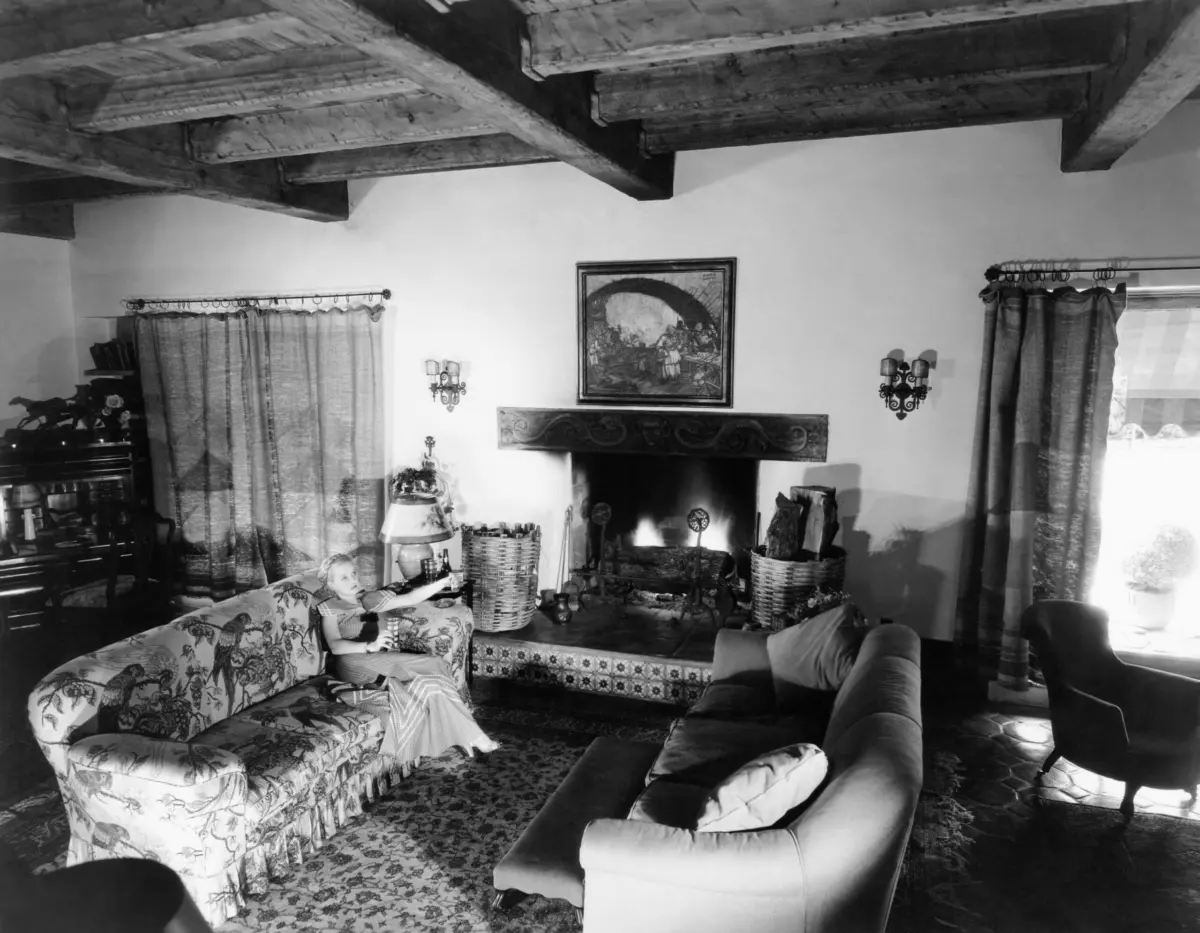
In 1937, Davis moved into a sprawling estate located at 1700 Coldwater Canyon Drive. Biographer Ed Sikov, in his comprehensive book Dark Victory: The Life of Betty Davis, characterized the property as a classic hacienda-style house outfitted with a swimming pool, a dedicated tennis court, and a generous acre of land. Archival photographs from this period show the actor seemingly disappearing into the oversized cushions of her expansive living room sofa, surrounded by rustic wooden ceiling beams and a large stone hearth.
Hollywood’s Croquet Champ
During the 1930s and 1940s, a fierce wave of croquet-mania swept through the upper echelons of Hollywood. Major studio executives and top-billed stars alike—including contemporaries like Shirley Temple and Orson Welles—were famously captivated by the lawn game. Davis, however, reigned supreme among them. According to a prominent publication from the era, Davis was widely “reputed to be the film colony’s champion croquet player.” She was frequently photographed meticulously setting up her croquet court on the vast, manicured lawns of her Coldwater Canyon property.

Books Over Everything
Despite her immense fame and proximity to Hollywood’s bustling social scene, Davis often preferred quiet domesticity over public nightlife. According to Sikov, the star favored curling up with a good book at home most evenings. In fact, Davis cherished her reading time so intensely that her first marriage ultimately suffered because of it.
During their divorce proceedings, Harmond Nelson reportedly cited her reading habits as a primary factor in their split, claiming she read to an “unnecessary degree.” Nelson testified that Davis “even insisted on reading books or manuscripts when he had guests,” adding, “It was all very upsetting.” A photograph from 1941 captures Davis at home, deeply engrossed in the manuscript for an upcoming CBS radio program.

On a Ranch Out West
By 1942, Davis had expanded her real estate portfolio to include 1705 Rancho Avenue in Glendale, California. A subsequent 1943 profile in The New Yorker highlighted the property as “probably the only two-bedroom, two-acre estate in the film colony.” The relatively modest Tudor-style home offered the actor a distinct sense of rustic privacy, complete with a swimming pool, stables, and direct access to local equestrian trails.
Beach House
Following her marriage to her fourth husband and All About Eve costar, Gary Merrill, in 1950, Davis sought out a larger coastal residence. Finding Merrill’s existing Malibu home too cramped for their growing family—which now included a daughter from her previous marriage to William Grant Sherry, alongside two children she and Merrill would adopt in 1951—Davis took charge of the housing search.

While Merrill was away filming Decision Before Dawn in Germany, Davis executed the move. “We found a house near the one Gary had at Malibu,” Davis wrote in her memoir. “Moved him out of his house—his antiques, and I did not pitch them in the ocean—moved all of my belongings in.” A 1951 photograph captures the couple relaxing together on the sandy beach just steps from their shared coastal dwelling.
Cape Elizabeth
For the majority of the 1950s, Davis made her primary residence in Cape Elizabeth, Maine. The family’s discovery of the striking, white three-story clapboard house happened entirely by accident after taking a wrong turn down a long, tree-lined lane.

“We called our house Witch-way because we didn’t know which way we were going and a witch lived there—guess who,” Davis joked in her memoir, playfully acknowledging her own formidable reputation. The Atlantic-facing estate spanned an impressive eight acres and featured a private pond where the family would ice-skate during harsh New England winters.
Flower Girl
“I always like men who sent me flowers,” Davis was quoted as saying in Charlotte Chandler’s biographical work, The Girl Who Walked Home Alone. “But I have to admit most of the flowers I’ve enjoyed in my life, I’ve bought for myself. A great many of them I grew. I’m a country mouse, you see.”

Though her career anchored her to the entertainment capitals, Davis consistently sought out green spaces and vibrant flora at every home she maintained. In a 1967 photograph taken on the front porch of her final Los Angeles residence—just prior to her relocation to Westport, Connecticut—Davis smiles brightly in a dark outfit while holding a cigarette, framed by cascading vines of brilliant red bougainvillea climbing up the porch columns.