
Gustin’s social media feeds operate as a kind of sacred, digital space for modern fathers. His content often carries a melancholy, confessional tone, featuring stark observations such as his recurring thought about what he is constantly leaving behind. It is a familiar, universal sentiment among working parents, yet it is rarely confronted directly in public discourse. In this sense, the digital persona of The Tired Dad can feel slightly dystopian, evoking the protagonist of Lois Lowry’s classic novel The Giver, acting as a receiver of memory who absorbs the unspoken pains that society often prefers to ignore. Yet, just as the darkness threatens to overwhelm, Gustin pivots into the role of a motivational speaker, coach, and teacher. By confronting the difficult realities of modern parenting head-on, he consistently finds the light, concluding the vast majority of his posts with a simple, grounding mantra: "Keep showing up."
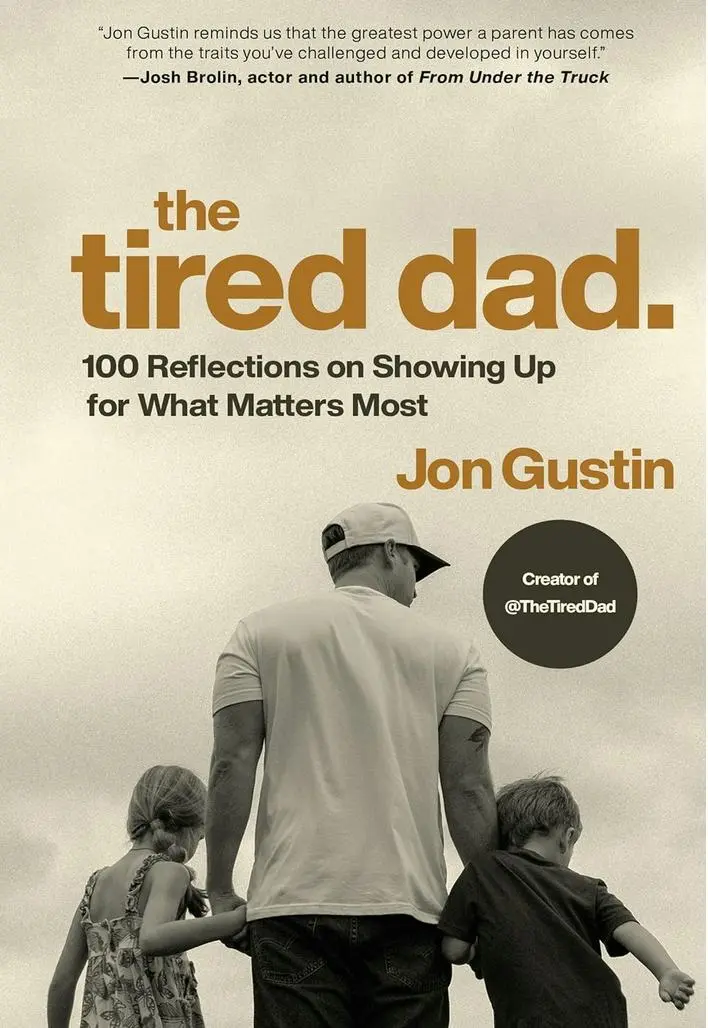
That philosophy of persistent presence has now expanded beyond digital platforms and into the literary world with the publication of his new book, The Tired Dad: 100 Reflections on Showing Up for What Matters Most. Within its pages, readers will find fully fleshed-out contemplations, personal histories, and practical advice concerning manhood, sobriety, marriage, fatherhood, and the necessity of emotional vulnerability.
Just a week out from the official release of his book, Gustin sat down to discuss the core themes of his work. Rather than approaching the conversation with the hyper-polished energy typical of modern internet influencers, he arrived with a signature sincerity that immediately reveals itself as an extension of his daily practice. Early in the discussion, he cuts to the heart of his philosophy. Vulnerability, he explains, is freedom—not just because it frees the individual from the exhausting burden of perfection, but because it liberates those around them by proving they are not alone in their struggles.
Reflecting on the foundations of his own worldview, Gustin points directly to his upbringing and the generation of men who shaped him. His father entered the United States Marine Corps at the age of 17, requiring his parents to sign permission forms, and was deployed to Vietnam by the time he turned 18, spending over two years in active combat. It is a timeline that Gustin admits is difficult to fully comprehend today. Yet, the primary lesson imparted by his father was an unwavering commitment to personal character, a value passed down from Gustin’s grandfather, who served in the United States Navy during World War II. Coming from a deeply structured military background characterized by men who rarely displayed overt emotion, Gustin notes that he has only seen his father cry a handful of times, mostly in recent years. Instead of emotional demonstrations, communication was rooted in action and integrity. His father’s mantra was simple: if you say you are going to do something, you do it, and true character is defined by doing the right thing even when no one is watching.
That legacy of quiet strength and wisdom was similarly embodied by his grandfather, who passed away at the age of 99 just as Gustin was finishing his book. Toward the end of his life, his grandfather dropped many of the emotional shields typical of his generation, becoming remarkably expressive and unfiltered in his appreciation for his wife and their decades-long marriage. Described as a voracious reader who consumed newspapers daily and occasionally finished two books in a single day, his grandfather was a reservoir of insight who cared little for material possessions. Instead, his focus remained strictly on the integrity of a man’s character. While his generation did not express emotion through modern vocabulary, they demonstrated love through relentless kindness and support, famously spending their retirement years traveling to visit descendants and quietly directing their finances toward charitable causes.
When the conversation turns to the broader societal issue of paternal absenteeism, Gustin acknowledges the stubborn persistence of the problem while highlighting a silver lining observed among his own peers. Men who grew up with absent or deeply flawed fathers often channel that pain into powerful motivation, breaking generational curses and showing up for their families with deliberate intent. Although Gustin admits he once hesitated to view himself as a role model due to his own early mistakes, he has embraced the responsibility. The goal, he stresses, is not to have everything figured out, but to remain on a lifelong journey of learning, leading with wisdom and intentionality.
This focus on emotional openness naturally invites questions regarding the concept of stoicism, a philosophy historically tied to traditional masculinity that has often been criticized for fostering the repression of emotion. However, as stoicism experiences a cultural resurgence driven by concerns over youth resilience, Gustin notes that modern interpretations—such as those popularized by author Ryan Holiday—do not preclude vulnerability. While perseverance is vital, he argues that the traditional male impulse to constantly fix problems and possess all the answers can be detrimental. True strength includes the willingness to admit defeat and acknowledge uncertainty. At the same time, Gustin cautions against the extremes of ancient philosophies, such as the relentless focus on mortality, preferring to focus on living a full life rather than obsessing over the end of it. He warns that young men often adopt hyper-masculine identities—warriors, Spartans, or strict stoics—as a mask to hide their underlying insecurities and egos.
Those extremes, Gustin observes, are heavily cultivated within the darker corners of the modern manosphere. Drawing from his own experiences in his early twenties, when he gravitated toward similar hyper-masculine postures, he recognizes that the entire subculture is birthed from a deep-seated lack of identity and insecurity. Young men, searching for a framework of what it means to be a man, are easily seduced by loud voices, aggressive posturing, and superficial markers of success like wealth or status. Looking back decades later, Gustin views those former values as entirely hollow. Time, he emphasizes, is the ultimate currency, and an obsession with material accumulation or superficial power is ultimately a sign of profound weakness and overcompensation.
Despite the visibility his book and platform provide, Gustin firmly rejects the label of an expert. Claiming expertise, he suggests, implies an end to learning, whereas personal growth is a continuous, lifelong process. This perspective heavily informs his views on relationships, particularly the immense pressures introduced when children enter a marriage. Navigating those inevitable curveballs requires the complete eradication of ego, effective communication, and a shift away from viewing a partner as a competitor. Successful parenting and partnerships, he insists, require both individuals to work as teammates, holding space for one another without resorting to defensiveness.
While Gustin acknowledges that more fathers are visible in public spaces like parks and playgrounds today, he believes the cultural shift toward full participation in parenting still has a long way to go. Too many men continue to view their responsibilities as ending once they clock out of their paying jobs, compartmentalizing financial provision from domestic life. Gustin argues that fathers must view their role at home as equally, if not more, important than their professional titles. Reflecting on his own family’s experience as cross-country transplants raising children without a nearby support network, he admits the grueling tag-team dynamic with his wife was often exhausting and occasionally bred resentment toward those with more built-in help. Looking back, however, he views those draining days as a blessing that forced him into deep, daily engagement with his children’s lives. Those sacrifices—such as stepping away from work to care for a sick child—form the bedrock of the tired dad’s badge of honor, representing a commitment to showing up fully across every area of life until the day is done.