
Gustin’s social media feed functions as a sacred space for honest reflection. There is a melancholy, confessional aspect to his digital presence, where he regularly offers stark statements like, "I’m constantly thinking about what I’m leaving behind…" While it is a familiar sentiment for many adults, it is a reality that people rarely dare to face straight-on. In this sense, the persona of The Tired Dad can feel nearly dystopian, reminiscent of a protagonist in Lois Lowry’s acclaimed novel The Giver, acting as a receiver of memory who deliberately absorbs and acknowledges the hidden pains that society often tries to ignore. Yet, out of that darkness, Gustin frequently pivots into the role of a motivational speaker, coach, and teacher. In facing the difficult emotions head-on, he consistently finds the light, ending most of his posts with a grounding mantra such as, "Keep showing up."
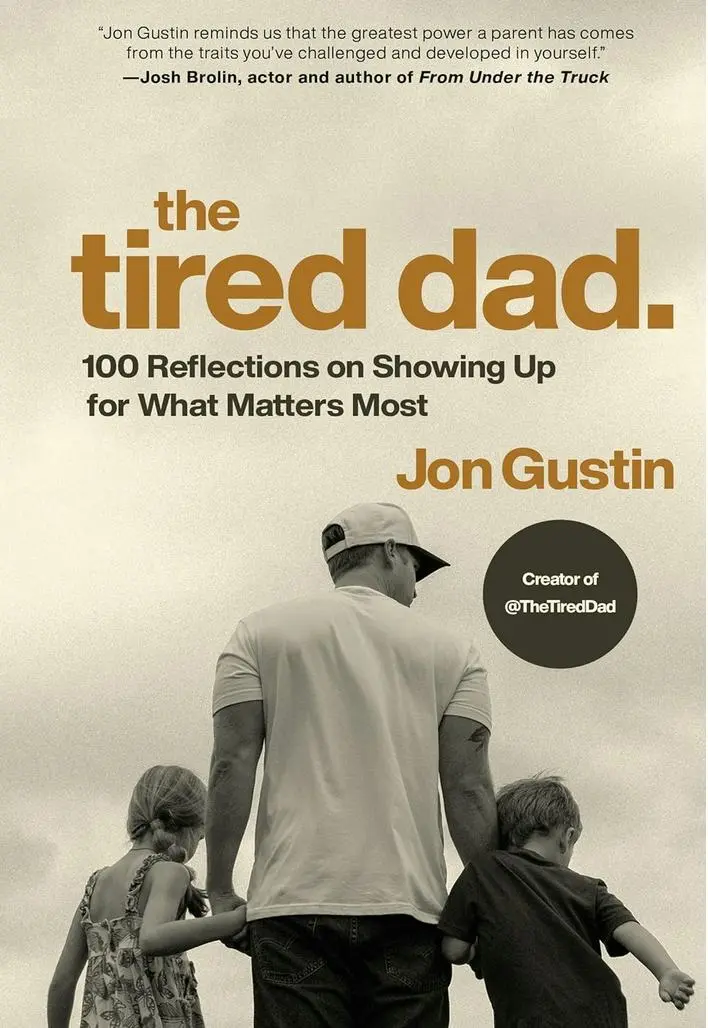
Gustin has now taken his online philosophy and translated it into a full-length book, The Tired Dad: 100 Reflections on Showing Up for What Matters Most. Inside the pages, readers will find fleshed-out contemplations, personal histories, and, naturally, plenty of advice on navigating manhood, sobriety, marriage, fatherhood, and vulnerability.
Just a week out from his book release, I had the opportunity to speak with Gustin about his journey and his message. He did not come to the conversation ready to push his book with the aggressive influencer energy one might routinely expect, but rather with a signature sincerity that, as I quickly realized, is a fundamental part of his daily practice. "Vulnerability is freedom," Gustin tells me shortly into our discussion. "And not only is it freedom for yourself to be vulnerable, but it’s freedom for other people because they feel less alone."
To understand where Gustin’s perspective originates, it helps to look at his own upbringing and the figures who shaped him. When asked about his father, Gustin notes that his dad entered the United States Marine Corps at the age of 17, with his parents having to sign permission forms, and was deployed to Vietnam by the time he turned 18, spending just over two years in active combat. It is an experience that Gustin admits is difficult to fully wrap his mind around.
The number one lesson his father imparted was character, a value the elder Gustin learned from his own father, who served in the Navy during World War II. Gustin comes from a strict military background characterized by structure and men who traditionally did not show much emotion. He recalls seeing his father cry perhaps five times in his entire life, with three of those instances occurring just within the past couple of years. Despite the emotional restraint, his father constantly taught him about personal integrity, often sharing lessons such as, "If you say you’re going to do something, do it," and emphasizing that true character means always doing the right thing when no one is looking. His father and grandfather did not just talk about these values; they demonstrated them daily through consistent actions, whether that meant showing up to play catch or attending family events without fail.
In his book, it is abundantly clear that Gustin held his grandfather in profound esteem. His grandfather passed away at the age of 99 just as the book was being written, and the passage dedicated to him was composed immediately following his passing. Toward the end of his life, his grandfather became remarkably unfiltered in a positive way, dropping the emotional shields of his generation and becoming more expressive because he simply stopped caring about superficial expectations. The way he spoke about his grandmother, their decades-long marriage, and their deep love for one another resembled a storybook romance.
Throughout his life, Gustin’s grandfather was a man of immense wisdom who read the newspaper daily and could finish two books in a single day. He cared little for material possessions or the superficial trappings of modern life, focusing instead on the core question of who a person is as a man at their very foundation. Coming from a different generation, he may not have been outwardly expressive with grand emotional displays, but he treated people with exceptional kindness and was always present for his family. After retirement, he and his grandmother purchased a motorhome and traveled everywhere to visit their children, grandchildren, and great-grandchildren. They dedicated their time and financial resources to supporting family members and charitable causes, frequently facing government audits simply because their charitable donations were so extensive that authorities struggled to believe the scale of their generosity.
Reflecting on the state of modern families, the conversation naturally turned to the stubborn and persistent problem of fatherly absenteeism in contemporary society. Gustin firmly believes that fathers play a vital role in family dynamics. However, he notes that some of his friends who endured horrific relationships with their own fathers, or grew up without them entirely, have transformed that painful absence into profound motivation. They are using their past as fuel to break generational curses, show up for their families, and fundamentally shift the trajectory of generational trauma.
Though Gustin acknowledges he is not a perfect figure and made numerous mistakes early in life, he embraces the responsibility of being a role model. Reaffirming his central philosophy, he reiterates that vulnerability is freedom, explaining that when one person has the courage to express their struggles, other fathers and individuals realize they are not alone or losing their minds. The ultimate goal, in his view, is not to have life completely figured out, but rather to remain on an endless journey of personal growth, leading with wisdom and intentionality to set an example for children and, as a powerful side effect, for the wider world.
Given that vulnerability forms the bedrock of Gustin’s public persona, the topic naturally shifts to stoicism. Historically viewed as a traditionally masculine trait and often criticized for fostering emotional repression, stoicism is currently experiencing a cultural renaissance, particularly as many young people struggle with independence, perseverance, and resilience. Gustin shares that he recently sat down with author Ryan Holiday to discuss the modern interpretation of stoicism. Before exploring Holiday’s work, Gustin admits he viewed stoicism through a narrow, overly masculine lens—picturing emotionless statues and Greek gods constantly chipping away at themselves. It was only through deeper study that he realized modern stoicism actually allows for vulnerability. While perseverance is admirable, Gustin argues that there is profound strength in acknowledging defeat and admitting a lack of answers. Men often feel pressured to fix everything and possess all the solutions, internalizing the fear that not knowing makes them weak or unintelligent, when true vulnerability lies in saying "I don’t have the answers."
Gustin also cautions against the more extreme interpretations of stoic philosophy. When the world feels brutal and Roman emperors like Marcus Aurelius are said to have kissed their children goodnight as if they might never see them again, Gustin believes such extreme mentalities are unhealthy. While the ancient concept of memento mori—remembering that you must die—is addressed in his book, Gustin prefers to approach mortality differently. He chooses not to dwell constantly on dying, preferring instead to live as though he will reach the age of 100, noting that while thinking you will die tomorrow might change your daily routine, the statistical reality is that tomorrow is rarely your final day. Men often crave black-and-white thinking, adopting rigid archetypes like the warrior, the Spartan, or the stoic to find a sense of belonging, but life rarely conforms to such absolute categories. Sometimes, participating in modern hyper-masculine trends like jiu-jitsu or cold plunges—activities Gustin himself partakes in—can become an identity that merely masks deeper insecurities, ego, and unresolved fears.
Addressing the darker extremes of contemporary internet culture, Gustin speaks candidly about the modern manosphere, asserting that it is fundamentally birthed from insecurity and a profound lack of identity. Drawing from his own experiences in his early twenties, Gustin admits he participated in a similar mindset before the term "manosphere" even existed, adopting an egotistical persona under the guise of traditional manliness. He observed mentors who exuded superficial power while clearly radiating deep insecurity and overcompensating for personal flaws, noting that they rarely made exemplary husbands. He understands why young, impressionable men are drawn to this subculture, as they are desperately searching for an identity and struggling to navigate basic social interactions. When young men are taught to view women as inferior to gain power, or to measure self-worth strictly through financial accumulation without any emotional substance, they fall victim to a hollow facade of masculinity. Looking back across two decades, Gustin realizes that the things he valued in his youth hold no weight today; time has proven to be the ultimate currency, while an obsession with wealth, luxury cars, or endless validation ultimately breeds emptiness rather than fulfillment.
Despite his prominent online presence and new book, Gustin firmly rejects the label of an expert. He believes that calling oneself an expert implies reaching a final destination, whereas human life requires continuous learning, reading, and self-improvement until the very end.
Transitioning to the realities of domestic life, the conversation addresses how relationships inevitably become strained after the introduction of children. Gustin emphasizes that effective communication is paramount, which requires individuals to completely abandon their egos, as ego serves absolutely no purpose within a romantic partnership. Instead of trying to fix a partner, individuals must meet them where they are, recognizing that sustainable partnership relies on teamwork rather than competition. When couples drop their defensiveness and communicate vulnerably with the shared goal of solving problems rather than attacking each other, true relational growth can take place.
Finally, observing the public spaces of today, Gustin notes a visible increase in fathers at playgrounds, yet he still observes a distinct imbalance in total domestic participation. Serving regularly in community settings where mothers vastly outnumber fathers, Gustin advocates for a fundamental shift in mindset. He urges men to move beyond the antiquated notion that their sole responsibility is financial provision, arguing that active fatherhood is just as important—if not more important—than any career title. When fathers return home from work, they must transition into their role as a parent, acknowledging that the work of raising a family never truly stops. Reflecting on his own family life as a transplant living far away from a supportive network of grandparents, Gustin acknowledges the initial resentment and exhaustion of playing an intense tag-team parenting role without a local village. Yet, looking back, he sees that grueling schedule as a blessing that forced him to forge deep, constant memories with his children, cementing his belief that showing up fully in every area of life is the true badge of honor for a tired dad.