
For decades, the stock market has consistently found ways to surprise investors, moving from cyclical corrections to staggering, unprecedented valuations. Today, the conversation is dominated by the artificial intelligence boom, a technological wave driving markets to new heights while simultaneously fueling anxieties about an impending crash. For many market observers, the frenzied enthusiasm surrounding AI evokes memories of past speculative manias, most notably the dot-com bubble of the early 2000s—an era that shaped the early career of online financial commentator and early retirement advocate Mr. Money Mustache.

Addressing audiences at recent financial gatherings such as Camp FI Midwest and previewing discussions for the upcoming Bogleheads conference, financial commentators have begun tackling a pressing question that weighs heavily on retirees and prospective investors alike: Will the AI bubble ruin retirement, or is the underlying panic simply a recycled manifestation of human anxiety?

Looking Back at Two Decades of Market Anxieties
Reflecting on financial history reveals that market participants have always found compelling reasons to worry about the future. Comparing the current macroeconomic climate to the landscape of 2006 illustrates how shifting anxieties consistently dominate the financial news cycle. Two decades ago, investors wrestled with geopolitical tensions, the escalating national debt, rising inflation, and a housing market bubble that ultimately precipitated the Great Financial Crisis—the most severe economic downturn since the Great Depression. Beyond finance, societal worries centered on job outsourcing to emerging economies and dire warnings regarding "Peak Oil," a theory predicting that fossil fuel scarcity would soon cripple global civilization.

Despite the severity of the Great Financial Crisis and subsequent shocks, such as the 2020 pandemic-induced market drop, long-term historical data demonstrates the remarkable resilience of equities. A $100,000 investment sustained through the turbulence of the past twenty years would have experienced substantial growth by modern standards. Furthermore, broader global metrics paint a picture of extraordinary human progress during the same timeframe. Extreme poverty rates declined significantly from roughly twenty percent in the mid-2000s to single digits over the ensuing two decades, while global infant mortality rates were cut in half. Simultaneously, technological and infrastructural advancements transformed clean energy, making solar power exponentially cheaper and positioning it as a dominant force in new power generation, while electric vehicle adoption surged globally.

This historical trajectory underscores a fundamental economic reality: genuine economic prosperity is not derived from abstract financial systems, stock market ticker symbols, or computerized numbers, but rather from human productivity. Financial markets are inherently volatile and prone to irrational swings, but beneath the fluctuations lie tangible human labor, ingenuity, and real-world technological inventions. History shows that when financial systems face catastrophic corrections, societies frequently adapt, restructure, and continue driving productivity forward.

Wealth, Happiness, and the Human Brain
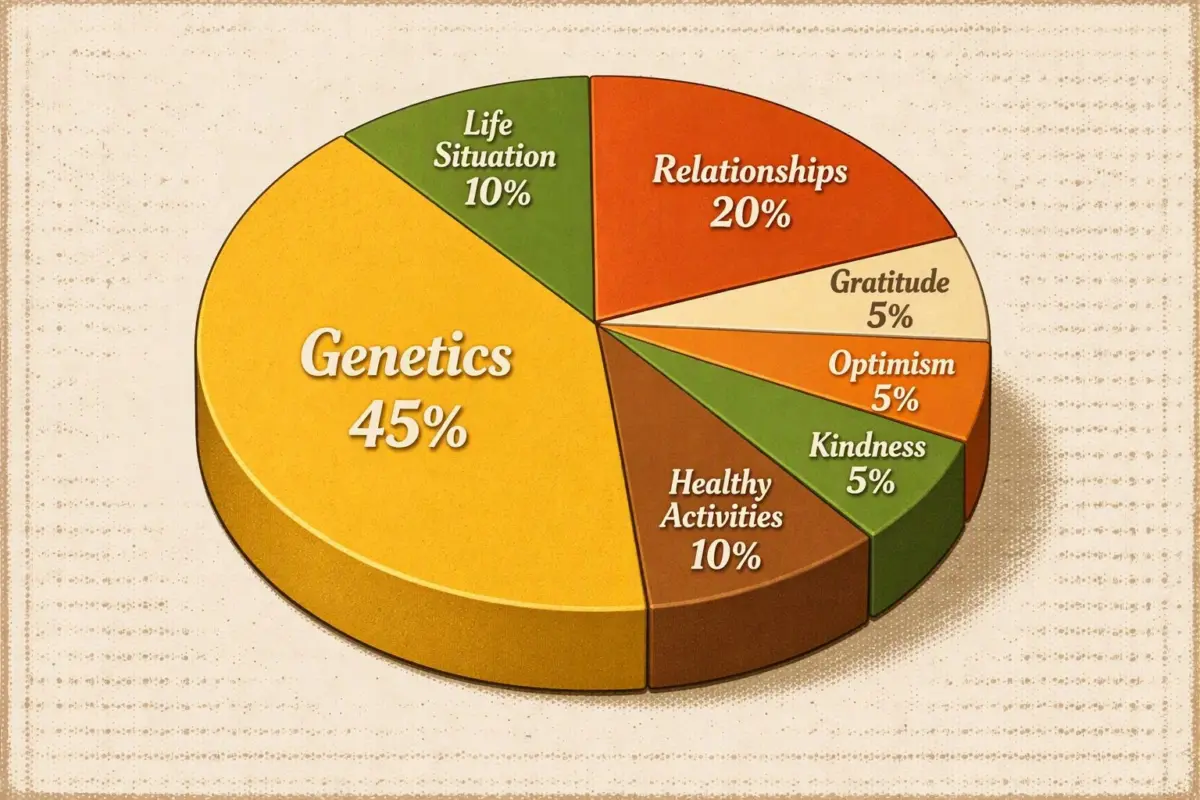
While financial stability and productivity are vital components of modern life, psychological research suggests that human happiness plateaus after a certain standard of living is achieved. In developed nations, basic survival and minimum comfort requirements were surpassed decades ago. Beyond material wealth, psychological well-being is largely dictated by factors largely independent of portfolio performance, including genetics, strong personal relationships, the practice of gratitude, and maintaining an active, outdoor lifestyle.

Yet, despite achieving comfortable financial standing, many individuals continue to experience persistent anxiety about the future. Psychologists attribute this phenomenon to evolutionary biology. Human beings evolved primarily as danger-detection machines, utilizing background anxiety as a vital mechanism to protect against predators, disease, and scarcity. However, once physical survival and financial security are successfully secured, the human brain often fails to deactivate this protective machinery. Instead, it simply shifts the goalposts, finding new targets for concern—ranging from societal conformity and neighborhood aesthetics to tax optimization strategies and government-mandated Required Minimum Distributions (RMDs) for individuals holding substantial retirement assets.

Combating this pervasive anxiety requires self-awareness and an understanding of personal history. Financial anxieties frequently stem from childhood experiences, family scarcity mindsets, or historical trauma passed down through generations. Recognizing that these fears are often echoes of the past rather than objective assessments of the present allows investors to evaluate risks rationally. Taking proactive measures helps demystify the unfamiliar, fostering resilience and confidence in one’s ability to navigate changing circumstances. Furthermore, curating media consumption by reducing exposure to sensationalized daily news cycles helps mitigate unnecessary psychological distress, allowing individuals to focus their energy on constructive behaviors and positive social connections.

The AI Era as a Technological Experiment
Viewing new economic developments through the lens of experimentation can fundamentally alter how individuals perceive modern disruptions. Rather than viewing artificial intelligence purely as an impending economic catastrophe, technology and economic observers suggest reframing the current wave as a large-scale societal experiment.

AI functions essentially as a sophisticated form of cognitive acceleration—a tool designed to boost human efficiency and productivity. Like previous major technological revolutions, such as the rise of the internet and mobile computing, artificial intelligence will inevitably transform the labor market, displacing certain entry-level administrative, financial, and transportation roles while simultaneously lowering service costs and catalyzing entirely new industries.

While these productivity gains tend to concentrate financial rewards among enterprise owners and shareholders—a demographic that includes broad stock market investors—they also represent the continuation of human ingenuity. Ultimately, navigating the uncertainties of the modern economy requires distinguishing between manageable market volatility and foundational human capability. By addressing the root causes of financial fear rather than merely reacting to symptoms of market hype, individuals can better position themselves to achieve long-term security and fulfillment.