
New-home buyers across Ontario are currently navigating a complex financial landscape shaped by substantial Harmonized Sales Tax (HST) relief of up to $130,000 on eligible transactions. While this enhanced relief has injected a significant boost into the new-construction market, real estate professionals are warning that a critical distinction in how builders market their properties is leading to widespread confusion.
For prospective purchasers and the real estate agents advising them, understanding the precise math behind a property’s list price has never been more important. Industry experts note a growing trend among builders who are advertising new-home prices as "exclusive of HST." Crucially, market observers emphasize that an HST-exclusive price does not mean a price calculated "after the HST rebate."
When the province first introduced its enhanced HST relief measures, many builder price lists adopted a more consumer-friendly approach. Advertised prices were frequently described as "after HST rebate" or otherwise presented in a way that reflected the anticipated financial relief upfront. For many everyday buyers entering the market, seeing a single, comprehensive number made budgeting and comparing properties significantly more straightforward.
However, marketing a home using an HST-exclusive price operates on an entirely different financial mechanism. Under this method, the advertised figure represents the baseline price strictly before the 13 per cent HST is added. To determine the actual financial obligation, the applicable HST must first be calculated against that baseline. Only after the tax is fully assessed are the specific rebates or government relief programs that an individual purchaser qualifies for subtracted from the total.
While marketing a home using an HST-exclusive price is not inherently incorrect—provided it is accompanied by clear and transparent disclosures—it routinely creates severe misunderstandings. Buyers frequently assume that the prominent number on an advertisement already accounts for available government tax relief. When this discrepancy goes unnoticed during early negotiations, it can transform into an unpleasant and costly surprise when the transaction finally reaches closing day.
Understanding the Numbers Under Current Ontario Relief
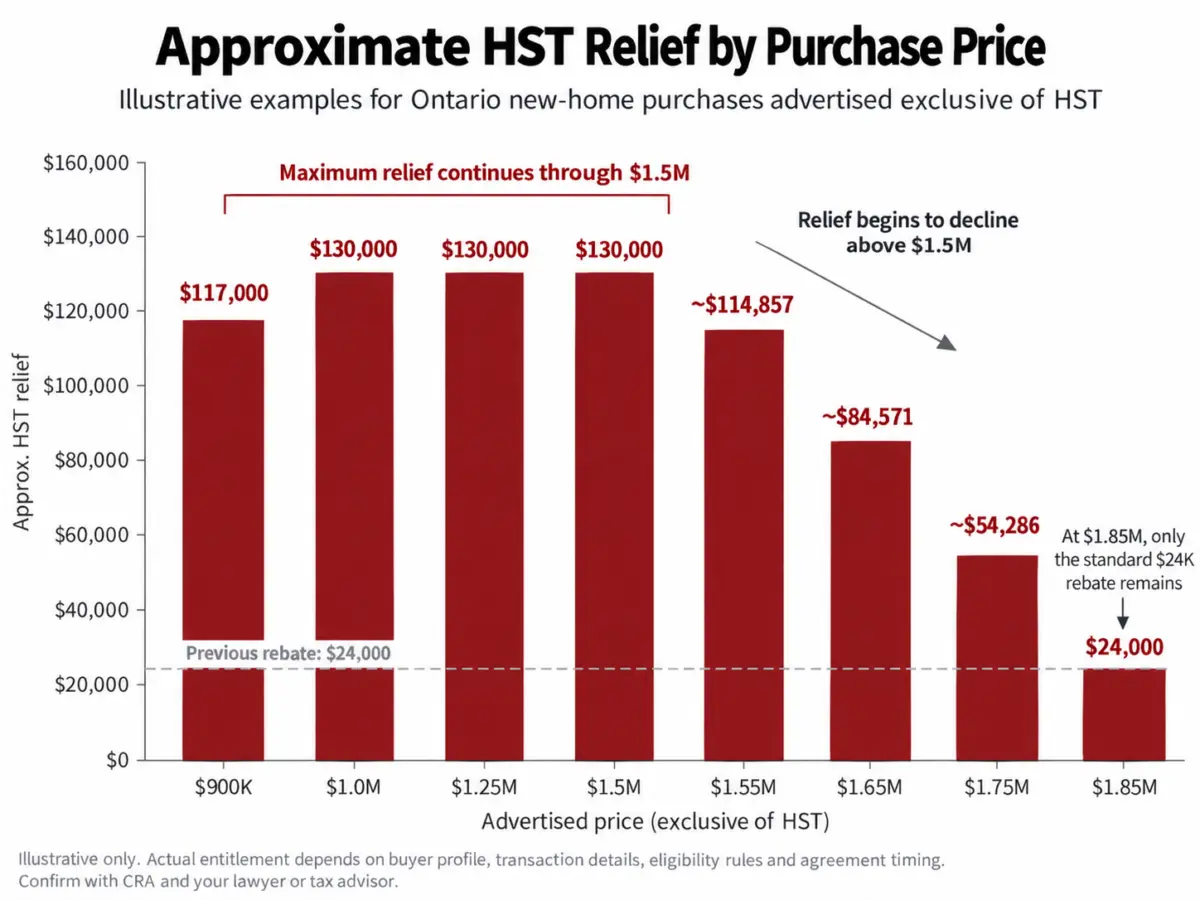
To comprehend why these marketing distinctions matter so much, buyers must look closely at how Ontario’s current enhanced HST relief scales with purchase prices. Under the framework, eligible purchasers buying primary residences can receive relief equivalent to the full 13 per cent HST on homes priced up to $1 million. For properties priced higher, maximum relief of $130,000 remains available up to $1.5 million. Beyond that threshold, the enhanced relief gradually tapers off until it effectively disappears at a purchase price of $1.85 million, leaving only the longstanding provincial rebate of up to $24,000 where applicable.
The monetary impact of this system is substantial. For instance, at a purchase price of $1.5 million before HST, an eligible buyer stands to benefit by roughly $106,000 compared to the older, more restrictive $24,000 rebate regime. Yet, real estate specialists caution that this does not make a $1.5-million home advertised as "exclusive of HST" a $1.5-million acquisition. In this scenario, factoring in the tax and the maximum available relief, the actual purchase price after HST relief settles at approximately $1.565 million.
The variance becomes even more pronounced when buyers factor in structural upgrades, custom finishes, or lot premiums. These additional outlays can fundamentally alter the underlying tax calculation in ways that catch purchasers unawares.
The Hidden Cost of Lot Premiums and Upgrades
Consider a newly constructed home advertised at $1,475,000 exclusive of HST. Assuming the buyer qualifies for the maximum available relief under the provincial framework, the purchase price after accounting for the HST and the rebate lands at approximately $1,537,000.
If that same buyer decides to introduce a $75,000 lot premium to secure a preferred property location, the baseline price before HST shifts to $1,550,000. Crucially, that adjustment pushes the total transaction value past the $1.5-million threshold where the enhanced HST relief begins its downward slide. As a result of crossing that critical financial boundary, the final purchase price surges to approximately $1,637,000.
In this real-world scenario, although the lot premium itself carries a face value of $75,000, the buyer’s total closing cost increases by roughly $100,000. The underlying reason is twofold: the buyer is not only paying the standard 13 per cent HST on the additional $75,000 worth of value, but they are also penalized by the reduction of their maximum available HST relief triggered by crossing the statutory threshold. Consequently, a seemingly straightforward upgrade can carry a disproportionate ripple effect on a home’s final financial ledger.
A broader look at the pricing spectrum illustrates the compounding effect of these variables. For a home with an advertised exclusive price of $900,000, eligible buyers can see their HST entirely offset by the $117,000 relief, keeping the final acquisition cost at the baseline $900,000, compared to $993,000 under the old regime. At a $1,000,000 price point, maximum relief covers the $130,000 tax burden entirely.
However, as prices climb into $1,250,000 and $1,500,000 territory, remaining tax portions of $32,500 and $65,000 respectively must be paid after the $130,000 cap is applied, resulting in actual purchase prices of $1,282,500 and $1,565,000. At the upper end of the enhanced relief scale, a home listed at $1,850,000 exclusive of HST sees the enhanced relief phase out completely, reverting to the standard $24,000 rebate and leaving a remaining tax burden that pushes the total cost past the $2.06 million mark. Industry experts emphasize that these figures serve as illustrative guidelines, and actual entitlements depend heavily on transaction structures, agreement dates, occupancy timelines, and strict individual eligibility criteria.
A Critical Consideration for Buyers and Agents
For consumers entering the new-build market, the overarching takeaway is the necessity of rigorous financial due diligence. Before comparing a pre-construction purchase against another development or evaluating it alongside a standard resale property, both buyers and their representatives must look beyond the initial marketing materials.
While government tax relief programs offer substantial savings, headline prices can easily create a false sense of security. Whether navigating baseline costs, lot premiums, or custom interior upgrades, the ultimate metric that matters for any real estate transaction remains unchanged: what the home will actually cost the buyer at the closing table.