
New-home buyers across Ontario are currently navigating a lucrative landscape of enhanced Harmonized Sales Tax (HST) relief, with potential savings reaching up to $130,000 on eligible transactions. However, as the real estate market adapts to these updated financial incentives, housing experts and industry professionals are issuing a critical warning regarding a subtle yet significant shift in how builders market their properties.
At the center of the issue is a distinction in pricing terminology that has the potential to catch unprepared buyers and their real estate agents completely off guard. While the enhanced relief offers substantial financial breathing room for purchasers entering the new-construction market, misunderstanding the fine print can lead to significant and unwelcome financial surprises at the closing table.
The Shift in Builder Pricing Terminology
According to market observations, a growing number of builders are beginning to advertise new-home prices as "exclusive of HST." Industry veterans are quick to point out that this phrasing does not mean "after the HST rebate," a critical differentiation that can dramatically alter the math for prospective homeowners.
When the enhanced HST relief framework was first introduced, the presentation of builder price lists was noticeably different. Many developers marketed their inventory using phrases like "after HST rebate" or otherwise presented upfront figures that already incorporated the anticipated tax relief. For everyday buyers trying to navigate complex financial commitments, those earlier price lists offered a streamlined, transparent number that was easy to digest and incorporate into their initial budgets.
In contrast, an advertised price described as "exclusive of HST" operates on an entirely different mechanism. This figure represents the base cost of the home before any federal or provincial taxes are factored in. Once that base price is established, the applicable HST must be calculated first. Only after the total tax is determined are the specific rebates or enhanced relief programs that a particular purchaser qualifies for applied to the transaction.
While marketing a property using an HST-exclusive baseline is not inherently improper—provided it is clearly and transparently disclosed—it carries a high risk of consumer misunderstanding. Buyers frequently assume that the prominent headline number displayed in marketing materials already accounts for available tax relief. When that assumption goes uncorrected during the initial stages of a purchase, the financial discrepancy between expectations and reality becomes apparent only when closing day arrives.
Breaking Down the Numbers Under Ontario’s Enhanced Relief
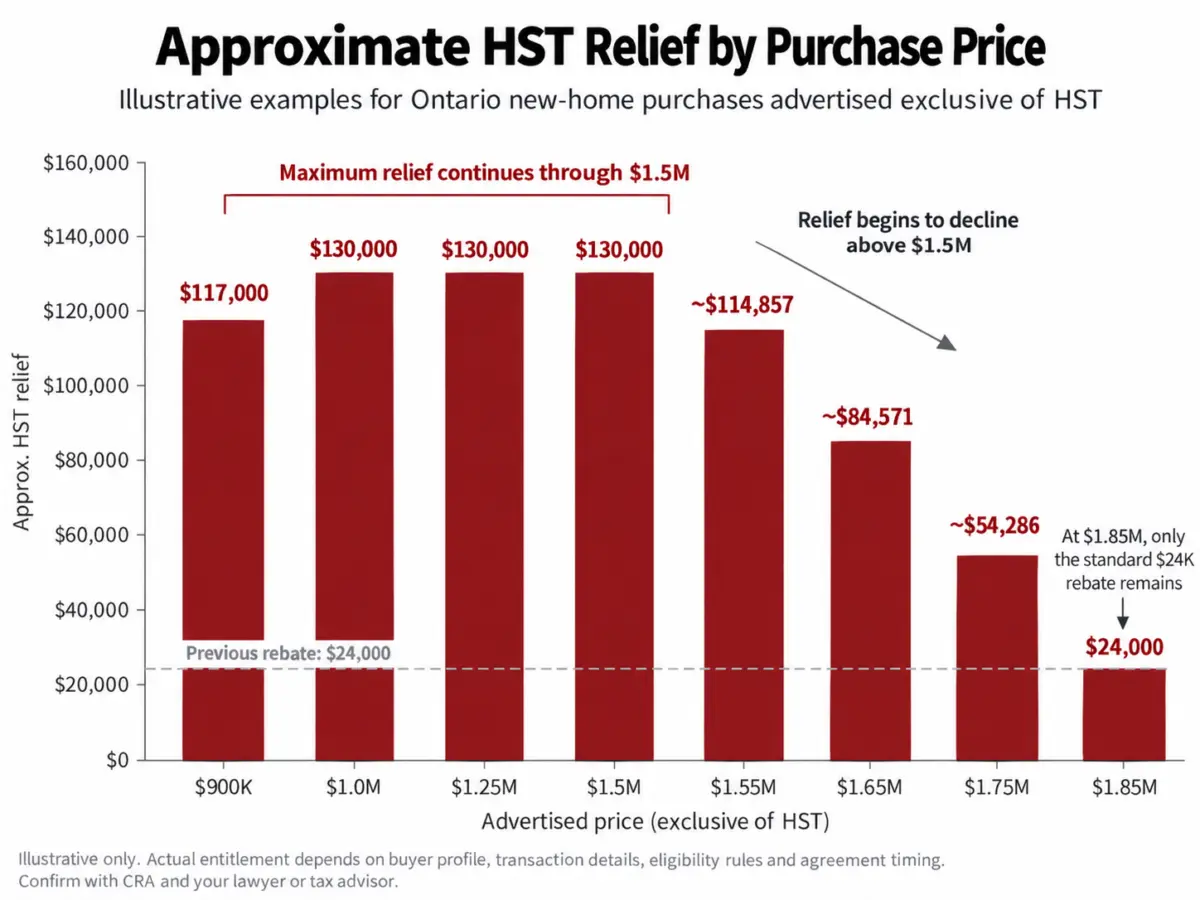
To understand why these discrepancies matter so much, one must examine how Ontario’s current enhanced HST relief structure functions in practice. Under the updated guidelines, eligible purchasers can receive relief equivalent to the full 13 per cent HST on homes valued up to $1 million. For properties priced higher, the maximum relief cap of $130,000 remains accessible up to $1.5 million. Beyond the $1.5-million mark, the enhanced relief tapers off progressively until it effectively disappears at a purchase price of $1.85 million, reverting the transaction to the existing provincial rebate framework of up to $24,000 where applicable.
The sheer scale of these numbers underscores why precision is vital. For example, consider a home with a base purchase price of $1.5 million before HST. Under the current enhanced framework, an eligible primary residence buyer could benefit by approximately $106,000 compared to the older, legacy rebate regime that maxed out at $24,000.
However, that substantial benefit does not translate into a flat $1.5-million acquisition cost. When applying the rules to a $1.5-million "exclusive of HST" listing, the final purchase price after factoring in the appropriate HST and the maximum available relief settles at approximately $1.565 million. The baseline marketing figure simply does not reflect the final tally that must be financed and paid.
Watch the Lot Premium and Other Upgrades
The complexity increases further when buyers begin customizing their properties through lot premiums, structural changes, or interior upgrades. These optional additions do more than just add a flat fee to the invoice; they can fundamentally alter the underlying HST calculation by pushing the total transaction value across sensitive financial thresholds.
Consider a real-world scenario involving a newly constructed home advertised at $1,475,000 exclusive of HST. Assuming the buyer qualifies for the maximum level of relief, the purchase price after applying the applicable HST and subsequent relief lands at approximately $1,537,000.
If that same buyer chooses to add a $75,000 lot premium to the transaction, the base price before HST climbs to $1,550,000. This adjustment does more than just tack on an extra expense; it pushes the total pre-tax valuation across the critical $1.5-million threshold. Crossing that threshold triggers a reduction in the amount of enhanced HST relief the buyer is permitted to claim.
Consequently, the resulting purchase price for the property rises to approximately $1,637,000. In this instance, a $75,000 lot premium ends up inflating the buyer’s total actual cost by roughly $100,000. The escalation occurs because the buyer is not only paying the standard 13 per cent HST on the additional $75,000 value, but they are simultaneously penalized by a diminished rebate due to entering a higher valuation bracket. Once its cumulative impact on both taxation and relief is fully accounted for, an upgrade can carry a significantly heavier financial footprint than its initial sticker price suggests.
The Real Cost at Closing
Market analysts emphasize that while the enhanced HST relief represents a genuinely valuable incentive for new-home purchasers, headline figures can easily obscure the true financial commitments required. For both everyday buyers and the real estate professionals advising them, the central question must always be focused on the bottom line: what will this property actually cost when the transaction finalizes on closing day?
As developers continue to roll out diverse marketing strategies, maintaining absolute clarity regarding pre-tax figures, tax calculations, tier thresholds, and eligibility criteria remains essential. Failing to map out these financial variables early in the purchasing process risks turning an exciting milestone into a costly lesson in real estate arithmetic.