
The stock market continues to confound investors, shifting between record-breaking valuations and sudden drops that rattle retirement portfolios. Amid the current market surge driven largely by the artificial intelligence boom, many investors find themselves haunted by a familiar anxiety: the fear that an unprecedented boom is simply setting the stage for a historic crash. This tension forms the core of a recent presentation and essay by prominent financial independence commentator Mr. Money Mustache, who examined the parallels between today’s AI mania and past market frenzies, such as the dot-com bubble of the early 2000s.

The discussion, initially delivered at the Camp FI Midwest event and slated for an expanded version at the upcoming Bogleheads conference in November, addresses a fundamental question troubling many retirees and near-retirees: Will the AI bubble ruin retirement?

Reflecting on more than two decades of retirement, the author notes that anxiety about the state of the world is a constant fixture of human life. Friends and investors frequently voice alarm over global instability, inflation, ballooning national debt, geopolitical conflicts, and technological disruption. Yet, a historical look back reveals that these worries are perennial. In 2006, investors were gripped by a different set of anxieties, including the impending housing bubble, geopolitical conflicts in the Middle East, outsourcing to emerging economies, and fears of "peak oil."

Despite the subsequent arrival of the Great Financial Crisis—the most severe economic downturn since the Great Depression—long-term data demonstrates the resilience of the broader financial system and the global economy. Over the twenty-year span following those 2006 anxieties, broad market indices showed substantial long-term growth, while global metrics of human well-being improved dramatically. Extreme poverty rates dropped significantly, infant mortality was cut in half, clean energy technologies like solar power became vastly cheaper and more prevalent, and electric vehicle adoption expanded worldwide.

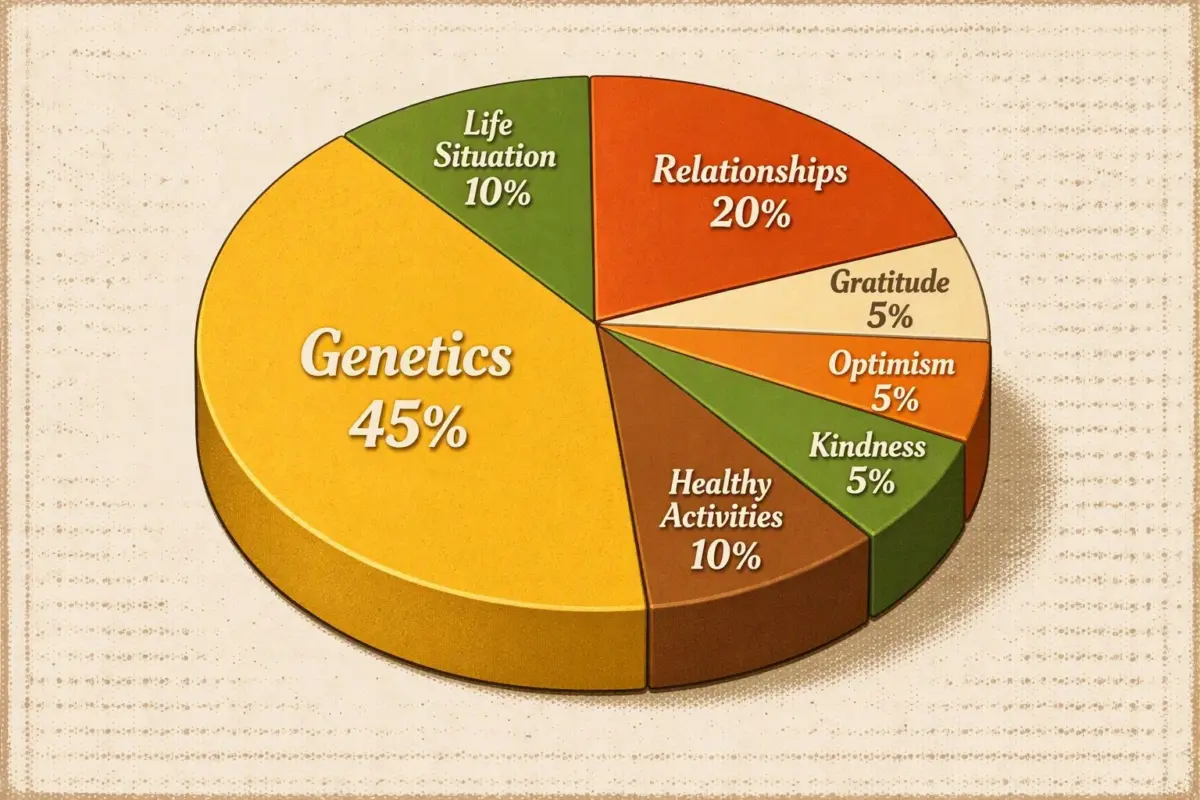
This historical perspective highlights a crucial economic truth often missed by fear-mongering financial media: at its core, prosperity does not derive from abstract financial numbers or stock market tickers, but from real human productivity. The global economy is built on tangible work, innovation, and problem-solving. Financial systems and markets are human inventions that can bend, break, and rebuild without halting the underlying march of human productivity and technological progress. Once societies reach a certain baseline of economic development, further accumulation of wealth ceases to be the primary driver of human happiness, which is instead heavily influenced by personal relationships, community, gratitude, and physical health.

However, the persistence of financial anxiety despite favorable long-term data points to a deeper psychological root: human evolutionary biology. Humans evolved as danger-detection machines, equipped with a nervous system designed to spot threats, scarcity, and predators. Once immediate physical survival needs are met, this detection machinery does not simply turn off. Instead, it moves the goalposts, finding new targets for worry ranging from community standing and tax strategies to neighborhood rules and market valuations.

To combat this pervasive background fear, financial commentators suggest looking inward at personal history and the origins of scarcity mindsets, which are often passed down through generations or shaped by past trauma. Understanding that current anxiety is frequently an echo of the past rather than an objective assessment of the present allows individuals to confront worst-case scenarios rationally. Taking concrete action remains one of the most effective antidotes to fear, transforming the unfamiliar into the manageable and building personal resilience.

Furthermore, reducing exposure to sensationalized daily news diets helps mitigate unnecessary mental stress. Because humans are physical and social creatures meant to solve problems actively, retreating from passive digital consumption toward outdoor activity, physical movement, and constructive community engagement can significantly improve mental well-being. Surrounding oneself with optimistic, solution-oriented peers in movements dedicated to intentional living also reinforces a positive outlook.
Applying this experimental mindset to the modern artificial intelligence landscape helps reframe a technological revolution from a source of dread into an object of fascination. Rather than yielding to doom-scrolling, analyzing the underlying mechanics of AI reveals its potential as a powerful cognitive tool designed to amplify human efficiency and productivity. While technological shifts historically cause labor displacement and concentrate short-term rewards among capital owners and shareholders, they simultaneously lower costs and pave the way for entirely new industries, much like the advent of the internet and mobile computing.

Ultimately, navigating market bubbles and technological transitions requires shifting focus away from uncontrollable external symptoms and toward personal emotional regulation and productive behavior. As financial observers frequently note, the most significant obstacles to a fulfilling life are rarely found in external market fluctuations, but rather in the internal limitations imposed by fear itself.