
Managing rental properties across multiple LLCs, tracking income and expenses by individual property, and keeping security deposits rigorously organized requires far more capability than a standard business checking account can typically offer. Modern real estate investors and portfolio operators need banking tools engineered specifically for the intricate financial demands of multi-property portfolios. Finding the right banking solution can fundamentally transform how cash flow is organized across disparate properties and business entities, seamlessly connecting daily banking activities with advanced bookkeeping and comprehensive tax reporting workflows.
Whether an operator is managing a single rental house or overseeing a vast portfolio spanning dozens of properties across various markets, choosing a banking platform that thoroughly understands real estate investing can streamline overall operations and establish a firm foundation for future growth. Traditional small business banking models often fall short when applied to real estate. A commercial property owner managing diverse assets through separate limited liability companies faces an operational reality entirely different from a traditional retail business owner who might rely on a single, straightforward checking account. When financial information is fragmented across multiple bank logins, disparate applications, and uncoordinated systems, the tasks of account reconciliation and annual tax preparation become exceptionally time-consuming burdens.
To combat these challenges, the market has evolved to offer a diverse array of specialized banking solutions. These range from digital-first platforms built expressly for real estate operators to legacy traditional banks with deep commercial real estate lending capabilities, as well as online institutions offering unique treasury and credit features.
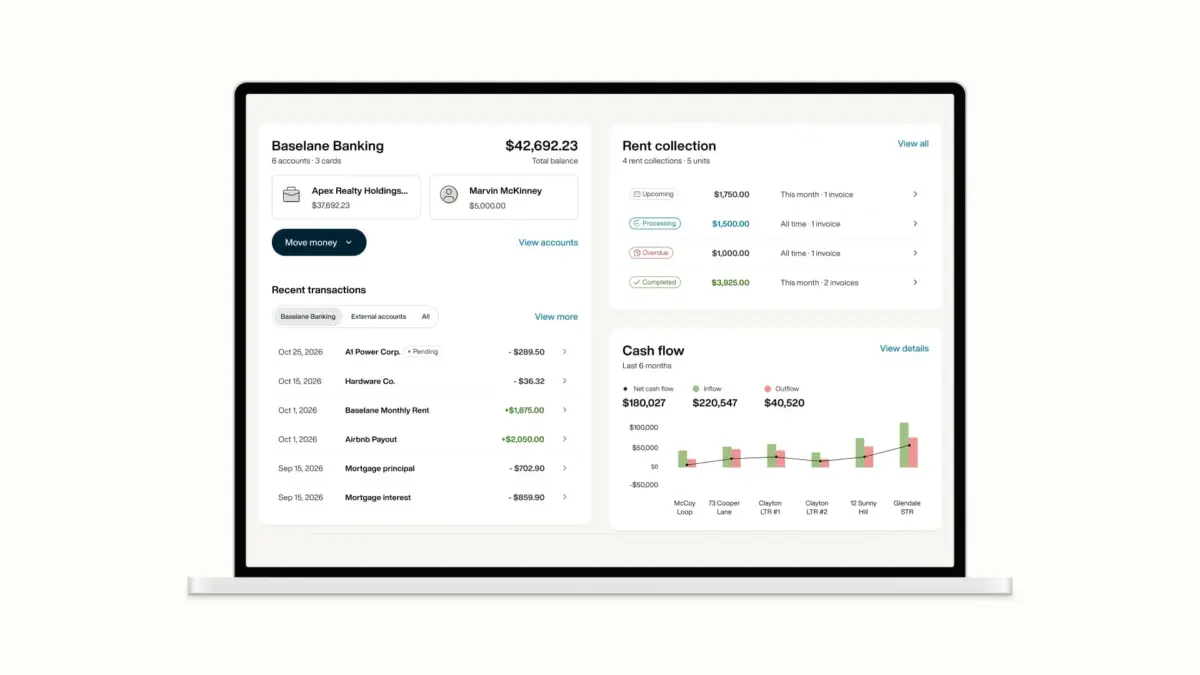
A prominent example of a platform tailored specifically for this niche is Baselane, which combines dedicated property-level banking accounts with automated bookkeeping and integrated rent collection. By allowing investors to open unlimited checking and savings accounts organized by specific properties, entities, or functional purposes within a single dashboard, the platform directly addresses the core operational challenge of managing multi-entity cash flow. Transactions are automatically assigned to the correct property, entity, and tax category using a robust system of real estate-specific categories, drastically reducing the manual labor typically required at year-end and smoothing out tax preparation workflows. While digital platforms like this offer powerful automation, they typically operate without physical branches, meaning operators who require heavy cash handling or traditional teller services often pair them with a legacy banking institution.

Other digital competitors approach the space from slightly different angles. Stessa, based in Oakland, California, operates primarily as a property management and portfolio tracking software that incorporates cash management features. Its built-in accounts allow investors to separate funds by property or portfolio while tying banking directly into broader property management, leasing, and maintenance workflows. Similarly, platforms like Bluevine and Relay focus on multi-account management, working capital access, and team collaboration features. Relay, for instance, allows real estate operators to establish multiple checking accounts to separate cash flow across complex multi-LLC portfolios, supporting sophisticated allocation strategies like Profit First through automated percentage-based transfers.
On the other end of the spectrum, traditional nationwide financial institutions such as Chase, Wells Fargo, and U.S. Bank continue to serve investors who prioritize physical branch networks, cash deposit capabilities, and direct commercial real estate lending. Chase and Wells Fargo cater heavily to experienced investors and larger-scale operators who require extensive treasury solutions, merchant services, and specialized multifamily financing programs, including agency lending through prominent federal housing programs. Meanwhile, institutions like U.S. Bank provide traditional investment property loans alongside standard business checking options, appealing to established investors who want the reassurance of physical branch access without navigating fintech platforms.
Online commercial lenders and specialized institutions also occupy a vital segment of the market. Live Oak Bank has established itself as a national leader in SBA-backed financing, offering streamlined digital processes for major acquisitions and renovations, though these loans generally cannot fund rental properties that the borrower does not personally occupy. Axos Bank provides entirely online lending solutions tailored to debt service coverage ratio financing strategies, accompanied by interest-bearing checking accounts. Tech-forward platforms like Mercury cater to investors managing complex holding company structures who require robust API access for custom financial automation workflows, though users must navigate FDIC insurance considerations carefully.
As the real estate landscape becomes increasingly digitized, the friction points between traditional banking models and modern portfolio management have become starker. Traditional banks were simply not designed to handle the granular, property-level organization that residential and commercial real estate investing demands. Specialized digital platforms attempt to bridge this gap by offering virtual debit cards with customizable spend limits—ideal for assigning to property managers, co-hosts, or maintenance cleaners—alongside dedicated, segregated accounts for tenant security deposits that ensure compliance and clear recordkeeping.
Ultimately, the choice of a banking platform depends heavily on an investor’s specific operational model, portfolio size, and financing needs. While digital-first solutions excel at automated bookkeeping, property-level cash separation, and digital rent collection, legacy banks remain essential anchors for physical branch access and large-scale commercial mortgages. Many active real estate operators find success by adopting a hybrid approach, leveraging specialized financial technology platforms for day-to-day operational accounting and rent management while maintaining relationships with traditional financial institutions to secure long-term capital and property loans.