
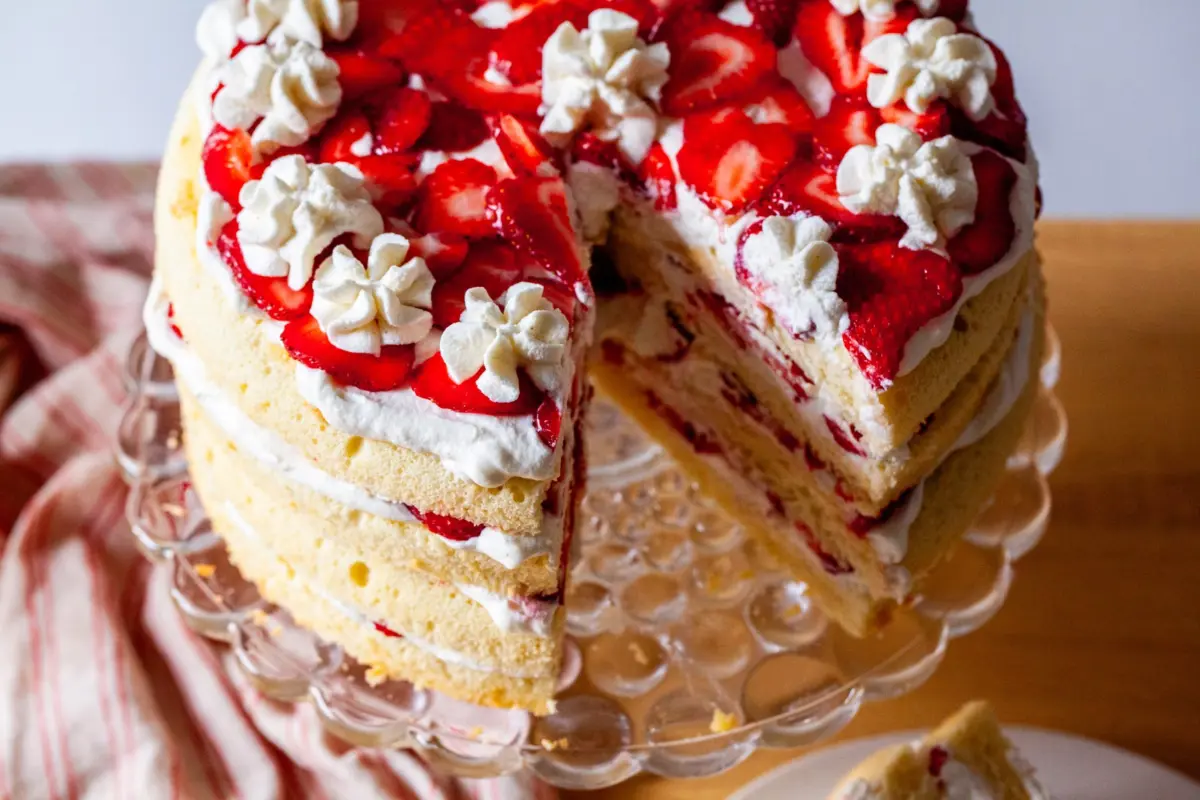
Nearly two decades after first introducing a towering, featherweight strawberry chiffon shortcake to the digital world, home-baking authority and cookbook author Deb has revisited the recipe, stripping away its notorious kitchen anxiety to deliver a streamlined, modern version. What began in 2007 as an ambitious experiment for a friend’s rooftop birthday barbecue has evolved, nineteen years later, into a profound culinary appreciation for a dessert style that defies gravity, withstands the test of time, and manages to vanish from a dessert table in a matter of minutes.
In its original incarnation, the chiffon shortcake served as a delightful centerpiece, brought along with the optimistic assumption that guests would happily overlook any imperfections in its assembly. Yet, despite its success, the path to creating a chiffon cake historically demanded a measure of patience and precision that kept many casual bakers at bay. Traditional chiffon cakes are famously finicky, requiring meticulous sifting, specialized ingredients like cake flour instead of all-purpose flour, and superfine sugar in place of regular granulated alternatives. Bakers had to contend with an uneven ratio of egg whites to yolks, the mandatory inclusion of cream of tartar, and a small mountain of dishes—often requiring a minimum of three distinct mixing bowls just to prepare the layers. Compounding these hurdles was the cake’s notorious tendency to dip and deflate in the center as it cooled, presenting a frustrating challenge for anyone seeking reliable results in a home kitchen.

When the recipe recently resurfaced in an editorial queue earmarked for a refresh, the objective became clear: eliminate as much of that structural rigidity as possible and engineer a chiffon cake tailored for the realities of modern home baking. Along the way, a deep appreciation for the genre blossomed. Chiffon cakes offer a texture that is remarkably light as air, making them an exceptionally glorious centerpiece for summer dessert tables. Beyond their ethereal mouthfeel, these cakes possess a surprising practical advantage—the layers keep phenomenally well, tasting just as fresh on day six as they did the moment they emerged from the oven.
The true test of the perfected recipe arrived during a recent birthday celebration. A supersized, four-layer iteration of the cake was prepared for the festivities, featuring towering dimensions designed to feed a crowd. After blowing out the candles, the baker stepped away briefly to walk a family member out to her car. Upon returning to the party space, a startling discovery awaited: save for a single solitary wedge left on the tables, the entire multi-layered creation had vanished, leaving untouched plates in its wake. An initial wave of panic gave way to the realization of what had occurred during those few unguarded moments. The cake had been devoured frantically and directly from the serving platters the very second they hit the table, entirely bypassing the formalities of patience and individual plates. Party guests were quick to shower the dessert with praise, describing it as a weightless, melt-in-your-mouth creation, with one attendee playfully demanding a double batch next time to ensure everyone could secure a second or third helping.

The newly updated iteration of the recipe introduces several thoughtful modifications designed to streamline the process without sacrificing the cake’s legendary texture. The baking process begins by preheating the oven to 325 degrees Fahrenheit and preparing two nine-inch round cake pans. Rather than coating the entire interior of the pan—a practice that can prevent a chiffon cake from climbing the walls properly—only the bottom of each pan is lightly coated with nonstick spray and lined with a fitted circle of parchment paper, which serves simply to hold the paper in place. The sides of the pan remain entirely ungreased. Additionally, two cooling racks are lightly coated with nonstick spray in preparation for the cooling phase.
The foundation of the cake batter is mixed in a large bowl, where egg yolks, lemon zest, and a cup of granulated sugar are vigorously whisked together. Although the mixture initially appears remarkably stiff and dry, persistent whisking for approximately one minute transforms the batter, loosening its texture into a pale yellow, thick consistency reminiscent of frosting. Cooking oil is whisked in next, followed by water and vanilla extract. The dry ingredients—divided flour, salt, and baking powder—are then incorporated into the yolk mixture to create a batter that remains intentionally thick at this stage.

In a separate large bowl, an electric mixer is employed to whip the egg whites until they reach a stage capable of holding firm peaks. The remaining quarter-cup of sugar is gradually introduced while beating continuously. The whipping process continues until the whites are exceptionally thick and hold their structure, with the tips of the peaks maintaining a slight flop when the beaters are lifted. A touch of lemon juice is beaten in at the end to finalize this component. To integrate the two mixtures, a quarter of the whipped egg whites are whisked directly into the heavy yolk base to loosen the dense batter. The remaining egg whites are then carefully folded in across two separate additions, exercising a gentle touch to preserve the incorporated air and prevent deflation.
The resulting batter is divided evenly between the two prepared pans and baked for twenty to twenty-five minutes, or until a wooden toothpick inserted into the center emerges clean. The moment the layers come out of the oven, a counterintuitive technique is applied: each pan is dropped a few inches onto the kitchen counter several times. While unconventional, this physical shock is a critical measure that actively prevents structural shrinkage. The cake layers are then inverted immediately and cooled completely in their pans upside down, resting upon the pre-sprayed cooling racks to counteract the cake’s natural inclination to develop a sunken center.

The assembly process centers around a rich yet delicate cream topping. Heavy cream, powdered sugar, and vanilla are whipped together using an electric mixer until soft peaks form. Sour cream or crème fraîche is then introduced, and the mixture is beaten further until it thickens sufficiently to hold its shape while maintaining a smooth, creamy, and non-grainy texture.
Once the cake layers have cooled completely, the pans are carefully flipped back over. Although the top of the cakes will have adhered slightly to the cooling racks, the pre-spraying minimizes any tearing. A knife is run around the perimeter of each layer to release it from the pan sides before turning them out. A long, serrated knife is then used to carefully slice each of the two baked layers horizontally into two thinner tiers, yielding four distinct layers in total.

The construction of the shortcake proceeds on a serving platter or cake stand. The first cake layer forms the base, topped with a slightly heaped cup of the prepared whipped cream and approximately one-quarter of the sliced fresh strawberries distributed evenly over the cream. This layering sequence is repeated three more times. A small reserve of whipped cream is saved for finishing, easily transferred to a piping bag fitted with a star tip to decorate the crown of the cake.
When it comes time to serve, the shortcake is cut into generous wedges. The dessert embraces its inherently wobbly nature, refusing to stand rigidly upright, which is considered part of its rustic charm and appeal. Beyond its immediate presentation, the dessert offers remarkable flexibility for home cooks through its make-ahead capabilities. The baked cake layers can be prepared five to six days in advance, kept securely wrapped at room temperature without losing their fresh texture, or frozen for longer-term storage. Meanwhile, the fully assembled cake maintains its integrity in the refrigerator for nearly a week, though in practice, disappearing within minutes remains its far more common fate.