

For millions of investors tracking their retirement portfolios through index funds, the past several years have felt nothing short of extraordinary. The value of the S&P 500 index has surged by approximately fifty-seven percent in just the past two years, and it has more than doubled over the course of the last five. This massive upward trajectory has fundamentally altered net worth calculations for households across the country. Individuals who felt they were only halfway to their retirement goals during the economic shifts of the Covid-19 era may suddenly find they have accelerated past the finish line. Meanwhile, those who achieved financial independence and retired long before that period are confronting a market environment where portfolios are swelling, occasionally prompting conversations about high-end real estate and other discretionary spending.
Yet, this rapid appreciation invites a critical question: Is this historic financial growth real, or is it merely a bubble or a temporary financial illusion? As one concerned reader recently asked in an inquiry regarding market stability, the prevailing hype surrounding Artificial Intelligence has left many wondering whether equities are overly vulnerable to a catastrophic future crash and how that might impact long-term retirement security.

To address these concerns, it is helpful to examine the foundational mechanics of what a stock actually represents. At its core, owning a stock is a business arrangement that functions much like owning a rental house. When an individual owns a rental property, their primary entitlement is the collection of rent. After covering maintenance, taxes, and other related expenses, the remaining capital constitutes profit. If the average market value of rental homes in a specific region climbs significantly, but tenants continue paying the exact same monthly rent, the higher valuation looks impressive on paper, but it yields no immediate change in cash flow unless the property is sold. Even then, selling high typically means turning around and paying similarly inflated prices to acquire a replacement property.
An investor’s actual income remains unchanged unless the rental business itself becomes more profitable. Owners might squeeze in a basement apartment, execute strategic renovations, or streamline operating expenses to increase net earnings. When that property is eventually sold to another investor, the purchase price should theoretically reflect that future stream of income. For instance, if a house generates $2,000 per month—totaling $24,000 annually—and sells for $240,000, the buyer is acquiring an asset with a price-to-earnings ratio of 10. If the seller manages to convince a buyer to hand over $480,000 for that same property, the transaction occurs at a price-to-earnings ratio of 20. While that represents an exceptional outcome for the seller, it establishes a much less favorable financial outlook for the incoming buyer.

Applying this exact framework to the broader stock market reveals a striking parallel. An investment of $100,000 placed into the market in 2019, with dividends continuously reinvested, would have grown to approximately $256,960 by early 2025, representing a 157 percent gain on the original principal. However, over that exact same timeframe, the aggregate share of company earnings generated by that basket of stocks rose from $5,290 to $7,540, marking a much more modest 42 percent increase. Consequently, the overall price-to-earnings ratio of the market climbed from roughly 20 to approximately 30.
Contemporary stock investors find themselves in a position analogous to rental property owners discovering that housing prices have doubled while rental income has barely budged. This compression makes the underlying business of owning shares inherently less lucrative in terms of immediate yield, suggesting that future returns generated by purchases made at today’s elevated valuations will likely be lower than those available when equities are purchased at a discount. While owning stocks or rental properties remains a viable wealth-building strategy, basic financial math dictates that higher initial purchase multiples correspond to more subdued future returns.

Of course, valuations can shift if underlying earnings expand rapidly. Consider a prospective real estate investor eyeing an overpriced property who happens to know that a massive corporate campus is slated for construction nearby, signaling that rental rates will climb sharply for years to come. In such a scenario, paying a premium for those anticipated future earnings is entirely rational. This dynamic explains why individual stock prices routinely surge upon the arrival of positive corporate news. During the height of the Covid-19 pandemic, consumer demand for home exercise equipment drove massive sales for Peloton, leading investors to assume that the trend was permanent. When reality eventually set in and sales returned to historical baselines, the stock price adjusted downward accordingly.
The broader question centers on what occurs when the entire stock market climbs to historic highs. Does this broad-based euphoria signal that the entire national economy is poised for unprecedented expansion?
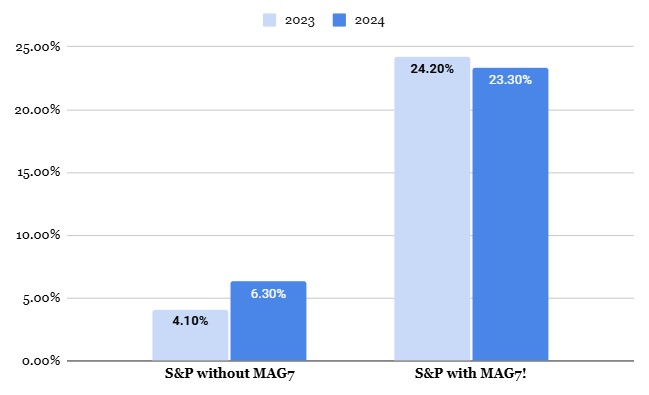
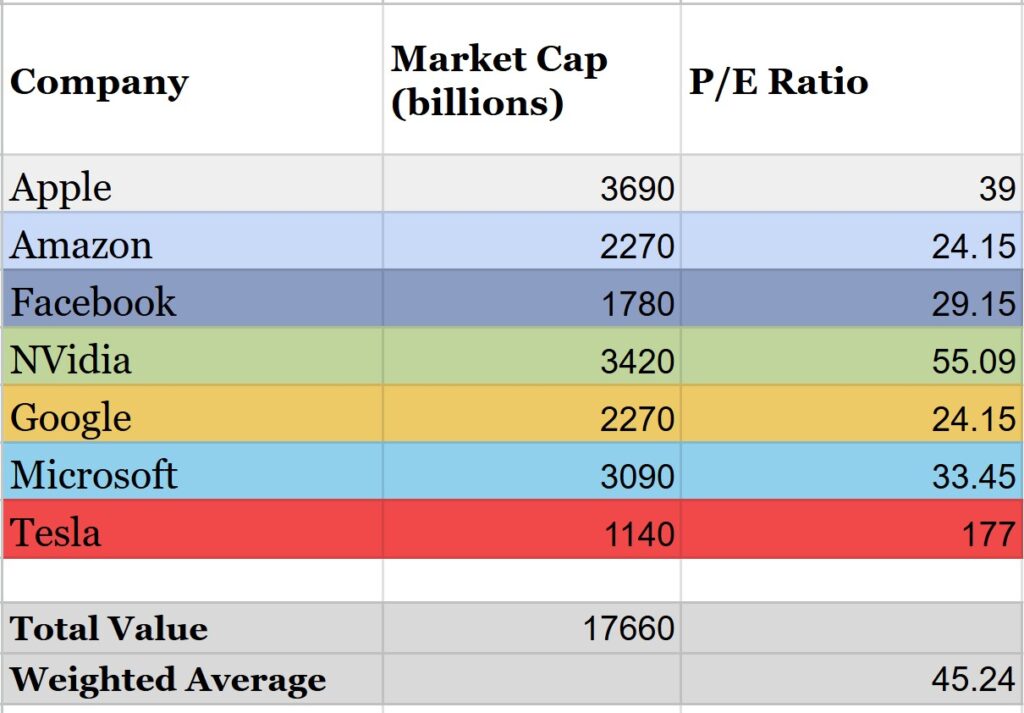
A deeper examination of the S&P 500 reveals a more nuanced reality. The vast majority of recent market growth—roughly three-quarters of it—has been driven by just seven massive technology corporations: Apple, Nvidia, Microsoft, Amazon, Google, Meta, and Tesla. Often referred to as the "Magnificent Seven," these highly profitable enterprises have captured the imagination of investors betting on transformative technological advancements, bidding their share prices up to extraordinary heights. Collectively, these seven companies account for more than 25 percent of the total market value, boasting a combined capitalization of approximately $17.66 trillion and carrying a weighted average price-to-earnings ratio of roughly 45.
When these seven tech giants are excluded from the calculation, the remaining 493 companies in the S&P 500 trade at a much more moderate price-to-earnings ratio of around 20. While still elevated compared to historical averages, this divergence indicates that while investors anticipate a generally healthy broader economy, they are placing an exceptionally high premium on the future growth potential of a handful of dominant technology leaders.
This market concentration is inextricably linked to recent breakthroughs in Artificial Intelligence. Recent advancements have demonstrated that software can exhibit human-like reasoning across an expanding array of complex fields, igniting a frenzy across the global business landscape. Six of the Magnificent Seven are currently channeling hundreds of billions of dollars into the construction of massive data centers housing advanced supercomputers. Meanwhile, Nvidia sits at the center of this hardware boom, supplying the specialized chips required for these operations and commanding substantial pricing power amidst relentless global demand.
Beyond the foundational infrastructure, industries across the commercial spectrum are betting that AI will usher in an unprecedented era of corporate productivity and profit expansion. Modern systems can already ingest entire legal documents, complex software codebases, and extensive volumes of data to answer detailed analytical questions, identify contract loopholes, debug software, diagnose medical conditions from imagery, design pharmaceutical compounds, and lay the groundwork for humanoid robotic labor. The prevailing investment thesis is that society stands on the threshold of an infinite workforce of highly intelligent digital and mechanical employees capable of operating continuously, thereby overcoming humanity’s historical constraints of finite labor and cognitive bandwidth.

While many industry observers believe these technological transformations will ultimately materialize, the critical uncertainty lies in the timeline and the realization of corporate profits. Businesses face potential hurdles including cost overruns, intense competition, regulatory shifts, and structural labor market disruptions.
Despite these unknowns, historical economic data provides a useful baseline. Over the long term, U.S. economic growth has averaged a remarkably stable figure of approximately three percent annually after adjusting for inflation, with recent decades actually experiencing slightly slower-than-average growth.
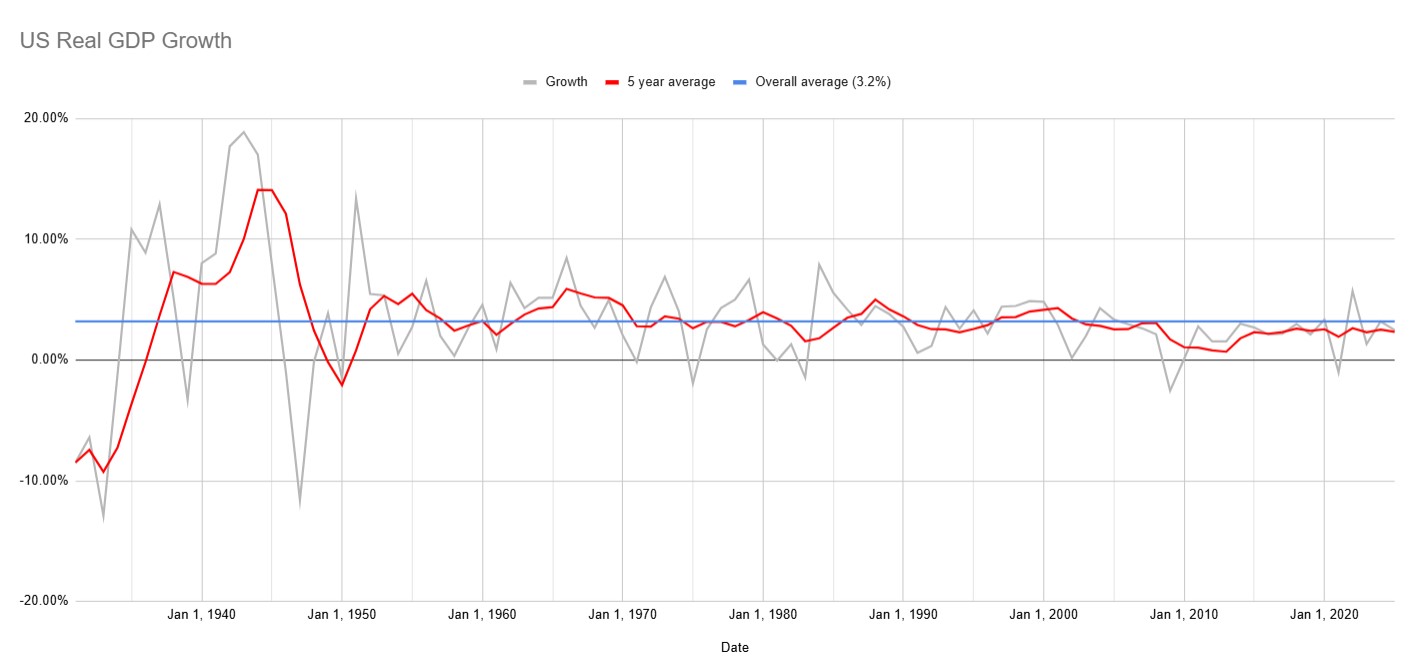
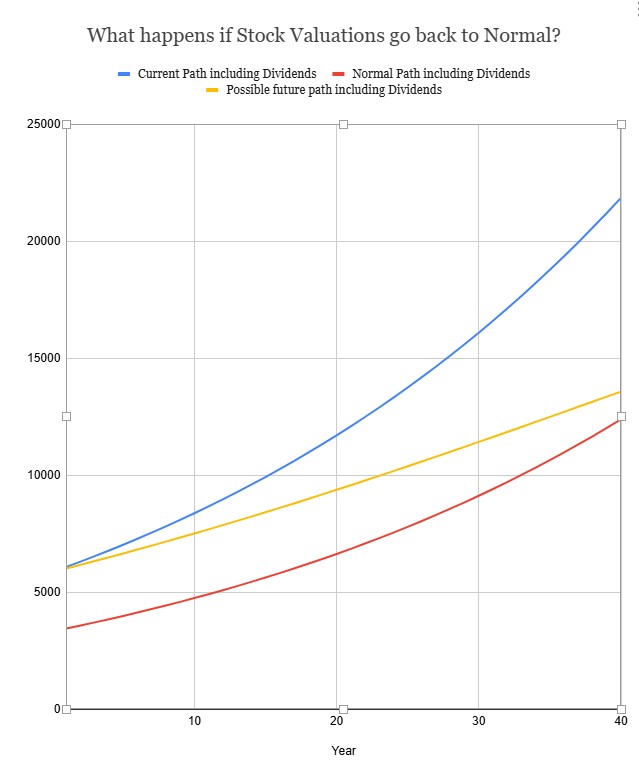
While market corrections, manias, and panics remain a permanent fixture of financial history, attempting to time these fluctuations by liquidating portfolios in anticipation of a market crash generally proves counterproductive over long investment horizons. Even if stocks eventually return to more traditional valuation multiples, corporate earnings are projected to expand alongside the broader economy, ensuring that long-term investors continue to build wealth, albeit at a measured pace.
Alternative asset classes offer different risk-return profiles for those looking beyond domestic equities. Major financial institutions regularly publish long-term return projections; for instance, institutional forecasts have periodically suggested that international equities and fixed-income assets could outperform U.S. stocks over coming decade cycles, largely due to more attractive baseline valuations reflected in lower price-to-earnings ratios for overseas markets. However, foreign markets have often lagged domestic performance due to the concentration of technology innovation within the United States.
Other strategies, such as multi-asset robo-advisor portfolios, seek to capture balanced returns by diversifying across international borders and asset classes, albeit with historical performance trailing a purely U.S.-focused equity allocation during recent tech-led bull markets. Meanwhile, conservative market figures like Warren Buffett have signaled caution regarding prevailing asset valuations, maintaining substantial reserves of uninvested cash at Berkshire Hathaway as opportunities meeting strict margin-of-safety criteria remain scarce.
For individual homeowners evaluating capital deployment, the decision between aggressively paying down a mortgage versus directing surplus cash into index funds involves balancing guaranteed interest savings against historical equity returns. While maintaining a low-interest mortgage while investing excess funds remains a popular strategy, the rising interest rate environment has altered the calculus for many households, elevating the psychological appeal of eliminating housing debt entirely.

Ultimately, navigating the complexities of the modern stock market points back to core principles: maintaining a long-term investment horizon, ignoring daily media noise, and focusing on consistent capital allocation while maintaining perspective on the broader economic landscape.