
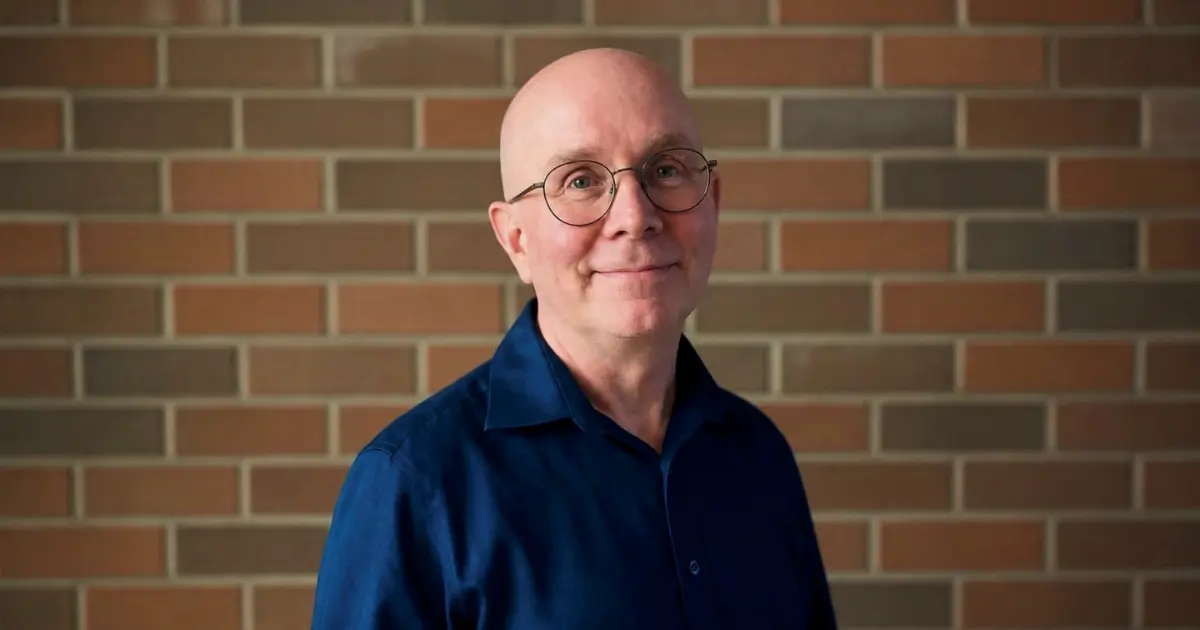
As he prepares to officially take office on January 1, Rev. Éric Hébert-Daly is wasting no time getting up to speed on his new responsibilities as the general secretary of the United Church of Canada. Confirmed for the role at a General Council Executive meeting held in September following a rigorous seven-month search, Hébert-Daly steps in to succeed the retiring Rev. Michael Blair. Amid a busy schedule of transitions, Broadview editor Janice Young caught up with Hébert-Daly over Zoom while he was stationed at a bustling Montreal train station between meetings, discussing his background, his leadership philosophy, and his forward-looking vision for the denomination.
Why the General Secretary Role?
For Hébert-Daly, stepping into the highest administrative office of the United Church is rooted in an enthusiasm for challenging conventional boundaries and exploring new paths for faith communities. Reflecting on his decision to pursue the position, he explains that he began to imagine what institutional transformation could look like on a national scale. He hopes to inject a renewed sense of optimism and enthusiasm into the church in the coming years, driven by a deep personal conviction about where he believes the divine is calling the community.
A Vision for a Smaller, More Connected Church
Addressing his overarching vision for the denomination, Hébert-Daly points to a recurring reality highlighted by contemporary polls: a widespread, deep-seated spiritual hunger and an appetite among Canadians to connect with something larger than themselves. He notes the irony that the church occupies a unique space dedicated to exploring profound existential questions and fostering genuine community, yet often struggles to meet that hunger effectively.
Rather than chasing sheer size, Hébert-Daly envisions a church that may ultimately be smaller in membership, but is widely recognized nationally—even by those who do not regularly attend services—as an accessible destination for deep spiritual experiences, meaningful conversations, and authentic community engagement. He expresses a desire for the denomination to build a reputation centered entirely on being a welcoming home for these vital human connections.
Lessons from Political and Nonprofit Leadership
Before entering ordained ministry, Hébert-Daly built a diverse career in political and nonprofit leadership. Most notably, he served as the national director of the New Democratic Party (NDP) under the late Jack Layton during a period when the party was widely underestimated. Drawing parallels between his past political life and his upcoming ecclesiastical duties, he recalls Layton’s forward-looking philosophy.
Faced with conventional wisdom that viewed the NDP as a spent force, Layton consistently urged his team to focus on the future rather than getting bogged down by past defeats or limitations. As an avid runner, Layton frequently used athletic metaphors, reminding colleagues that runners do not look backward during a race, but instead keep their eyes fixed on the destination.
Hébert-Daly carries those formative lessons with him into his new church leadership role. When confronting narratives that frame the decline of organized religion as a prewritten, inevitable conclusion, he firmly rejects that premise. Having witnessed organizations and individuals written off prematurely in the past, he remains convinced that the church should not accept a narrative of terminal decline today.
Bridging Communities: Francophone and Intercultural Integration
As the first francophone general secretary in the history of the United Church, Hébert-Daly addresses whether his election might help francophone communities of faith feel a deeper connection to the broader national church. He remains pragmatic, noting that individual leadership alone cannot bridge historical divides. Given that the majority of Canada’s francophone population has historically been rooted in the Roman Catholic tradition, he acknowledges it is entirely natural that integrating francophones into the United Church has been a gradual process.
Expanding on the broader theme of inclusion—encompassing francophone, Indigenous, migrant, and diasporic communities—Hébert-Daly emphasizes that ministry must focus on genuinely meeting people’s needs rather than inward-looking institutional preservation. In intercultural ministry, including English-French dynamics, he argues that encounters must be truly transformational.
This philosophy extends directly to the church’s ongoing relationship with Indigenous communities. While acknowledging the necessary framework of two independent canoes and the absolute imperative of abandoning colonial mindsets, he suggests that communities must occasionally tie their boats together, share a meal, and continue their journeys side by side. For Hébert-Daly, these intentional relationships and shared encounters are essential for the mutual transformation of the church as an integrated whole, moving away from isolated, parallel existence.
Navigating Current Challenges and Opportunities
Looking at the immediate challenges facing the general secretary’s office, Hébert-Daly points to the ongoing evolution of the relationship with the Indigenous church, catalyzed by the National Indigenous Spiritual Gathering held over the summer. He views this not as a burdensome challenge, but as a vital opportunity for mutual support in navigating the path forward.
Another pressing concern is how local congregations perceive their own ministries. He observes that Sunday services can occasionally feel overly structured, resembling administrative meetings driven strictly by an established order of service rather than leaving ample room for the movement of the Spirit.
When the conversation turns to growth and community engagement, Hébert-Daly tackles the complex topic of evangelism—a term the United Church has historically approached with considerable discomfort. Acknowledging that past generations have seen evangelism wielded in ways that caused harm, he understands the hesitation. However, he maintains that if individuals are genuinely in a relationship with God and have experienced the positive impacts of faith communities, prayer, or the divine, it is a missed opportunity not to share those experiences openly. He advocates for defining a uniquely United Church approach to sharing these stories.
Empowering Lay Leadership and Supporting Ministry Personnel
To foster future growth and vitality, Hébert-Daly highlights the importance of re-evaluating the ministry of the whole people of God, which involves elevating and adequately supporting lay leadership across the denomination. Concurrently, he emphasizes the urgent need to ensure that ministry personnel feel inspired, resilient, and well-supported during what is undeniably a difficult era for clergy across the Christian landscape in Canada.
Drawing on his four years of experience as a regional executive minister, Hébert-Daly has witnessed an encouraging cultural shift. Congregations that once preferred isolation are increasingly demonstrating an openness to collaboration. By embracing a culture of "failing forward"—trying new initiatives, learning from missteps, and trying again—he believes the denomination has reached a pivotal turning point that opens the door to unprecedented possibilities.
Reflecting on his time working closely with smaller communities of faith, Hébert-Daly notes that rural churches offer a unique inspiration. Their buildings often feature a natural porosity, maintaining fluid boundaries between the surrounding community and the congregation inside, creating a holistic sense of shared local life that does not require the scale of a megachurch to make a profound impact.
A Journey from Roman Catholicism to the United Church
A less widely known aspect of Hébert-Daly’s background is that he did not grow up within the United Church tradition. Born into a francophone Roman Catholic family, his parents were children of the Quiet Revolution who sought distance from organized religion and discouraged his participation. It was his grandparents who actively maintained his connection to his faith by taking him to church.
Over time, however, he found himself struggling with various aspects of Catholic policy, particularly regarding the treatment of women, divorced individuals, and the queer community. Discovering the United Church provided him with a spiritual home where he could authenticially embrace his identity while sitting comfortably alongside peers who might hold differing viewpoints. In an era marked by polarized public discourse and mutual hostility, he views the church as uniquely positioned to serve as a sacred space for genuine human encounter.
Concluding his conversation with Broadview, Hébert-Daly reflects on the ultimate legacy the institution could leave behind. Imagining a church widely recognized as a practical school for learning how to love one another, he notes that realizing this foundational call of Christ represents a transformative societal mission that continues to inspire his work.