
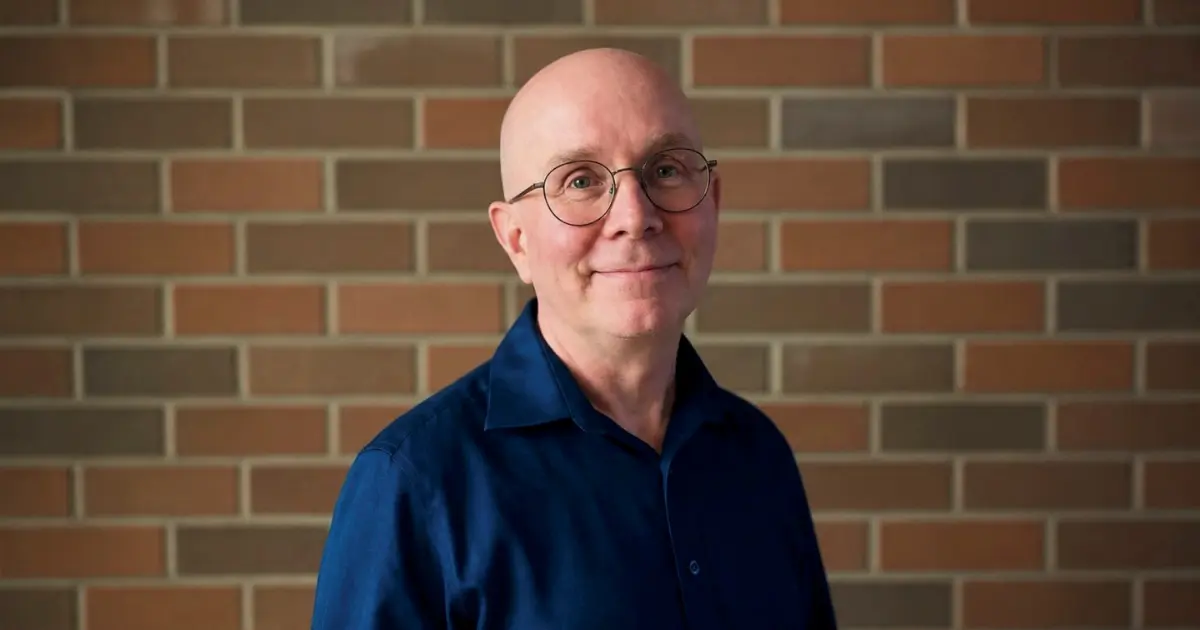
As he prepares to step into his new national leadership role, Rev. Éric Hébert-Daly is already hard at work mapping out the future of the United Church of Canada. Although his official term as general secretary does not begin until January 1, Hébert-Daly has spent the months following his September confirmation getting up to speed. Selected after a rigorous seven-month search process to succeed the retiring Rev. Michael Blair, Hébert-Daly brings a wealth of diverse experience in both regional church leadership and secular political organization.
Caught between meetings at a bustling Montreal train station, Hébert-Daly spoke with Broadview editor Janice Young about his transition, his unique path to the denomination, and his forward-looking vision for a church navigating an evolving Canadian religious landscape.
Embracing Optimism and Breaking Out of Well-Worn Paths
Reflecting on his motivation for taking on the demanding national role, Hébert-Daly expressed deep enthusiasm for challenging institutional habits. He wants to help the denomination break out of its well-worn paths on a national scale, injecting a renewed sense of optimism and enthusiasm into congregations across the country over the coming years. For him, this drive stems naturally from a sense of divine calling, pushing the church to look beyond its comfort zones and engage directly with the spiritual realities of contemporary life.
That sense of divine calling intersects directly with a stark cultural reality. Polls consistently indicate that Canadians possess a deep spiritual hunger and an authentic appetite for connecting to something larger than themselves. Yet, as Hébert-Daly points out, the church often struggles to meet that distinct human need, even though it exists precisely to talk about profound matters and foster genuine community.
His vision for the denomination is not about chasing sheer numerical growth at all costs, but about cultivating deep cultural relevance. He envisions a church that may be physically smaller than it was in past generations, but one that is nationally recognized—even by individuals who never step through its doors on a Sunday morning—as a trusted destination for deep spiritual experiences, meaningful conversations, and authentic community.
Lessons from Political Leadership on the National Stage
Hébert-Daly’s path to the general secretary’s office is far from traditional. Before answering the call to ministry and later serving four years as a regional executive minister, he worked extensively in political and nonprofit leadership. Most notably, he served as the national director of the New Democratic Party (NDP) under the late Jack Layton.
That period in federal politics taught him vital lessons about resilience and perspective that he plans to carry into his church leadership. When Layton first took the helm of the NDP, many political observers and pollsters had written the party off as a spent force. Rather than dwelling on past glories or mourning past defeats, Layton urged his team to look forward, famously drawing on his identity as an avid runner to remind colleagues that racers do not look back at where they have been, but forward to where they are going.
Hébert-Daly sees a direct parallel between the political underdog status the NDP faced and the narrative of decline that often plagues modern mainline Christianity. When people suggest that the downward trend of church attendance is a prewritten, unalterable determination, Hébert-Daly firmly rejects the premise. Having witnessed institutions and individuals written off before only to experience historic breakthroughs, he believes the United Church has every reason to look toward the future with hope and determination.
Engaging Francophone and Intercultural Communities
As the first francophone general secretary in the history of the United Church of Canada, Hébert-Daly represents a historic milestone for the denomination. However, he is quick to emphasize that systemic inclusion cannot rest on the shoulders of one individual. Historically, the vast majority of the francophone population in Canada has been shaped by the Roman Catholic Church, meaning it has naturally taken time for the United Church to fully integrate francophone communities into its broader institutional life.
Addressing the broader challenge of connecting francophone, Indigenous, migrant, and diasporic communities to the wider church, Hébert-Daly argues that ministry must focus on meeting people’s genuine needs rather than trying to satisfy institutional self-preservation. Intercultural encounters, he stresses, must be truly transformational.
This philosophy applies equally to the ongoing reconciliation and relationship-building efforts with the Indigenous church. Rejecting old colonial mindsets of isolation, Hébert-Daly advocates for a dynamic model of relationship. While acknowledging the necessary independence symbolized by the concept of "two canoes," he suggests that the church must also periodically tie its boats together, share a meal, and journey alongside one another. These shared encounters and relationships hold the power to mutually transform the church as an integrated whole, moving away from isolated, parallel existence toward genuine solidarity.
Navigating Evolving Relationships and Renewing Worship
Among the primary challenges facing the general secretary’s office, Hébert-Daly points to the continuing evolution of the relationship with the Indigenous church. Following the National Indigenous Spiritual Gathering held over the summer, he views this relationship not as a burdensome challenge, but as a profound opportunity for mutual learning and collaborative path-finding.
At the local level, he also harbors concerns about how individual congregations view their own ministries. He notes that Sunday services can sometimes feel uncomfortably like administrative meetings, driven strictly by a printed order of service that rushes through an agenda without leaving adequate space for the movement of the Holy Spirit.
Coupled with this is the denomination’s historical discomfort with evangelism. Given how aggressive or exclusionary forms of proselytizing have played out over generations, Hébert-Daly understands why the United Church has long kept the "e-word" at arm’s length. Yet, he believes the church is missing an opportunity by failing to share the transformative impact of faith, prayer, and divine connection. His goal is to foster a uniquely United Church expression of evangelism—one rooted in sharing good news openly, authentically, and compassionately.
Empowering Laity and Embracing Rural Inspiration
To address these challenges, Hébert-Daly looks forward to developing robust support systems for both lay leadership and active ministry personnel. Recognizing that it is an exceptionally difficult time to be a minister within the Christian church in Canada, he emphasizes the importance of mutual support, inspiration, and resilience. He advocates for a culture of "failing forward"—giving congregations and leaders permission to try new initiatives, learn openly from mistakes, and try again.
Drawing from his four years of experience as a regional executive minister working closely with smaller faith communities, Hébert-Daly finds daily inspiration in rural churches. He points out that rural congregations often possess a uniquely porous relationship with their surrounding communities, blurring the hard lines often found between insiders and outsiders in urban settings. For Hébert-Daly, proving that a faith community does not need to be a massive megachurch to make a profound local impact is a vital part of the denomination’s strength.
A Journey from the Quiet Revolution to the United Church Pews
Hébert-Daly’s vision for an inclusive, listening church is deeply personal. He was not raised in the United Church; rather, he was born into a francophone Roman Catholic family during the height of Quebec’s Quiet Revolution. His parents, deeply disillusioned by the traditional church, wanted nothing to do with religious institutions and actively discouraged his participation. However, it was his grandparents who brought him to church and maintained his connection to the Christian faith.
As he grew older, Hébert-Daly struggled intensely with various Roman Catholic policies and doctrines, particularly regarding the status of women, the treatment of divorced individuals, and the church’s stance on the queer community. When he discovered the United Church, he found a spiritual home where he could bring his full, authentic self while sitting in the pews beside people who might hold differing perspectives.
In an era characterized by public polarization, where people frequently shout past one another and refuse to listen, Hébert-Daly believes the church possesses a vital calling. By functioning as a sacred space of genuine encounter, the denomination can help heal societal divisions.
Imagining the ultimate legacy of the church, Hébert-Daly envisions a community universally known not for dogma or division, but as a reliable school for learning how to love one another. Fulfilling that fundamental call of Christ, he notes, remains the most inspiring task ahead.