
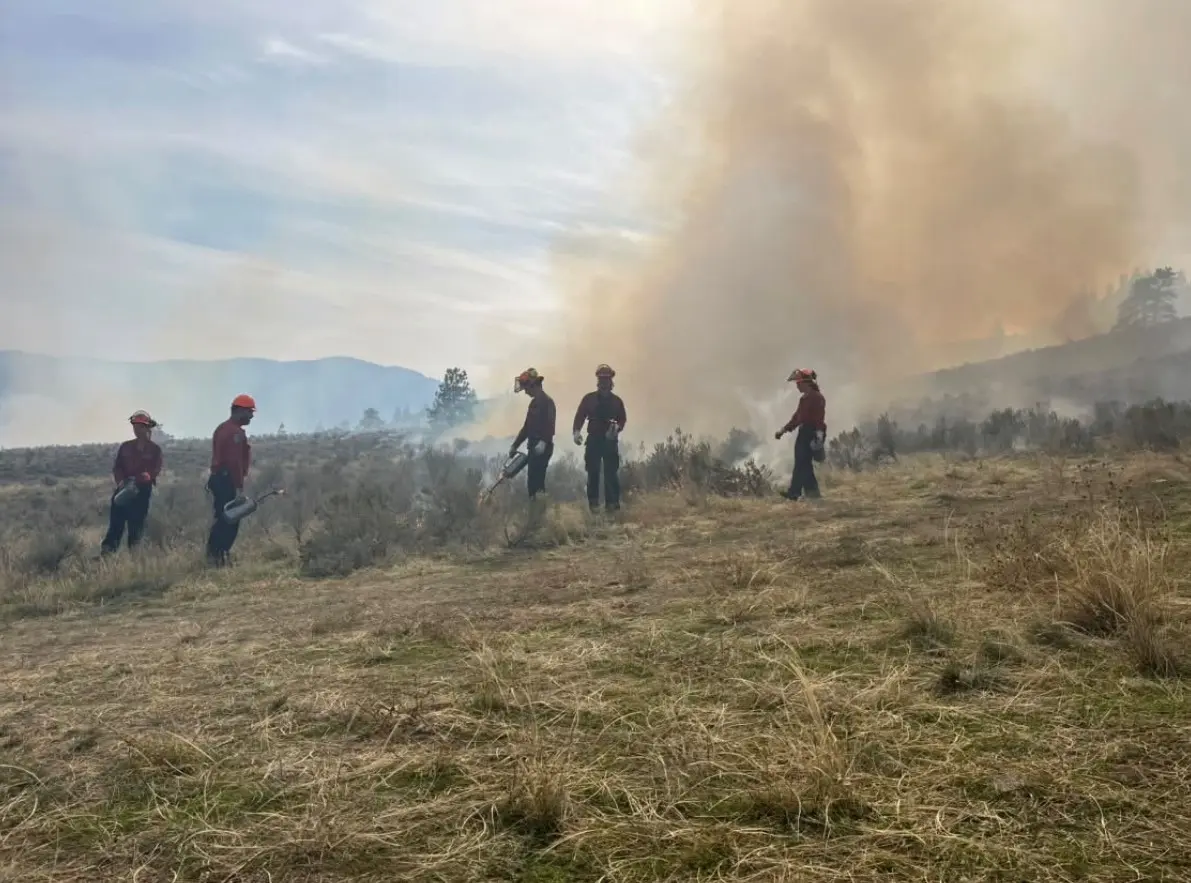
Plumes of grey and white smoke rising over the arid grasslands west of Osoyoos have caught the attention of local residents and travellers this week. While the sight of smoke in this fire-prone region often triggers anxiety, this particular fire is different. It is a carefully planned, deliberate burn designed to do far more than simply reduce the risk of catastrophic summer wildfires.
Spanning approximately 160 hectares in the Nighthawk Road area, the multi-day controlled burn represents a profound intersection of ecological restoration, community safety, and cultural reclamation. The initiative is a collaborative effort led by the Lower Similkameen Indian Band in partnership with the B.C. Wildfire Service and other regional stakeholders. Beyond its immediate practical applications, the project is a vital step toward reviving Indigenous cultural burning practices that were systematically suppressed by colonial authorities for generations.
For the Lower Similkameen Indian Band, the significance of the burn extends far beyond modern forestry metrics. Julia Peterson, a councillor with the band, explains that the project is fundamentally about bridging the past and the present, bringing traditional ecological knowledge back into alignment with modern wildfire management strategies.
Historically, Indigenous peoples across North America used controlled, low-intensity fires to manage landscapes, clear underbrush, and encourage the growth of food and medicine plants. However, these practices were outlawed under early Canadian laws and forestry policies that viewed all fire as a destructive threat to timber resources and settlement.
"It was abolished, you know, by previous law, and so we’re really trying to bring those practices back, and combine these together with Western science," Peterson said.

The prohibition of cultural burning had far-reaching consequences. For more than a century, policy-mandated fire exclusion altered the natural balance of the region’s ecosystems. Without regular, low-intensity burns to clear out dead wood and organic debris, forests and grasslands grew increasingly dense. This accumulation of fuel, combined with the escalating impacts of climate change, has set the stage for the highly destructive, high-intensity wildfires that now threaten British Columbia’s interior every summer.
By returning fire to the land under controlled conditions, the Lower Similkameen Indian Band is reclaiming a stewardship role that was disrupted by colonial legislation. For Peterson, the physical act of lighting the grasslands is deeply intertwined with ceremony and the sacred relationship that exists between the community and the natural world.
"Ceremony connects us to land, it connects us to the animals, to the water," Peterson said. "This is bringing this ceremonial practice back into our community."
The ecological benefits of the Nighthawk Road burn are extensive. Grasslands in the southern interior of British Columbia are among the province’s most endangered ecosystems, supporting a wide array of specialized wildlife. Over time, the absence of natural fire cycles has allowed woody shrubs and invasive species to encroach upon these open spaces, degrading the habitat.
One of the primary ecological targets of this burn is the dense sagebrush that has overtaken portions of the local landscape. While sagebrush is a native species, its overgrowth can choke out the diverse understory of native bunchgrasses and flowering plants that local wildlife rely on for forage.
This ecological shift has been observed firsthand by local residents. Daryl Gibb, who owns the Nighthawk RV Park situated near the burn area, has watched the landscape change over the years. He notes that the lack of fire has allowed the brush to dominate the hillsides at the expense of vital grasslands.

"At the bottom of the hill there was a lot of sagebrush that choked out the grass," Gibb said. "Getting rid of that sagebrush will definitely bring the grass back again."
By clearing away the thick overgrowth of sagebrush and consuming dead thatch, the low-intensity fire helps recycle nutrients back into the soil. This process stimulates the growth of native grasses, improves the overall health of the grassland ecosystem, and restores high-quality habitat for the numerous species that call the Similkameen Valley home.
In addition to ecological restoration, the burn serves a critical safety function for the surrounding communities. The southern interior of British Columbia is one of the most wildfire-vulnerable regions in Canada, characterized by hot, dry summers and strong valley winds. Local business owners and residents are acutely aware of how quickly a spark can turn into an emergency.
Gibb has seen how rapidly wildfires can escalate and threaten local lives and properties. Living and operating a business in the valley means constantly monitoring the summer skies for signs of smoke.
"About six or eight years ago, there was a big fire burning in the Cascades just across the river from us," Gibb recalled, pointing to the rugged terrain that dominates the horizon. "And then there’s been little local ones close."
By proactively burning off the accumulated fuel loads during the cooler, damper shoulder season, the Lower Similkameen Indian Band and the B.C. Wildfire Service are creating a buffer zone. Should a wildfire spark in the area during the dry summer months, it will have significantly less fuel to consume, making it easier for ground crews to manage and protect nearby structures like Gibb’s RV park.

The success of the Nighthawk Road burn highlights a growing recognition among emergency management agencies that traditional Indigenous land stewardship is a crucial tool in modern disaster mitigation. The collaboration between the Lower Similkameen Indian Band and the B.C. Wildfire Service represents a shift away from top-down, centralized fire suppression toward a cooperative model that respects local expertise and sovereign jurisdictions.
Wildfire mitigation in the region is particularly complex due to the patchwork of land ownership and jurisdiction. The Similkameen Valley is a mosaic of federal reserve lands, provincial Crown land, private properties, and municipal areas, all situated just north of the Canada-United States border.
Justin Smith, who works with the Lower Similkameen Indian Band Emergency Management, emphasizes that effective wildfire preparedness requires breaking down these artificial boundaries and working together.
"Everybody’s in the same boat," Smith said. "The fire doesn’t recognize the boundary. The fire doesn’t even recognize the border. It just goes where it wants to go."
This reality has driven closer cooperation between First Nations emergency services, provincial wildfire crews, and local governments. By aligning their resources and expertise, these groups can plan and execute landscape-level treatments that protect entire valleys, rather than just isolated pockets of land. This coordinated approach is becoming increasingly urgent as climate change drives longer, hotter, and more unpredictable fire seasons across Western Canada.
The vulnerability of the region has been underscored by several high-profile fire events in recent years. Nearby communities have faced sudden evacuations from fast-moving grass fires, some of which have been sparked by ordinary human activity, such as a lawnmower igniting dry grass near Osoyoos and quickly spreading to nearby homes. Other larger blazes, like the Bald Range wildfire near Summerland, have demonstrated the immense challenges of controlling fires once they gain momentum in untreated, fuel-heavy forests and grasslands.

These incidents highlight why proactive measures, such as the prescribed burn at Nighthawk Road, are so critical. Waiting until the heat of summer to react to fires is no longer a viable strategy; instead, communities must actively manage the landscape during the spring and fall to mitigate the potential impact of summer blazes.
While the 160-hectare burn west of Osoyoos is a significant achievement, those involved in the project view it as just the beginning of a much larger, ongoing effort. The scale of the wildfire challenge in British Columbia is vast, and decades of fire suppression have left millions of hectares of forest and grassland in need of active management.
Peterson stresses that while the Nighthawk Road project is a positive step forward, there is an urgent need to expand these types of cultural and prescribed burns across the wider region to ensure long-term safety and ecological resilience.
"We still have many other areas that need this kind of treatment to bring safety to the communities, both on and off reserve," Peterson said.
As the smoke from the Nighthawk Road burn gradually clears, it leaves behind a blackened landscape that will soon flush with vibrant green growth. For the Lower Similkameen Indian Band, the charred earth is not a symbol of destruction, but of renewal—a testament to a restored relationship with the land, a revived cultural practice, and a shared commitment to protecting the valley for generations to come.