
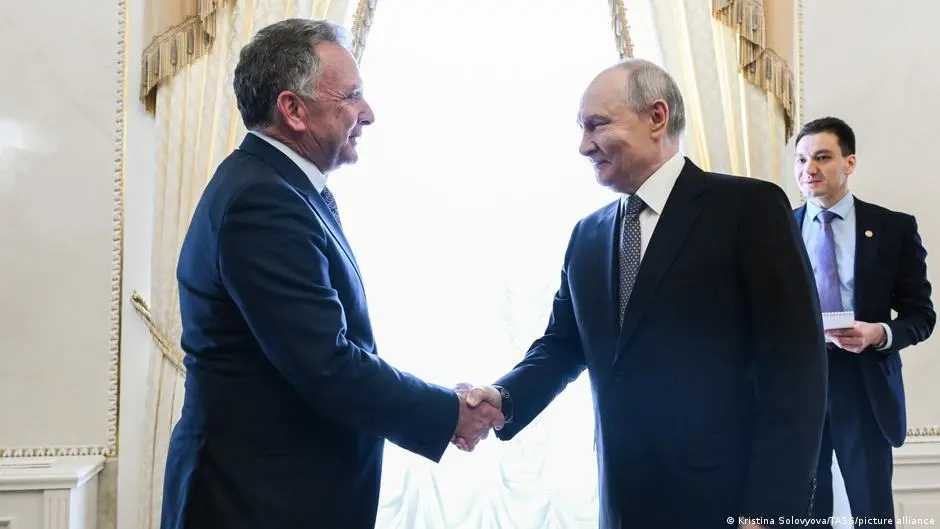
ST. PETERSBURG — Russian President Vladimir Putin announced on Wednesday the release of American citizen Stephen Hubbard during high-level diplomatic talks with United States special envoy Steve Witkoff in St. Petersburg. The release of the 72-year-old American prisoner came amid intensive diplomatic shuttling aimed at brokering a potential peace framework between Russia and Ukraine, marking an unexpected diplomatic breakthrough in the otherwise fraught relations between Washington and Moscow.
Hubbard, who was detained by Russian forces and subsequently accused of operating as a foreign mercenary on behalf of Ukraine, had been sentenced in 2024 to seven years in a Russian penal facility following a closed-door trial in Moscow. He has consistently denied the mercenary charges leveled against him.
Announcing the decision alongside the American envoy, Putin stated that Hubbard was already at the airport prepared for departure. Witkoff confirmed the development, noting that the elderly American was finally "going home to his family" after months of legal wrangling and incarceration under Russia’s judicial system.
In Washington, US President Donald Trump stated that Hubbard’s repatriation was the direct result of personal diplomacy, having raised the case with Putin during a telephone conversation late last week. Trump took to his Truth Social platform to characterize the transfer as a diplomatic success achieved without reciprocal prisoner exchanges.
"The United States, out of respect for President Trump, was not required to give anything in return — an unprecedented situation for Russia," Trump claimed in an online post detailing the prisoner release. "There was no ‘swap’ necessary for this release."
The decision to release Hubbard was widely interpreted by diplomats and observers as an overt goodwill gesture directed toward the Trump administration, designed to cultivate political capital as both sides test the waters for broader negotiations regarding the conflict in Ukraine.
However, the domestic political atmosphere surrounding the negotiation revealed underlying complexities. In a subsequent post published shortly after his initial statement, Trump addressed mounting criticism from domestic opponents who had objected to his recent decision to put a scheduled round of new sanctions against Russia on hold.
Trump defended the suspension of the sanctions package as an indispensable tactical concession that made the diplomatic exchange possible, claiming that those who had questioned his strategy were forced to reconsider. According to Trump, "numerous people" had reached out to apologize for having criticized his decision to pause the economic penalties.
"If sanctions would have been placed, certainly those negotiations would have come to a complete and total halt," Trump wrote, emphasizing his belief that punitive financial measures would have torpedoed both the humanitarian arrangement and the broader channel of communication being pursued by his administration.
Russia Agrees to Trilateral Talks with Ukraine and the US
The high-stakes St. Petersburg meeting between Putin and Witkoff extended far beyond consular affairs, focusing heavily on prospective outlines to bring an end to the war in Ukraine, which has now raged for more than four years following Russia’s full-scale invasion.
During the direct exchange, Witkoff delivered a set of preliminary proposals directly to the Russian leader. "We’ve brought some papers. It’s really some ideas, some sort of peace deal between Russia and Ukraine, and you’ll read that at your leisure," Witkoff told Putin as he submitted the American delegation’s working concepts.
The initial official reaction from Moscow was distinctly cool. Following the conclusion of the talks, Kremlin representatives offered a skeptical assessment of the American documents, asserting that Witkoff’s proposals "lacked substance" and offered little immediate utility for the construction of a durable peace settlement. Russian officials indicated that the broad ideas presented did not adequately tackle the fundamental issues Moscow considers essential to resolving the dispute.
Despite the Kremlin’s critical appraisal of the American working papers, the diplomatic mission produced a notable procedural breakthrough. Putin agreed "in principle" to resume peace talks featuring delegates from Russia, Ukraine, and the United States, indicating a target date following November 10.
Providing further detail on Moscow’s perspective, Putin’s senior foreign affairs adviser, Yuri Ushakov, outlined the parameters under which the Kremlin is prepared to engage in such tripartite negotiations. Ushakov emphasized that future discussions must address overarching regional stability rather than merely temporary measures.
Such talks should focus on "building a security system for Russia and Ukraine after the conflict ends," Ushakov stated, signaling Moscow’s intention to center future negotiations on legal guarantees, mutual security architectures, and the long-term post-war equilibrium between the neighboring countries.
Furthermore, the diplomatic exchange in St. Petersburg touched upon the broader state of affairs between the two nuclear-armed superpowers. Putin utilized the engagement to propose that Witkoff and the Trump administration discuss steps toward the eventual restoration of bilateral ties between Washington and Moscow, which have deteriorated to historic lows during the course of the ongoing military conflict.
Ushakov also revealed that broader geopolitical alignments were discussed during the encounter, noting that the Russian leadership remains open to unprecedented multilateral summits. Specifically, Moscow indicated preliminary interest in an extraordinary trilateral meeting between President Trump, Russian President Vladimir Putin, and Chinese President Xi Jinping, potentially to be hosted in Beijing.
"A possible first-ever meeting of the leaders of China, Russia and the United States… is being prepared," Ushakov announced, suggesting an ambition to expand diplomatic engagement into a triangular summit involving the world’s most dominant military and economic powers.
European Leaders Hope for Productive Negotiations
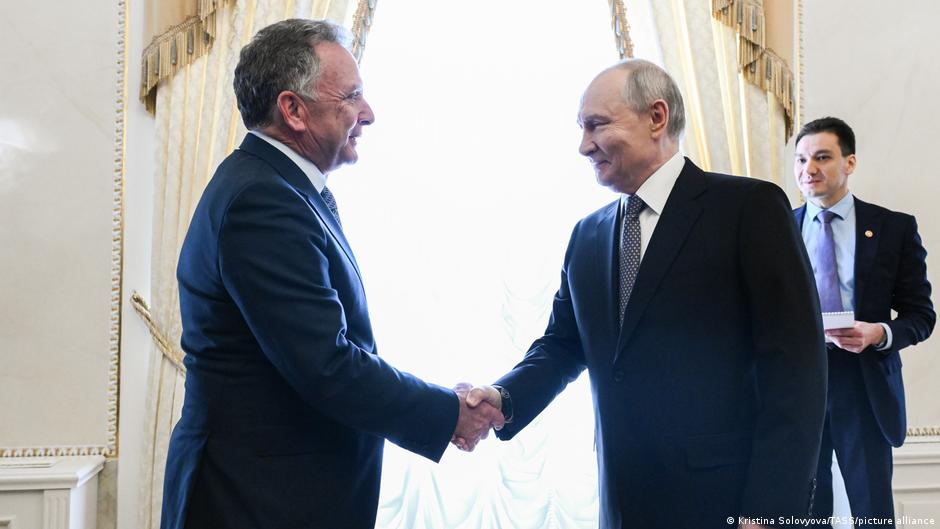
The session in St. Petersburg represented the ninth round of direct talks conducted between Witkoff and Putin, highlighting the envoy’s role as the Trump administration’s primary diplomatic channel to the Kremlin. The meeting came immediately on the heels of extensive consultations Witkoff held a day earlier in Oslo, Norway, where he met face-to-face with Ukrainian President Volodymyr Zelenskyy and various European officials.
US Secretary of State Marco Rubio characterized the Norwegian consultations with Zelenskyy as "positive," framing the trip to St. Petersburg as a natural continuation of that dialogue.
"He will now, armed with those ideas, be able to go to St. Petersburg and share them with the Russian side, and let’s see if we can make some progress," Rubio observed prior to the commencement of the St. Petersburg meeting, pointing to the transfer of concepts from Oslo directly to the Kremlin.
Ukrainian President Volodymyr Zelenskyy struck a measured tone regarding the American envoy’s engagement with Moscow. In an interview with "Fox & Friends" broadcast on Wednesday, Zelenskyy expressed hope that the meeting between Witkoff and Putin would prove "productive" and deliver a "positive" outcome.
Crucially, the Ukrainian president reiterated his call for an immediate stabilization of the battlefield as an essential precondition for comprehensive diplomacy. Zelenskyy made a direct appeal for an armistice line based on the existing positions of the warring militaries.
"Right now we have to freeze, and I think this is (the) real way to end this war. We call it ceasefire… freeze and stop," Zelenskyy said during the broadcast, arguing that a cessation of combat along current battle lines represents the only pragmatic starting point for substantive negotiations.
The diplomatic movement in Northern and Eastern Europe has drawn keen attention from European Union headquarters and major continental capitals. The European Union, which dispatched representatives from multiple member states to observe and participate in Tuesday’s discussions in Oslo, stated that it anticipates a thorough debriefing from American officials following the conclusion of the St. Petersburg meetings.
Across European governments, the prospect of fast-tracked negotiations has prompted both cautious hope and warnings regarding the preservation of Ukrainian sovereignty. Speaking on Wednesday, German Chancellor Friedrich Merz reiterated that Berlin remains firmly committed to supporting Ukraine in an effort to bring an end to hostilities as swiftly as possible. However, Merz warned against any diplomatic formula that would compel Ukraine to surrender to Russian demands.
Any capitulation by Ukraine, Merz declared, would ultimately represent "a capitulation by all of us," underscoring European concerns that a forced or unjust settlement could undermine broader continental security.
Witkoff to Return to Oslo
Following his high-level sessions with Putin and senior Russian aides in St. Petersburg, Witkoff prepared to depart Russia to continue the shuttle diplomacy framework established earlier in the week.
Norwegian Prime Minister Jonas Gahr Store confirmed on Wednesday morning that Witkoff planned to return directly to Oslo for another round of consultations with European leaders and Ukrainian representatives. The sustained engagement comes at a critical juncture, more than four years into the grueling war unleashed by Russia’s invasion, with Western governments closely assessing whether the current diplomatic flurry will result in real movement or prolonged stalemate.
Speaking to Norway’s public broadcaster NRK, Prime Minister Store offered an encouraging, albeit guarded, assessment of the shifting regional posture.
"I think we may have entered a phase now where the Russians are also looking for opportunities for diplomacy," Store observed, suggesting that economic pressures, battlefield conditions, and new channels opened by the Trump administration might be creating fresh space for talks.
Zelenskyy remained in the Norwegian capital on Wednesday to coordinate with international partners, engaging in discussions with lawmakers in the Storting, Norway’s parliament, to shore up continued political and material backing as the diplomatic maneuvers unfold.
Despite the momentum surrounding Hubbard’s release and the tentative agreement to hold three-way talks after November 10, officials in Moscow have sought to temper public expectations of a rapid resolution. Russian Foreign Minister Sergey Lavrov signaled that while Moscow maintains an open channel and is willing to listen to proposals from Washington, Russian leadership does not anticipate any immediate breakthroughs.
Lavrov cautioned that Moscow was willing to engage in listening to Washington’s perspectives but explicitly stated that he did not expect any "miracle" to emerge from the talks.
At the same time, the impetus for rapid negotiations continues to be driven strongly from the White House. President Trump reaffirmed on Tuesday his determination to see an end to the fighting, publicly repeating that his primary expectation remains for Zelenskyy and the parties involved "to make a deal," keeping the pressure on all sides as envoy Witkoff resumes discussions in Oslo.