
For anyone who feels a sudden flash of irritation at the premature appearance of pumpkin spice displays or Halloween decorations during a blistering 85-degree week in September, there is a quiet comfort in holding the line. It is a shared understanding among summer loyalists that there are still countless weeks ahead destined for shivering, bundling up, and longing for heavy stews—meaning there is absolutely no reason to rush the arrival of autumn. Confronted with digital advertisements for heavy wool coats and seasonal paraphernalia while the thermometer still reads like mid-July, many find themselves gritting their teeth and muttering defiance at their screens, demanding just one more week of true summer.
Those who refuse to abandon the season prematurely will find themselves in good company. While the culinary world often leaps eagerly toward the cooler months, insisting on the immediate adoption of squashes and apples, there is a stubborn resistance brewing in home kitchens. The commitment remains steadfast to embrace summer cooking for precisely as long as the season’s premier produce continues to thrive, with tomatoes taking center stage. For home cooks who miss the vibrant, sun-ripened flavor profile of fresh tomatoes all winter long, discarding them from the daily rotation just because the first crisp apple has arrived feels like an unnecessary tragedy.

Of course, these culinary attachments often run deeper than mere agrarian appreciation. It is difficult to completely separate complex personal emotions—such as the bittersweet transition of watching one child step into middle school while another embarks on their final year of high school—from the slowly dwindling availability of peak summer produce. Whether or not these life transitions consciously influence the dinner menu, the kitchen frequently serves as a sanctuary for holding onto the fading warmth of the year.
The culinary inspiration often traces back to classic preparations, such as traditional rice-stuffed tomatoes, where short-grain rice absorbs the pure, bright notes of clean tomato sauce. That memorable flavor profile can serve as a catalyst for new recipes, inspiring standalone dishes that celebrate the fruit without unnecessary complication. To achieve a tomato risotto as simple and uncluttered as possible, cooks can utilize freshly grated tomato pulp, a modest foundation of onion and garlic, and a thoughtful splash of wine. To ensure the dish tastes overwhelmingly of the star ingredient, water is often preferred over traditional vegetable or chicken broth, keeping the flavor profile pure and distinct.

This approach leans into a broader culinary evolution, challenging long-held dogmas about traditional cooking methods. Much like the revelations surrounding oven-based risottos, many of the rules once deemed mandatory—such as endless hours of constant stirring, heavy reliance on pre-made broths, and mountains of butter and cheese—turn out to be entirely optional. By stripping away the labor-intensive choreography typically associated with the dish, the focus returns squarely on the quality of the ingredients themselves.
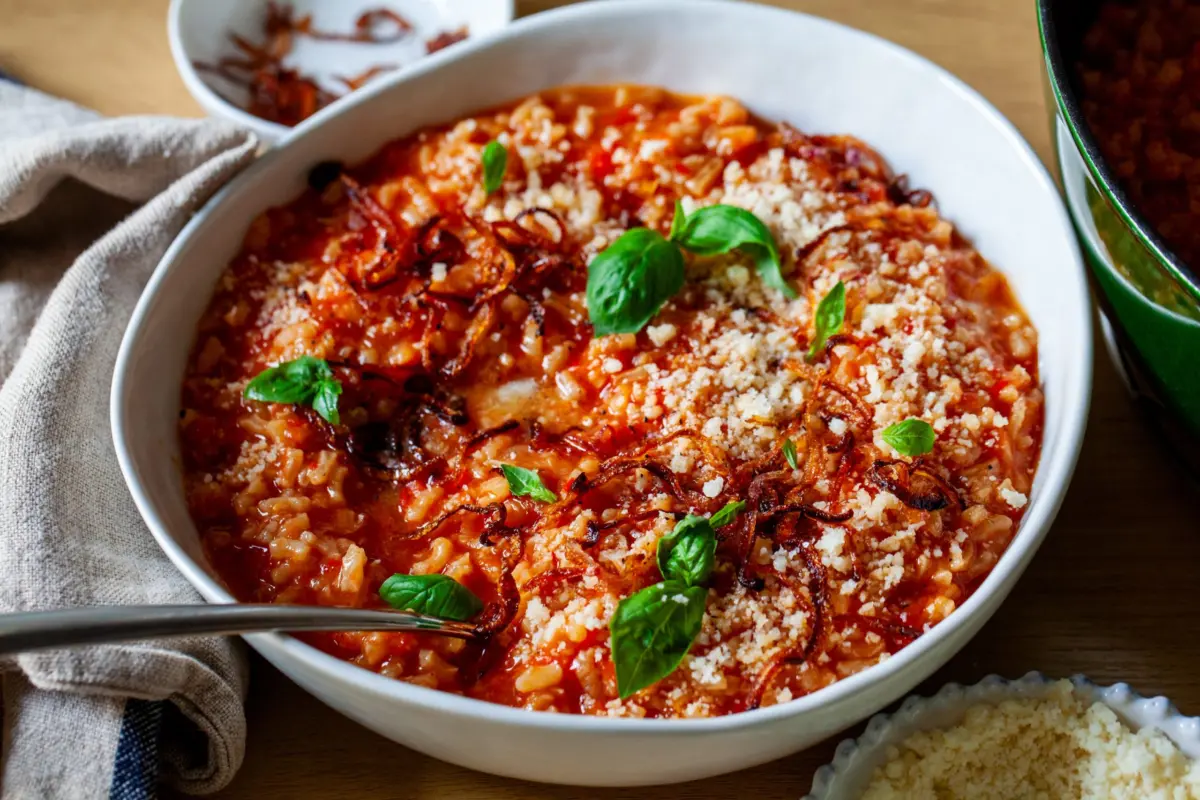
To elevate the dish without resorting to heavy or conventional garnishes, cooks can experiment with alternative textures. Rather than leaning on obvious choices like pan-crisped prosciutto, salami, or bacon, a brilliant contrast can be achieved using thinly sliced red onions that are "frizzled" early in the cooking process. By frying the onions until they are deeply golden brown and mostly crisp, half can be folded directly into the baking risotto while the remaining half is reserved to crown the dish upon serving. This technique imparts a remarkable fragrance, unexpected depth, and a gentle balance of flavors to a late-summer meal.

The final presentation can be adapted to personal preference or dietary needs. Finished with a scattering of fresh basil leaves, grated parmesan, and a final knob of butter or a bright drizzle of olive oil, the dish adapts effortlessly. Alternatively, it can be kept entirely vegan by relying solely on olive oil, fresh herbs, and the savory crunch of the frizzled onions. With so much natural flavor locked into the ingredients, the absence of heavy dairy or meat goes completely unnoticed.
Tomato Risotto with Frizzled Red Onions
To prepare the dish, the oven should be preheated to 350 degrees Fahrenheit. The foundation of the risotto begins by halving fresh tomatoes and pressing the cut side firmly against the large holes of a box grater, extracting the flesh and juices into a bowl while reserving and discarding the outer skins. This process should yield roughly two and a half to three cups of fresh tomato pulp.

In a four-quart Dutch oven or a deep, oven-safe saucepan equipped with a tight-fitting lid, three to four tablespoons of olive oil are heated over medium-high heat. Thinly sliced red onion is added to the pan and cooked, stirring frequently, until it softens and eventually transforms into deeply golden brown, mostly crisp pieces, which typically takes eight to ten minutes. Half of these onions are then transferred to a paper towel-lined plate, seasoned with salt, and set aside for later use.
Minced garlic is introduced to the remaining onions in the pan and cooked for approximately one minute, seasoned with salt, freshly ground black pepper, and a pinch or two of red pepper flakes. Uncooked short-grain rice is then added to the pan, gently toasting in the fragrant oil, garlic, and onion mixture for about three minutes. A splash of wine is poured in and cooked down until it completely evaporates, followed immediately by the reserved grated tomato pulp and two cups of water.

The mixture is generously seasoned—often starting with two teaspoons of kosher salt, adjusted to taste, along with ample grinds of black pepper. Once the entire mixture reaches a gentle simmer, the heat is turned off, the lid is secured tightly, and the pot is transferred to the oven. The risotto bakes for twenty-five to thirty minutes until the majority of the liquid is absorbed, though it should retain a slightly watery appearance. Checking the pot halfway through the baking time ensures the liquid is not evaporating too quickly; if the contents look dry, an additional half-cup of water can be added.
Once removed from the oven, the pan is placed on a trivet or cooling rack. Removing the lid and vigorously stirring the mixture for two minutes creates the characteristic creamy, emulsion-like consistency associated with traditional risotto. After a final taste test to adjust salt and pepper levels, two to three tablespoons of butter or high-quality olive oil are stirred in to finish the dish. The risotto is then garnished with the reserved frizzled red onions, freshly torn basil leaves, and grated parmesan before being served immediately while the warmth of late summer still lingers on the table.