
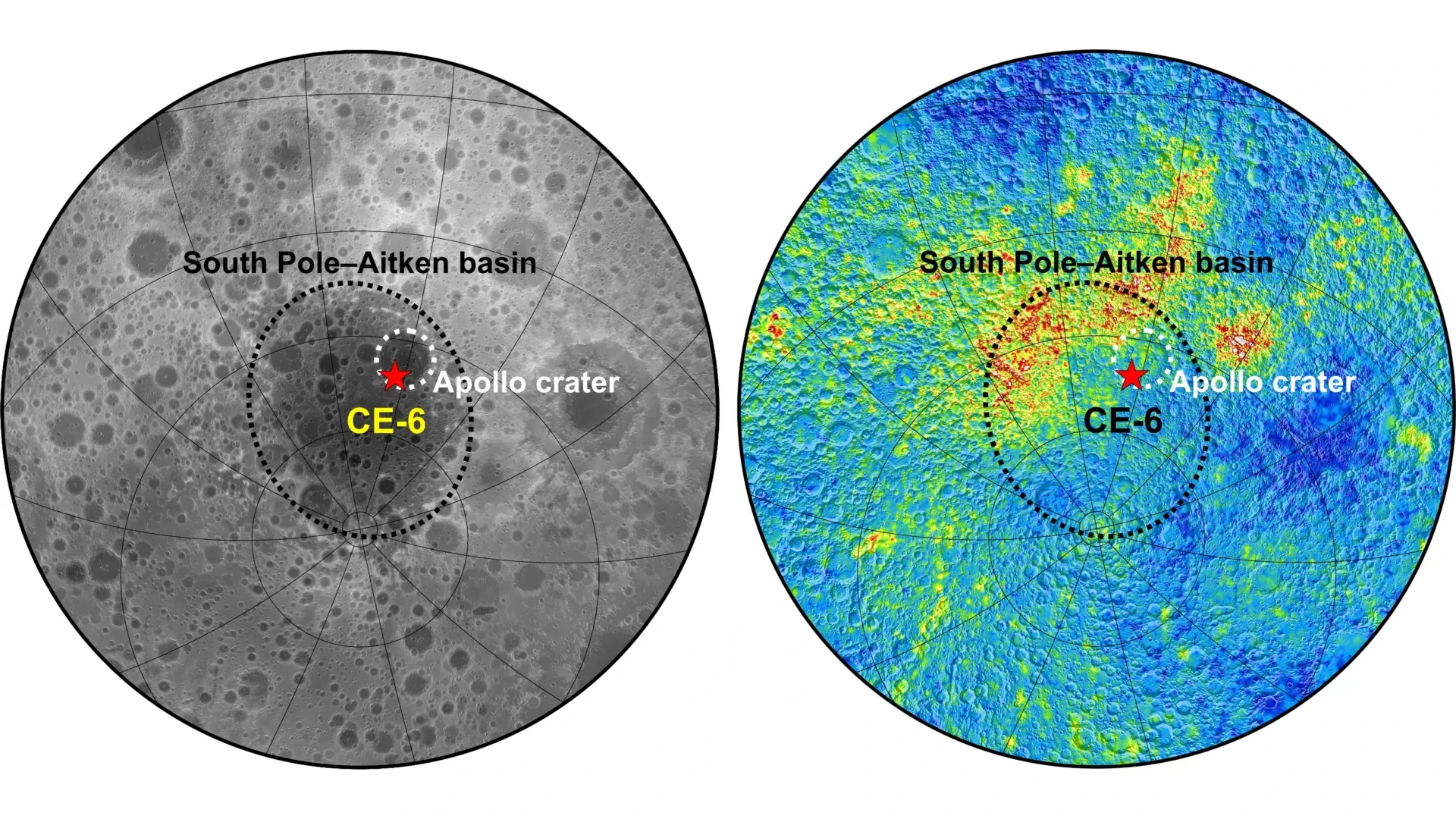
Although the Moon no longer generates a global magnetic field of its own, hidden traces of its long-lost magnetic youth remain permanently locked away inside ancient lunar rocks and soil. By meticulously studying the microscopic magnetic minerals preserved within these extraterrestrial materials, scientists can effectively reconstruct how the lunar magnetic environment evolved, shifted, and eventually faded over vast stretches of geological time.
Now, in a significant step forward for planetary science, researchers analyzing metallic iron encapsulated inside impact glass from the Chang’e-6 lunar soil have successfully identified face-centered cubic γ-Fe for the very first time in natural lunar samples.
This pioneering study was led by Professor Haifeng Du from the High Magnetic Field Laboratory at the Hefei Institutes of Physical Science (HFIPS), operating under the umbrella of the Chinese Academy of Sciences (CAS). The fascinating findings were officially published to the broader scientific community in the Proceedings of the National Academy of Sciences (PNAS) on September 16.
"This tiny magnetic fossil may help us better understand the Moon’s ancient magnetic history," said Dr. Long Li from HFIPS, who served as a key member of the research team investigating the complex properties of the samples.
A Rare Iron Phase Hidden in Lunar Glass
To examine the delicate lunar samples without damaging their microscopic architecture, the research team deployed an advanced array of analytical techniques. These included focused ion beam preparation for precise sample isolation, high-resolution transmission electron microscopy to visualize the internal structures at the atomic level, and comprehensive chemical analysis to determine elemental composition. Together, these sophisticated methods revealed the presence of numerous nanoscale iron particles seamlessly embedded throughout the glassy material retrieved from the lunar surface.
Upon closer, high-magnification examination, the researchers discovered a surprising reality: some of these minute particles actually consisted of face-centered cubic γ-Fe, commonly known as gamma-iron. In fact, to the astonishment of the scientific team, γ-Fe emerged as the dominant form of metallic iron present in the two distinct impact-glass samples subjected to the analysis.
Under normal, terrestrial, and standard thermodynamic conditions, face-centered cubic γ-Fe is inherently unstable and can only exist at remarkably high temperatures. As such materials undergo cooling, the gamma-iron structure typically transforms into another, more stable form known as body-centered cubic alpha-iron, or α-Fe. However, the researchers uncovered compelling evidence suggesting that the extreme, volatile, and highly unusual physical conditions produced by violent meteorite impacts on the Moon may provide the exact mechanism required to allow γ-Fe to survive and persist at the harsh lunar surface.
The research team proposed that several interacting physical and chemical factors could work together to help stabilize this unusual crystal structure. These stabilizing mechanisms potentially include the incorporation of small, trace amounts of carbon and other interstitial elements, the extraordinarily rapid cooling rates characteristic of molten material generated during a high-energy impact event, and the robust physical protection afforded by the surrounding, impervious glassy matrix.
Tiny Particles That Can Preserve Magnetism
Moving beyond basic structural identification, the research team sought to understand the functional implications of these findings by investigating the magnetic characteristics of the materials. They utilized off-axis electron holography, a cutting-edge microscopy technique, to investigate the intricate magnetic behavior of individual γ-Fe nanoparticles in unprecedented detail.
Through these holographic measurements, the scientists discovered that relatively large γ-Fe particles possess the capacity to form a remarkably stable single-vortex magnetic state. Furthermore, experiments demonstrated that these minuscule particles successfully retained a consistent and reliable magnetic response even when they were exposed to an external magnetic field.
That inherent structural and magnetic stability strongly suggests that γ-Fe could act as a previously unrecognized and highly reliable recorder of magnetic information within lunar geological material. By holding onto these signatures, the mineral preserves vital clues about the ambient magnetic conditions, intensities, and directions that existed during the dynamic and formative epochs of the Moon’s past.
A New Window Into the Moon’s Magnetic Past
The identification of face-centered cubic γ-Fe significantly broadens the known variety and complexity of magnetic minerals found within lunar samples returned by exploration missions. Because γ-Fe and the more common α-Fe form under distinctly different thermodynamic conditions and exhibit fundamentally different magnetic behaviors, each mineral could potentially record distinct information originating from separate, successive stages of complex lunar impact events.
As planetary scientists continue to piece together the puzzle of lunar evolution, future research will undoubtedly be required to determine precisely how much these newly identified minerals can reveal. Specifically, researchers hope to decode the exact magnitude of the Moon’s ancient magnetic field, understand the mechanisms that drove its generation, and trace how that field weakened and eventually collapsed over geological time. The Chang’e-6 samples, through discoveries like this, continue to prove their immense value in unlocking the deepest secrets of our nearest celestial neighbor.