
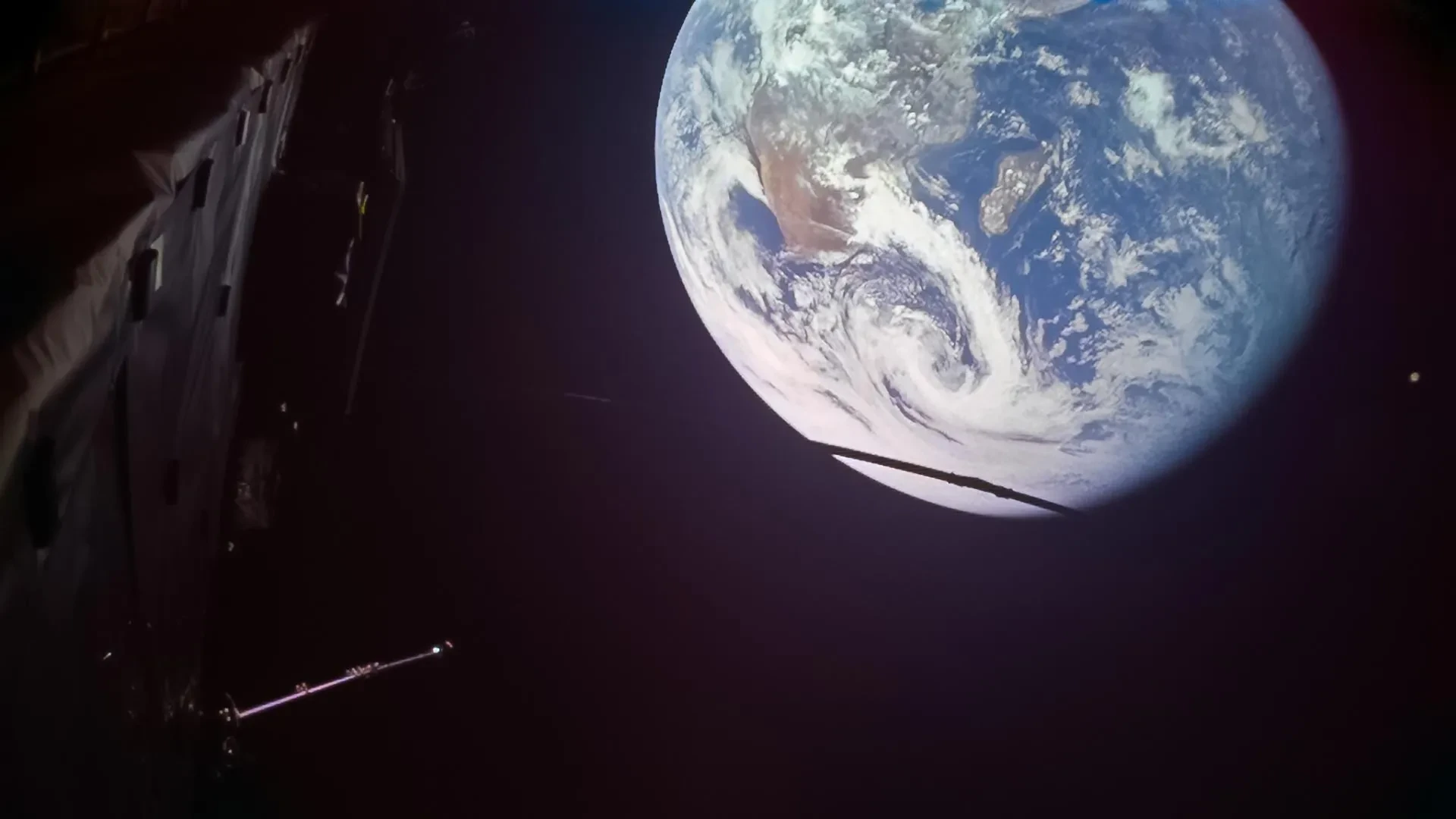
The European Space Agency’s Jupiter Icy Moons Explorer (Juice) successfully executed a critical close pass by Earth, skimming the outer reaches of the atmosphere to harness the planet’s gravitational pull. This carefully orchestrated maneuver reshaped the spacecraft’s trajectory toward the outer Solar System while consuming an absolute minimum of propellant, preserving valuable resources for its eventual arrival at the Jovian system.
The complex gravity assist altered Juice’s direction by 20 degrees relative to its previous trajectory while simultaneously boosting its speed by 3.5 kilometers per second. The flawless execution was the result of months of meticulous planning and real-time navigation by mission controllers. During the four weeks leading up to the encounter, mission teams needed to make only a single small course correction—utilizing just one of the six opportunities originally set aside—to place the spacecraft on the precise approach required to take full advantage of Earth’s gravity.
Mission controllers began monitoring Juice particularly closely on August 17 to ensure every parameter remained within safe margins, an intensive tracking campaign scheduled to continue through October 10.
Juice Makes a Close Pass Over Earth
The spacecraft reached its closest point to Earth at 13:45 CEST (11:45 UTC) on September 28. At that exact moment, Juice passed just 8,640 kilometers above the Indian Ocean, skimming past the planet while simultaneously capturing a sequence of detailed images using its onboard monitoring cameras.
The high-stakes maneuver demanded exceptional precision under real-time operational constraints. According to Angela Dietz, Juice’s Spacecraft Operations Manager, the success of the flyby highlights the dedication and foresight of the engineering teams.
"The flyby required ultra-precise navigation in real time. Thanks to our very careful planning, we used only a small amount of the propellant reserved for this flyby," says Angela Dietz. "यह gives us more to use at Jupiter to carry out observations of the planet’s icy moons."
Preserving that fuel is of paramount importance to the long-term success of the mission. Juice will ultimately rely on its remaining propellant reserves during its ambitious, multi-year scientific campaign in orbit around Jupiter and its massive ocean-bearing satellites.
Earth Becomes a Test Site for Juice
While changing the spacecraft’s trajectory and conserving fuel was the primary engineering purpose of the flyby, the close encounter also provided the mission team with a rare and valuable opportunity to test Juice’s suite of scientific instruments using a real, well-understood planetary target.
This marked the third such operational testing opportunity during the mission so far. The first occurred during Juice’s 2024 lunar-Earth gravity assist, which was subsequently followed by the spacecraft’s targeted observations of Comet 3I/ATLAS in 2025.
To make the most of the brief planetary encounter, teams hailing from the European Space Agency’s spacecraft operations, science operations, and technical centers spent months coordinating with the external scientific groups responsible for Juice’s 10 distinct instruments. Their shared goal was to carefully schedule when each instrument could safely operate, maximizing science return and calibration time without overwhelming the spacecraft’s limited onboard resources.
"Juice’s journey to Jupiter provides only a few opportunities to calibrate and validate the instruments under well-understood environmental conditions," explains Juice project scientist Claire Vallat, who spearheaded the coordination effort.
"Given the limited time available and operational constraints, instrument activities sometimes have to be prioritized, for example when Juice was in Earth’s shadow this morning, and relying on battery power alone. During this flyby, calibration activities were prioritized based on their relevance to preparing the instruments for their work at Jupiter, and also considering whether an opportunity is unique or can be scheduled later in the journey."
Preparing for Jupiter’s Icy Moons
Although navigating the Earth encounter required extensive preparation, international collaboration, and real-time adjustments, mission planners view it as relatively simple compared to the operational complexities that await Juice once it reaches the Jovian system. The spacecraft is scheduled to carry out a demanding series of 35 flybys of the giant planet’s three largest and most scientifically intriguing moons: Ganymede, Callisto, and Europa.
Planning for those upcoming planetary and lunar encounters began years in advance. For the planned Europa flybys, preliminary discussions regarding how the specialized instruments will operate commenced approximately a decade ago, and those planning sessions will continue until the spacecraft finally sweeps past the icy moon in the early 2030s.
Consequently, Earth serves as an indispensable rehearsal for the overarching mission. Scientists can use the flyby data to calibrate their instruments, better understand how the delicate hardware behaves once operating in the harsh environment of space—where instruments notoriously function somewhat differently than they do in terrestrial laboratories—and refine the analytical tools that will eventually be used to process raw data from the outer Solar System.
The upcoming encounters with Jupiter’s icy moons will be significantly more scientifically demanding. By the time Juice reaches them, the spacecraft must be fully prepared to capture as much high-quality information as humanly possible during each brief and precious flyby.
Juice Explores Earth’s Magnetic Tail
During its recent terrestrial encounter, the spacecraft also spent several days traveling directly through Earth’s magnetotail, which is the long extension of our planet’s magnetic field that stretches far away from the Sun under the constant pressure of the solar wind.
This unexpected transit offered Juice a unique scientific opportunity to measure magnetic fields and electrically charged particles at a great distance from Earth. Simultaneously, the joint European-Chinese Smile mission was actively observing the northern lights while measuring magnetic fields and energetic particles much closer to the planet.
By combining the concurrent measurements gathered by Juice and Smile, researchers hope to gain a rare observational tool capable of linking activity happening deep within Earth’s distant magnetotail with dynamic events unfolding around the planet’s polar regions.
Mission scientists expect to release initial images and spectra collected by several of Juice’s instruments in the coming weeks, as soon as the telemetry data finishes downlinking to Earth and the respective instrument teams have sufficient time to evaluate the results. Among the most anticipated deliverables are high-resolution images of both Earth and the Moon captured by JANUS, the mission’s primary scientific imaging camera.
Juice Will Return to Earth One More Time
Despite completing this milestone gravity assist, Juice is not finished with its home planet just yet.
In January 2029, the spacecraft is scheduled to return to the vicinity of Earth for a third and final planetary flyby. That upcoming encounter will provide the definitive gravitational push needed to place Juice on its final, immutable trajectory toward an arrival at Jupiter in 2031.
About Juice
The European Space Agency’s Jupiter Icy Moons Explorer, known simply as Juice, represents humankind’s next bold venture into the outer reaches of the Solar System. The mission is designed to conduct comprehensive, detailed observations of the gas giant Jupiter and its three prominent ocean-bearing moons: Ganymede, Callisto, and Europa.
This ambitious scientific endeavor will characterize these icy worlds using a powerful suite of remote sensing, geophysical, and in situ instruments. The primary objective is to discover more about these compelling destinations and evaluate their potential as habitats capable of supporting past or present life.
Furthermore, Juice will monitor Jupiter’s complex magnetic, radiation, and plasma environments in unprecedented depth, alongside examining the intricate interplay between the powerful planet and its surrounding moons. By doing so, the mission will study the broader Jupiter system as a primary archetype for gas giant systems found across the wider Universe.
Juice was successfully launched aboard an Ariane 5 rocket from Europe’s Spaceport in Kourou, French Guiana, in April 2023. The spacecraft is currently undertaking an eight-year cruise phase that utilizes carefully calculated gravity assists from both Earth and Venus to slingshot itself outward toward the Jovian system. Once it arrives, Juice will execute 35 close flybys of the three large moons while orbiting Jupiter, before eventually executing a major orbital insertion maneuver to settle into a dedicated orbit around Ganymede.