

The value of the S&P 500 index of stocks—where millions of individuals hold a significant portion of their retirement savings through index funds—has surged by approximately fifty-seven percent in just the past two years. Looking slightly further back, the index has more than doubled over the past five years.
This rapid expansion means that on a net worth basis, many investors who felt they were only halfway to retirement as recently as the COVID-19 era may have suddenly surpassed their financial goals. Meanwhile, those who achieved financial independence and retired long before the pandemic find themselves eyeing expensive properties or engaging in other luxury expenditures as their portfolios swell.
Yet, this unprecedented trajectory raises a fundamental question for savers and retirees alike: Is this financial growth real, or is it a bubble and a financial illusion?

The driving force behind this market acceleration is the widespread hype surrounding Artificial Intelligence, leading many investors to question whether the market is uniquely vulnerable to a severe crash and how that might impact long-term retirement security. To address these concerns, it is necessary to examine the foundational mechanics of the modern stock market by returning to the core definition of what a stock actually represents.
At its core, owning a stock is simply a more convenient, corporate version of owning a rental house. When an investor purchases a rental property, their primary entitlement is the collection of rent. After covering all maintenance and operational expenses, the remaining capital constitutes the profit. If the average sale price of rental houses within a specific region increases dramatically while tenants continue to pay the exact same monthly rent, that appreciation looks impressive on paper, but it yields no immediate economic benefit unless the property is sold. Furthermore, selling the house simply means the investor would have to turn around and pay an equally inflated price to acquire another rental property.
An investor’s actual income remains unchanged unless they can make the rental business more inherently profitable. This requires physical improvements, such as adding a basement apartment, executing renovations, streamlining expenses, or implementing operational changes to increase net earnings. When that property is eventually sold to another investor, the purchase price should ideally be anchored to that future stream of income.

For instance, if a property generates $2,000 per month—totaling $24,000 annually—and sells for $240,000, the buyer is acquiring a business with a price-to-earnings ratio of 10. However, if a seller convinces a buyer to hand over $480,000 for that exact same property, the transaction occurs at a price-to-earnings ratio of 20. While this is advantageous for the seller, it presents a much tighter margin for the incoming investor.
Translating this principle to the broader stock market reveals a striking parallel. An investor who placed $100,000 into the market in 2019 and continuously reinvested dividends would see that portfolio grow to approximately $256,960 today, representing a 157 percent gain on the original principal. However, over that exact same timeframe, the underlying share of company earnings generated by that $100,000 basket of equities has only risen from $5,290 to $7,540, a modest 42 percent gain. Consequently, the overall price-to-earnings ratio of the market has climbed from roughly 20 to approximately 30.
Current stock market participants find themselves in the exact position of rental property investors who discover that housing prices have doubled while rental income has remained largely stagnant. This dynamic diminishes the relative profitability of the underlying business assets, suggesting that investors should anticipate lower future returns as a percentage of their total portfolio value compared to periods when equities were valued more modestly. While owning stocks or real estate remains profitable over the long term, purchasing these assets at elevated price-to-earnings ratios naturally curtails future income yields.

The Role of Rising Earnings and the Magnificent Seven
A crucial variable in this equation is the trajectory of corporate earnings. An investor might consider purchasing a rental property that appears overpriced relative to current rental rates, but proceed anyway with the knowledge that a major corporate headquarters is slated for construction nearby, promising a rapid surge in future rental demand. In such scenarios, paying a premium for anticipated future earnings is a rational calculation.
This forward-looking expectation explains why individual company stock prices climb upon positive corporate announcements. During the COVID-19 pandemic, consumer demand for home exercise equipment surged, prompting investors to extrapolate a temporary lifestyle shift into permanent corporate growth, which temporarily drove companies like Peloton to towering valuations. Once normalcy returned and sales leveled off, share prices adjusted accordingly.
When the entire stock market experiences a broad elevation in price, however, it raises the question of whether the aggregate economy is poised for accelerated expansion. In the context of the current market rally, the broader economy is not the sole driver. A detailed examination of the S&P 500 reveals that approximately three-quarters of the recent market gains originated from just seven major technology firms: Apple, Nvidia, Microsoft, Amazon, Google, Meta, and Tesla.
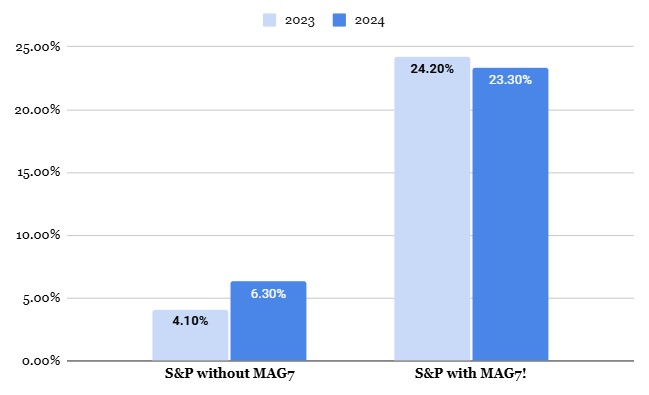
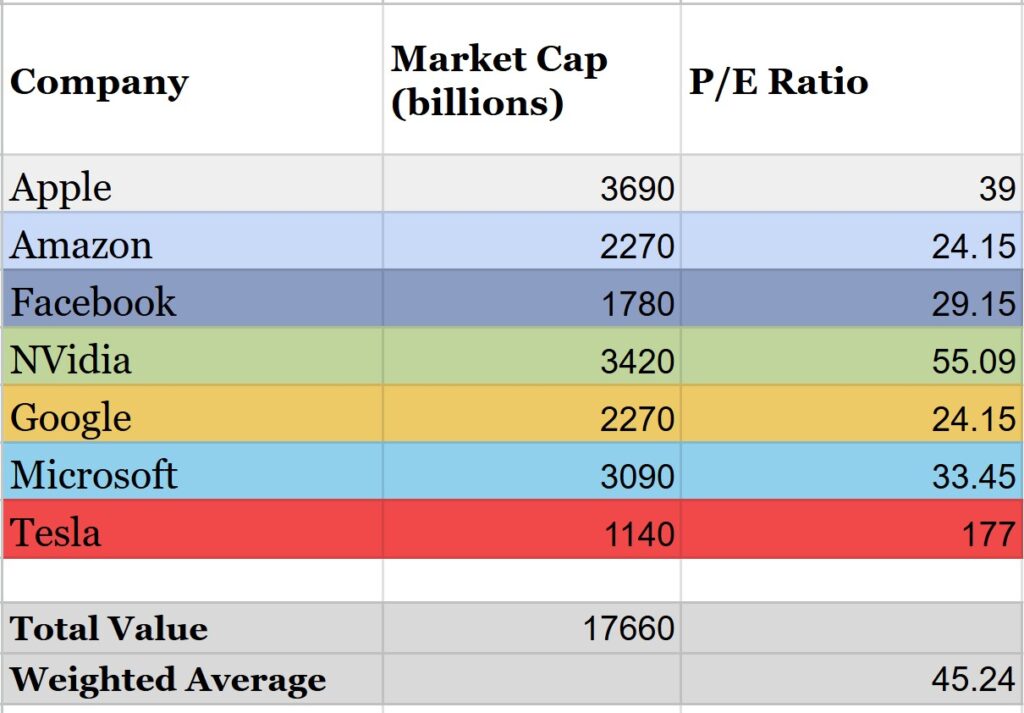
Often referred to as the Magnificent Seven, these highly profitable technology giants have captured the imagination of investors betting on sustained technological dominance. Collectively, these corporations account for more than 25 percent of the entire market’s capitalization—representing an astounding $17.66 trillion—and trade at significantly higher price-to-earnings ratios, averaging around 45. Excluding these seven dominant firms and analyzing the remaining 493 companies in the index yields a more moderate, though still elevated, price-to-earnings ratio of 20. This divergence indicates that while investors anticipate a reasonably healthy baseline economy, they are pricing in exceptionally rapid growth specifically for the tech sector.
Artificial Intelligence and the Infrastructure Boom
The unifying catalyst behind the recent ascent of mega-cap technology stocks is the rapid advancement of artificial intelligence. Recent breakthroughs have demonstrated that software can display advanced reasoning capabilities across an expanding array of disciplines, igniting widespread commercial enthusiasm.
Six of the Magnificent Seven companies are currently committing hundreds of billions of dollars to construct massive infrastructure projects housing advanced supercomputers. Meanwhile, the seventh company, Nvidia, captures a substantial share of those capital expenditures by manufacturing the specialized processors required to fuel this computational expansion, allowing the firm to command high margins amid relentless demand.
This infrastructure buildout represents the primary tier of the current boom. Beyond the foundational hardware, industries across the global economy are increasingly integrating AI tools in anticipation of a transformative leap in operational productivity and profitability. Businesses can now process extensive legal documents, analyze complex computer code, design pharmaceuticals, and pilot autonomous systems with unprecedented efficiency.
The underlying premise driving market valuations is that humanity is approaching an era where intelligent automation can augment or replace finite human labor and specialized expertise, which have historically served as primary constraints on economic output. While industry observers note that the timeline for these technological promises remains fluid, the capital markets are aggressively pricing in these future efficiencies today.
Nevertheless, uncertainties persist regarding whether corporate profits will ultimately materialize at the projected scales. Potential variables include rising operational costs, regulatory hurdles, intense industry competition, or broader macroeconomic disruptions resulting from workforce shifts.

Historical Perspectives and Long-Term Strategies
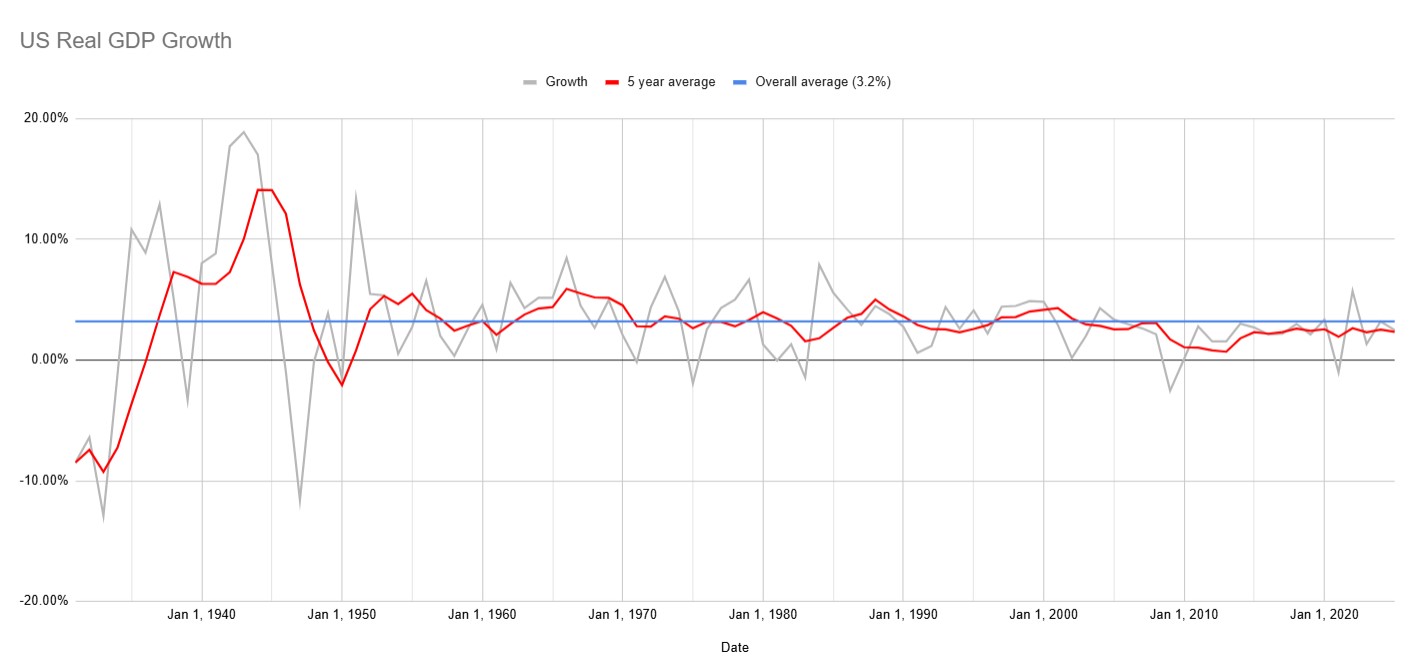
While the future remains inherently unpredictable, historical economic indicators offer a steady baseline. Over successive decades, U.S. economic growth has maintained a remarkably consistent average of roughly 3 percent annually after adjusting for inflation. Interestingly, recent decades have actually recorded slightly slower-than-average growth, providing additional context regarding current equity valuations.
For long-term investors, owning stocks remains a viable strategy, though future returns may moderate compared to historical periods characterized by lower market valuations. Attempting to time the market by liquidating portfolios to repurchase assets during a predicted downturn historically proves counterproductive. Even if valuations eventually normalize toward historical averages, continuous economic growth and rising corporate earnings typically support a sustainable upward trajectory over extended horizons.
Alternative investment classes offer different risk and reward profiles. Institutional forecasters, such as Vanguard, periodically project that international equities and fixed-income assets may outperform U.S. markets over coming decade-long cycles, pointing to more attractive price-to-earnings ratios overseas—such as international equity funds trading at nearly half the valuation multiples of domestic counterparts. However, domestic markets have historically outperformed these forecasts due to the concentration of technological innovation within the United States.
Other conservative financial strategies, such as paying down high-interest mortgages, present an alternative allocation of capital. While conventional wisdom often favors maintaining a low-interest mortgage while directing excess liquidity into equity markets, rising interest rates have narrowed that gap. Choosing to eliminate mortgage debt functions similarly to securing a guaranteed return equivalent to the mortgage interest rate, offering psychological and financial stability for homeowners who prioritize being debt-free.
Ultimately, navigating the complexities of modern market valuations requires maintaining a long-term perspective, ignoring daily financial news cycles, and adhering to disciplined saving and investing habits. As economic landscapes continue to evolve, the fundamentals of financial independence remain rooted in consistent execution rather than speculation on short-term market movements.