
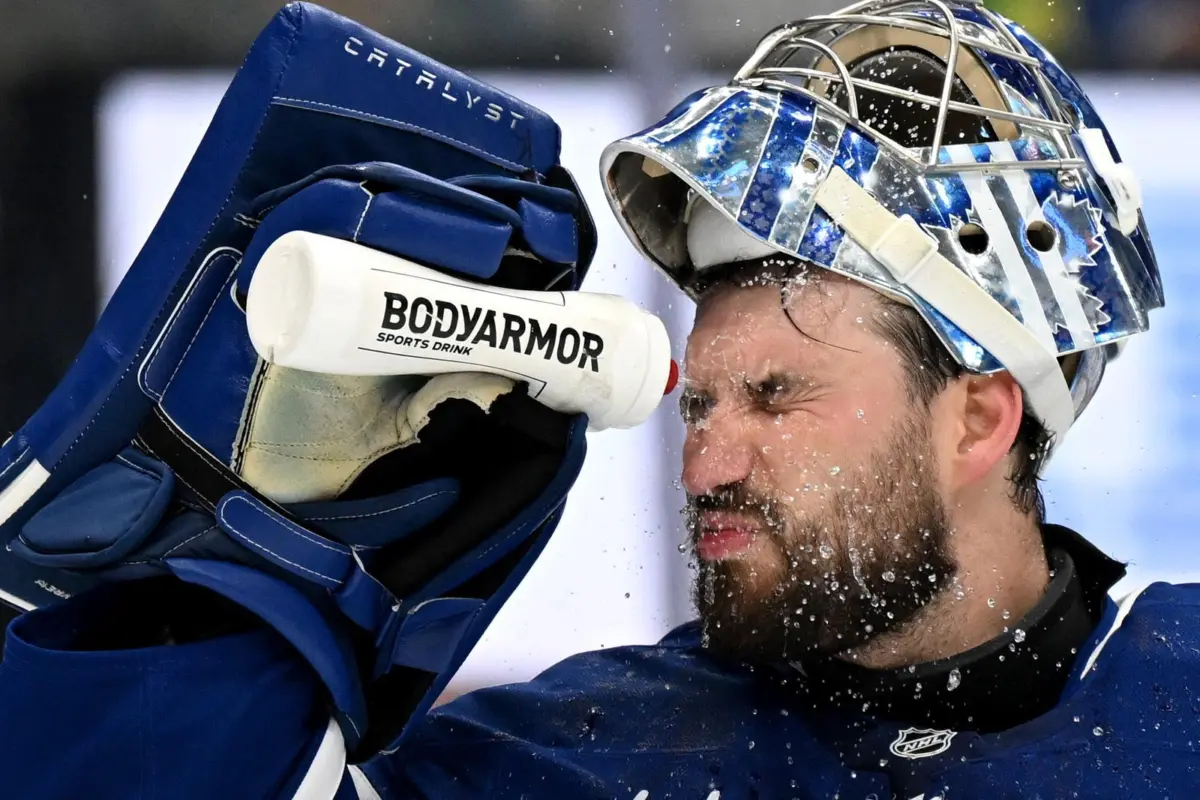
As the Toronto Maple Leafs navigate a testing stretch of their season and attempt to pull out of a concerning losing skid, head coach Jim Hiller has been forced to make difficult personnel decisions. Looking for a spark on Saturday, Hiller turned once again to goaltender Anthony Stolarz, leaving struggling veteran Sergei Bobrovsky on the bench for the second consecutive game.
While Bobrovsky’s ongoing struggles have become glaringly obvious to both the coaching staff and the fan base, Hiller’s decision is far from a simple reactionary benching. There is a calculated strategy behind the move—one designed to protect a high-priced veteran asset while giving the team the best possible chance to snap its current slide against a formidable opponent.
In the middle of the Toronto Maple Leafs’ current skid, one question feels more important than all the others: what is the actual problem with Sergei Bobrovsky?
Considering the 38-year-old netminder has been in the crease for five of Toronto’s past seven losses—surrendering four goals or more in three of those outings—it should not come as a major surprise that Hiller chose to keep Bobrovsky sidelined. Hiller elected to start Anthony Stolarz for Saturday’s matchup against the high-powered Edmonton Oilers, marking the first time this season that the 32-year-old goaltender has earned back-to-back starts.
Several factors likely influenced Hiller’s decision. On one hand, the coach may have felt that Stolarz simply earned the right to face Edmonton again. After all, Stolarz delivered a stellar 30-save performance against the Oilers back on October 24, in what stands as arguably the Maple Leafs’ most complete and impressive team game of the young season.
Beyond that specific matchup, the decision is underscored by a stark contrast in performance. Stolarz has simply been far better than Bobrovsky through the opening weeks of the campaign. In his first eight appearances, Stolarz has posted a respectable .900 save percentage, a 2.90 goals-against average, and a 5-3-0 record, providing steady and reliable minutes whenever called upon.
Contrast those numbers with Bobrovsky’s sub-standard metrics. The veteran goaltender currently holds an .881 save percentage, a 3.47 goals-against average, and a dismal 3-8-2 record. Given that disparity, it is entirely reasonable that Hiller opted to go back to Stolarz for the second straight game against an elite opponent like Edmonton.

However, the coaching staff’s responsibilities extend far beyond the immediate outcome of a single Saturday night game. Part of the daily job description for Hiller and general manager John Chayka involves seeing the bigger picture and managing the mental and physical health of the roster over an 82-game schedule.
Looking ahead, the Maple Leafs face a more manageable segment of their schedule next week, with upcoming games against the Chicago Blackhawks, Los Angeles Kings, and Columbus Blue Jackets. When evaluating how to rebuild Bobrovsky’s confidence, a critical managerial question arises: would you throw a struggling goaltender back into the fire against the stellar, high-octane Oilers, or would you strategically position him to return to the crease against some of the more favorable matchups on the horizon?
To ask that question is essentially to answer it. While a coach naturally wants to ride the hot hand of an in-form goaltender like Stolarz, feeding Bobrovsky to the explosive Edmonton offense in his current state would almost certainly do more harm than good to his psyche. Furthermore, a loss against a powerhouse like the Oilers carries different weight; a defeat in this situation will not stick to Stolarz the way it would compound the mounting pressure on Bobrovsky.
When asked about Bobrovsky’s recent form and struggles prior to Saturday’s game, Hiller offered a measured defense of his veteran netminder. "He’s had some really good games, and he’s had some average games, like every player," Hiller told reporters.
While that statement is technically true from a macro perspective, the granular reality is much harsher. Bobrovsky has managed just five games with a save percentage of .900 or better this season, and more alarmingly, he has allowed at least three goals in 12 of his 13 starts. That level of consistency simply is not good enough for a starting goaltender in the National Hockey League, and Maple Leafs fans, intimately familiar with high expectations, know it all too well.
Consequently, the next time Bobrovsky does get the nod to start, the spotlight will be blinding, and the pressure will be immense. He will face overwhelming expectations to put in a dominant effort that finally justifies the substantial commitment general manager John Chayka made to bring him to Toronto on a contract worth $7 million per season. Right now, nearly a quarter of the way through the schedule, that financial and organizational commitment increasingly feels like a major mistake to a restless fan base.
Bobrovsky arrived in Toronto carrying a storied resume filled with outstanding career achievements, individual accolades, and veteran leadership. Yet, through the early chapters of his tenure with the Maple Leafs, his performance has been far from outstanding. While Hiller’s current deployment strategy may be a calculated attempt to shield Bobrovsky from bearing the brunt of the blame as the primary scapegoat for the team’s broader structural and defensive woes, time is running out. If the veteran goaltender cannot turn his individual game around soon, he will undoubtedly feel the full, unforgiving wrath of Leafs Nation for a long time to come.