
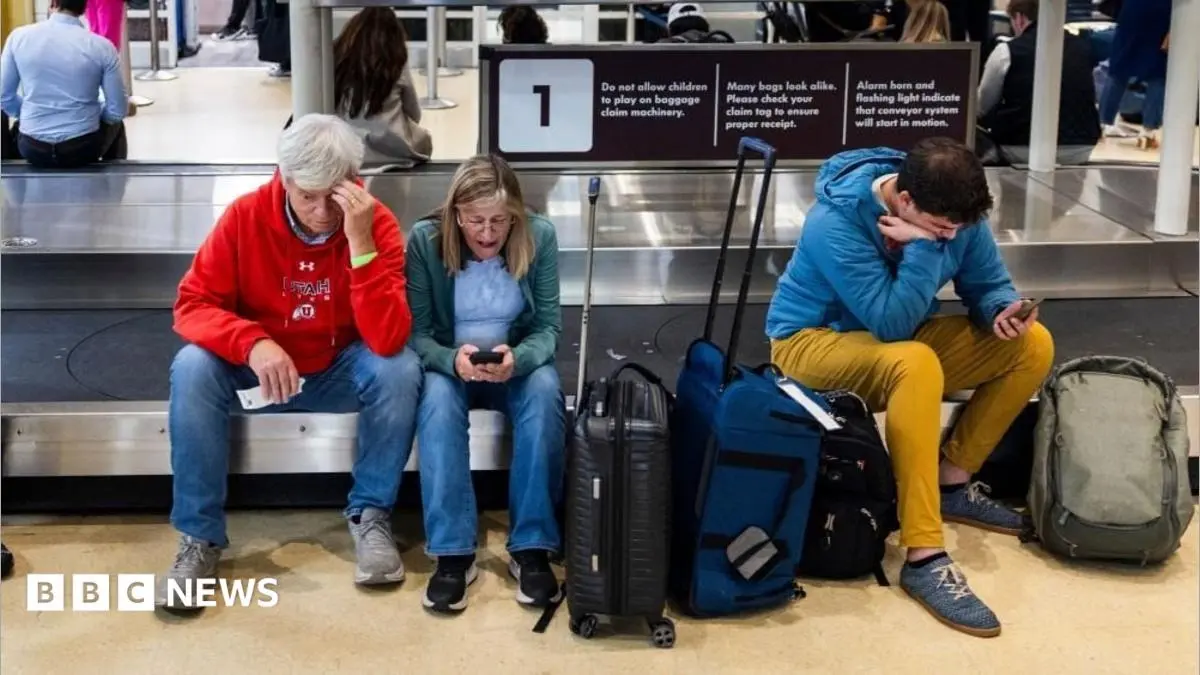
A critical infrastructure failure during a routine telecommunications upgrade led to a nationwide ground stop across the United States, throwing air travel into chaos and shuttering US-bound international departures. The incident, caused by a hardware malfunction during maintenance on the nation’s air traffic control network, represents one of the most severe system-wide operational disruptions to hit the American aviation sector in decades, forcing safety regulators and international aviation bodies to take immediate emergency measures.
The crisis began on a Friday afternoon when government contractor L3Harris was conducting ongoing work to modernize the Federal Aviation Administration’s aviation telecommunications infrastructure. As part of an effort to upgrade aging systems, technicians were replacing legacy copper communications lines with high-speed fiber optics at a remote facility in the United States. During this transition, L3Harris installed a new router—a crucial network hardware component designed to manage and direct data traffic across the air traffic control communications system.
However, the hardware deployment triggered an immediate and catastrophic network failure. According to official accounts provided by Duffy, the newly installed router malfunctioned and began flooding other connected routers across the air traffic control network with an overwhelming surge of data. The rogue piece of equipment flooded the critical system with approximately 1,000 connection attempts every four to five seconds, rapidly overwhelming the underlying network architecture.
The resulting network congestion caused widespread disruption to core operational systems across the country. Bryan Bedford, administrator of the Federal Aviation Administration (FAA), confirmed that 17 out of the nation’s 22 air route traffic control centers suffered severe instability across both voice communications and ground communications channels. With vital data pathways disrupted and communication stability compromised across a vast majority of regional control centers, air traffic controllers faced an unprecedented threat to their ability to safely track and direct aircraft across national airspace.
The response to the emergency was severely hampered by outdated administrative procedures within the aviation authority’s infrastructure. It took federal aviation authorities 45 minutes just to pinpoint the origin of the network flood. The delay occurred because maintenance activities across the national network are still logged manually on physical paper documents. Bedford admitted that in order to trace the source of the malfunction, FAA personnel had to manually pore through paper logs and physical documentation simply to figure out which contractors were working on specific hardware components and where those maintenance operations were taking place.
Faced with severe network instability and unable to immediately isolate the rogue hardware, federal officials took drastic action to prevent potential safety breaches. As a precautionary measure while technicians raced to identify and resolve the underlying cause of the network surge, Bedford stated that the decision was made to ground all flights operating across the national airspace system.
The sudden collapse of essential communications infrastructure has drawn intense scrutiny from aviation experts and industry analysts, who pointed to the incident as evidence of systemic underinvestment in critical national infrastructure. Aviation analyst Miles O’Brien delivered a scathing assessment of the state of the American air traffic system, comparing the complex network to a house that is about to be condemned. O’Brien remarked that the public is witnessing a national system that has been systematically allowed to decay, describing the current aviation infrastructure as being worse than a fixer-upper.
Addressing the scale of the challenge facing federal regulators, Duffy stated that the nation’s air traffic control system requires a complete overhaul, estimating that a comprehensive modernization effort would carry a price tag of $50 billion. In the immediate aftermath of the grounding, Duffy noted that federal authorities would conduct a thorough investigation to determine whether the catastrophic failure was driven by human incompetence or attributable to faulty hardware. Furthermore, he announced that the FAA would undertake a formal re-evaluation of policies that permit major network upgrades and maintenance operations to be executed during peak daytime travel hours.
The timing of the maintenance work drew sharp criticism from national security and transportation safety experts. Juliette Kayyem, who served as US Assistant Secretary of Homeland Security under President Barack Obama, openly questioned why such high-risk network modifications were permitted to take place on a Friday afternoon, historically one of the busiest travel days of the week. Kayyem emphasized that major infrastructure upgrades should not be executed when air traffic controllers are managing maximum operational workloads. She argued that authorities must structure modernizations incrementally to prevent widespread systemic failures, while ensuring robust fail-safe redundancies are operational and ready to step in instantly if a technical upgrade threatens the integrity of active aviation networks.
In response to the growing fallout, contractor L3Harris issued official statements addressing its role in the incident. A spokesperson for L3Harris confirmed that the firm is actively supporting the FAA in its official investigation to understand the precise conditions that led to the November 13 nationwide ground stop. The company reiterated that it is working alongside the FAA to modernize the nation’s airspace communications infrastructure, stressing that L3Harris takes the nationwide ground stop and its widespread impact on travelers, commercial airlines, and air traffic operations with extreme seriousness.
The operational shutdown instantly echoed around the globe, causing immediate disruptions to international flight schedules and transatlantic corridors. Eurocontrol, the European organisation for the safety of air navigation, issued a directive suspending all US-bound air traffic originating from its member states. The suspension affected flight operations across 42 Eurocontrol member nations, a vast geographic region encompassing dozens of European Union states, the United Kingdom, Turkey, Israel, and Morocco.
At international travel hubs across the United Kingdom, passengers faced immediate travel disruptions and warnings of lingering delays. London’s Heathrow Airport saw a series of flight cancellations and delays on US-bound routes as airlines adjusted to the sudden closure of American airspace. However, other major UK transit points experienced varying degrees of impact; Manchester Airport reported that no significant disruption was expected, while flight operations at Gatwick Airport continued to function normally despite the broader international uncertainty.
The disruption extended into the Asia-Pacific region and across neighboring borders in North America. At Sydney Airport, Australia’s largest international gateway, authorities temporarily grounded all flights bound for the United States, though scheduled departures were later expected to resume standard operations as conditions stabilized. Meanwhile, transborder travel between neighboring nations was severely curtailed after Air Canada was forced to cancel multiple flights operating between the United States and Canada.
Historically, severe nationwide stoppages of the US aviation system are extraordinarily rare. The incident represents only the second time since the immediate aftermath of the September 11, 2001 al-Qaeda plane hijackings that a complete nationwide ground stop of this magnitude has been imposed on American civil aviation.
Dr. Guy Gratton, an associate professor of aviation at Cranfield University, noted that while this incident stands as the worst system-wide operational freeze since 9/11, it operated on a fundamentally different scale than the 2001 national security emergency. Gratton compared the recent crash to a major operational outage that occurred in 2023, when a failure in the FAA’s Notice to Air Missions (NOTAM) system forced a temporary nationwide halt to air travel. That 2023 failure, which prevented the publication of essential safety notices to pilots, lasted for one hour and 52 minutes, resulting in approximately 9,500 flight delays and more than 1,300 flight cancellations before safety advisories could be restored.
As the industry recovers from the ground stop, thousands of displaced travelers face complex questions regarding compensation, rebooking, and passenger rights. Under standard regulatory frameworks in the United States, the United Kingdom, and the European Union, air traffic control failures are legally categorized as extraordinary circumstances outside the direct operational control of commercial air carriers. Unlike flight delays caused by aircraft mechanical faults or crew shortages, airlines are not legally required to pay mandatory cash delay compensation to passengers affected by air traffic control outages.
Despite the absence of direct airline delay compensation, passengers maintain key statutory protections under federal and international law. In the United States, consumer rights are governed by the FAA Reauthorization Act of 2024. Under this federal law, if a flight is canceled or experiences a "significant delay"—statutorily defined as a delay of three hours for domestic flights and six hours for international itineraries—airlines are legally obligated to offer passengers alternative travel options or a full refund of their ticket fare if the passenger elects not to fly.
The federal statute establishes strict timelines for processing these refunds, requiring airlines to issue full credit card refunds within seven business days of a formal request, and within 20 days for tickets purchased using other payment methods. However, passengers who accept alternative flight arrangements or rebooked itineraries waive their right to cash refunds. While US federal regulations do not legally mandate that domestic carriers provide free meal vouchers or hotel accommodations during air traffic control outages, individual airlines may choose to offer complimentary assistance to affected customers on a voluntary basis.
Passengers traveling from the United Kingdom to the United States, or those flying on UK-flagged carriers, are granted broader protections under UK passenger rights regulations. Unlike US domestic rules, UK law enforces a strict "duty of care" on airlines when flights are delayed or canceled, regardless of whether the underlying cause stems from weather, extraordinary circumstances, or air traffic control failures.
Under these UK regulations, airlines must provide stranded passengers with assistance, including food, refreshments, and hotel accommodations when overnight stays are required. If an airline is capacity-constrained or unable to arrange this assistance directly during a major crisis, passengers possess the legal right to organize their own necessary care and submit claims for reimbursement later. The UK Civil Aviation Authority explicitly advises affected travelers to retain all physical receipts and to keep expenses reasonable and strictly necessary when seeking post-disruption reimbursement from carriers.