
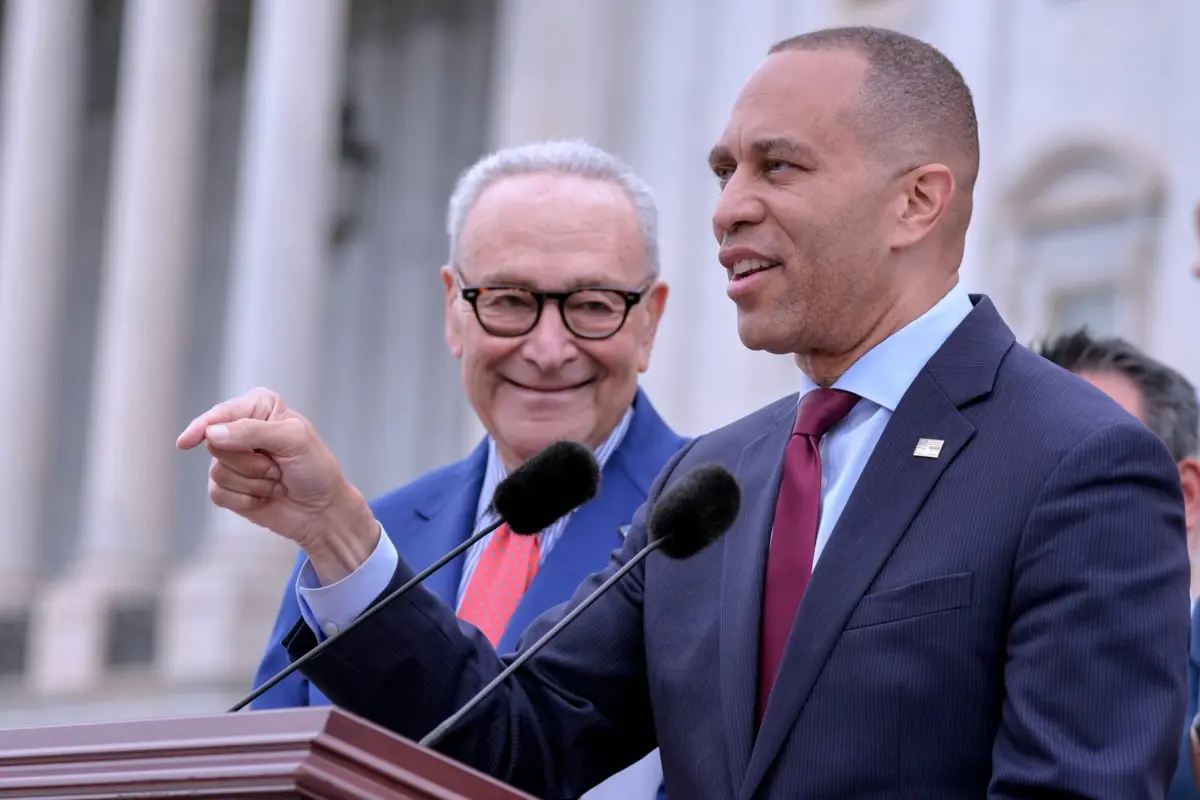
Over a week after riding a historic wave of voter support to reclaim control of the United States Congress, deep internal divisions within the Democratic Party are threatening to derail its newfound political momentum.
Despite mounting calls from progressive factions and reform-minded lawmakers for a sweeping change in congressional leadership, Senate Minority Leader Chuck Schumer and House Minority Leader Hakeem Jeffries appear positioned to hold onto power. As Democrats prepare to take full control of both Capitol Hill chambers in January, the two New York lawmakers are actively securing the votes necessary to lead their respective caucuses, consolidating authority after amassing the party’s largest share of power in Washington since 2009.
However, the prospect of maintaining the status quo at the top of the party apparatus has ignited fierce debate. Schumer, the 75-year-old veteran senator, is seeking to resume his role as Senate Majority Leader—a position he previously held during Joe Biden’s presidency. Across the Capitol, the 56-year-old Jeffries is vying for the Speaker of the House, a historic elevation that would make him the first Black speaker in American history and put him second in the line of presidential succession.
While leadership allies point to the party’s decisive electoral victories as proof of strategic success, critics argue that the midterm election results represent a clear mandate for structural reform and fresh leadership. The emerging clash has exposed long-simmering tensions between institutionalists who favor continuity and insurgents who argue the party must dramatically revamp its priorities to meet the moment.
An Election Victory Buys Political Goodwill
The primary defense of the current leadership rests on a straightforward political reality: winning elections builds strong institutional capital. Supporters of both Schumer and Jeffries argue that replacing the architects of a major electoral victory would be counterproductive and politically illogical.
In the Senate, Schumer’s defenders emphasize his central role in expanding the Democratic majority beyond expectations. Under his leadership, Democrats flipped at least eight Republican-held Senate seats, winning crucial races even in traditionally conservative strongholds. The party is now set to command as many as 56 seats in the upcoming Congress, establishing a robust Senate majority not seen since the opening years of former President Barack Obama’s administration.
Party strategists credit Schumer’s hands-on involvement in candidate recruitment for enabling Democrats to remain competitive in challenging political territory. Key recruits included former Ohio Senator Sherrod Brown and former North Carolina Governor Roy Cooper, both of whom secured significant victories in states where national Democrats have historically struggled.
"When the manager takes you to the World Series, you give him another contract," Democratic Senator Ruben Gallego told reporters on Capitol Hill, standing alongside Schumer. "And this has been a really good election cycle for us."

That sentiment is echoed by veteran political observers and party insiders. Adam Jentleson, a former senior Senate aide and author of Supermajority: How Democrats Can Build Lasting Power, noted that Schumer’s electoral record presents a formidable barrier to any challenger.
"It’s hard to argue with somebody who just oversaw the biggest election the Democrats have had since Watergate," Jentleson said in an interview with public radio station WBUR. "The only people who matter are the members of the Democratic Caucus."
Jentleson explained that incoming and re-elected Democratic lawmakers who directly benefited from party campaign infrastructure and funding have little incentive to oust the leader who helped deliver their seats. Senator Kirsten Gillibrand of New York, who leads the Democratic Senatorial Campaign Committee, similarly pointed to Schumer’s fundraising prowess and recruitment strategy as decisive factors in flipping the chamber.
"That takes vision. It takes clarity of thought. It takes strategic leadership," Gillibrand said.
For his part, Schumer has publicly brushed off doubts about his standing, expressing absolute confidence that he commands the necessary support within his caucus. In an interview with The Washington Sun, he asserted that his position is secure.
"I am going to be elected leader, OK, and we’re united on the issues," Schumer stated. "We’re united."
Schumer Faces a Challenge
Despite Schumer’s public confidence, resistance within the Senate Democratic caucus has formalized into a direct leadership challenge.
Senator Chris Van Hollen of Maryland officially announced he would run against Schumer for Senate Majority Leader, channeling growing frustration among the party’s progressive base and members seeking a more aggressive posture against President Donald Trump.
Van Hollen drew national attention at the start of Trump’s second presidential term when he traveled to El Salvador to intervene on behalf of a constituent, Kilmar Abrego Garcia, who had been deported despite an explicit judicial order barring his removal. A senior Senate Democratic aide cited that trip as a defining contrast between the two candidates, arguing that Van Hollen demonstrated "the fight Schumer just doesn’t have."

Speaking on MSNOW, Van Hollen framed his leadership bid as a response to popular demand for systemic change. "This is not about any one individual, but it is about answering the call of the American people," Van Hollen said, adding that voters sent a clear message to "reject the status quo and to reject business as usual."
Some Senate aides, speaking anonymously to discuss internal caucus discussions, suggested that Van Hollen’s challenge might serve a broader tactical purpose: forcing Schumer to make key organizational concessions, such as agreeing to serve as a temporary "bridge" leader to transition power to a younger generation of lawmakers.
An analysis of caucus support reveals a nuanced picture. Twelve Democratic senators have publicly endorsed Schumer’s bid for Majority Leader, while at least 10 lawmakers—including Vermont Independent Senator Bernie Sanders, who caucuses with Democrats—have indicated they will not support him. However, only about half of those opposing Schumer have explicitly backed Van Hollen, leaving the opposition somewhat divided.
In an interview with The Nation, Sanders emphasized that while he maintains a warm personal relationship with Schumer, the party needs a fundamental shift in direction.
"In this moment in American history, Chuck’s views are way out of touch with where the American people are at—and especially with where [the base of] the Democratic Party is," Sanders said, arguing that leadership decisions should be based on policy vision rather than longevity or personal ties.
Other senators have raised concerns about strategy. Michigan Senator Elissa Slotkin publicly questioned whether Schumer has articulated a clear legislative roadmap for how Democrats will exercise their new majority power. Slotkin went so far as to suggest that senators consider withholding a quorum—the minimum number of members needed to conduct official business—if Schumer runs unopposed, effectively forcing a caucus-wide debate on legislative priorities.
Georgia Senator Raphael Warnock also refrained from offering an endorsement, telling CNN that the party is at an "inflection point" and that any senator stepping forward to offer leadership deserves a fair hearing.
Despite these vocal criticisms, institutional mechanics favor the incumbent. Senate leadership elections are decided by secret ballot, requiring only a simple majority of the Democratic caucus. Furthermore, some party strategists question the wisdom of challenging a winning leader. Tre Easton, vice president for public policy at the Searchlight Institute and former deputy chief of staff to Senator John Fetterman, argued that calls for a leadership overhaul would have made more sense following election losses rather than after a historic victory.
"The job of the leader in each legislative chamber here in the U.S. isn’t to articulate a vision for the party," Easton posted on social media. "It’s to keep each respective caucus together and count votes. Dassit."

Jeffries Navigates a Different Kind of Challenge
While Schumer confronts an active challenger in the Senate, Representative Hakeem Jeffries faces a smoother path toward becoming Speaker of the House, though not entirely free of internal tension.
Unlike Schumer, Jeffries currently faces no formal opponent within the House Democratic Caucus. His standing among moderate Democrats remains exceptionally strong. The New Democrat Coalition, an influential bloc of 142 centrist lawmakers and members-elect, formally endorsed Jeffries for Speaker.
"Hakeem Jeffries is the right person at the right time to lead our party," the coalition said in a public statement. "He’s smart, strategic, and action-oriented, with strong relationships across the Democratic caucus." The group added that it "can’t wait to vote for Hakeem Jeffries to be Speaker of the House on January 3, 2027."
However, Jeffries continues to encounter skepticism from progressives who criticize his cautious approach toward the Trump administration and his long-standing foreign policy positions, particularly regarding Israel.
Representative Pramila Jayapal, former chair of the Congressional Progressive Caucus, indicated she is conditioning her vote on explicit legislative commitments, specifically demanding that Jeffries pledge to advance Medicare for All. At the same time, Jayapal acknowledged the reality of an uncontested race. "You can’t beat somebody with nobody," she told Talking Points Memo, noting that the dynamics could shift if a viable alternative candidate emerged.
Representative Alexandria Ocasio-Cortez of New York similarly pointed to the lack of an opponent when asked by CNN if she supported Jeffries. "The race is unopposed. Yeah," she said, highlighting the pragmatic calculation facing many progressives.
The tension within the House caucus broke into the open following public claims by incoming Democratic Congressman Don Leonard of Ohio. Leonard, an outspoken critic of U.S. military aid to Israel and the ongoing war in Iran, stated in a social media video that he would withhold his vote for Jeffries unless the party committed to specific policy changes.
Leonard further alleged that senior House Democrats warned him that his legislative life in Washington would become a "living hell" and that party leadership would actively sabotage his 2028 re-election campaign if he refused to back Jeffries.
Leonard did not name the specific lawmakers involved, and the allegations remain unverified. When questioned by reporters, House Democratic Caucus Chair Pete Aguilar stated he had no knowledge of any such threats or who Leonard was referring to.

Addressing media inquiries, Jeffries dismissed reports of organized resistance to his speakership bid while acknowledging the inherent accountability of legislative leadership.
"We take nothing for granted, because all of us in the House of Representatives are on a two-year employment contract," Jeffries told reporters. "And we have to continue to make our case both with respect to our track record up until this point, as well as, perhaps even more importantly, our vision for the future."
Post-Election Pressure and Governing Realities
The internal debates will reach a critical juncture in the coming weeks. House Democrats are scheduled to hold their leadership elections on November 18 and 19, while Senate Democrats will vote during an unannounced session in December.
Even if Schumer and Jeffries secure their posts as expected, both leaders will face immense pressure as they take command of Capitol Hill in January. They will be forced to balance the demands of a progressive base eager to confront the Trump administration with the electoral realities of moderate members representing swing states and competitive districts.
Furthermore, governing will present structural challenges. While Democrats will control both chambers, their Senate majority will fall short of the 60-vote threshold required to break a Republican filibuster on major legislation. Passing key policy initiatives will require navigating procedural hurdles and negotiating bipartisan compromises with Senate Republicans.
For now, however, the party’s historic midterm results provide Schumer and Jeffries with a strong foundation to defend their leadership.
Addressing the internal debate directly, Schumer posted a message on X reaffirming his commitment to leading the caucus into the new Congress.
"I welcome any discussion about the future of our caucus and the important work ahead," Schumer wrote. "I’m proud of what we’ve accomplished together—55 seats and counting is an amazing result—and I have the votes to continue serving as Democratic Leader."