
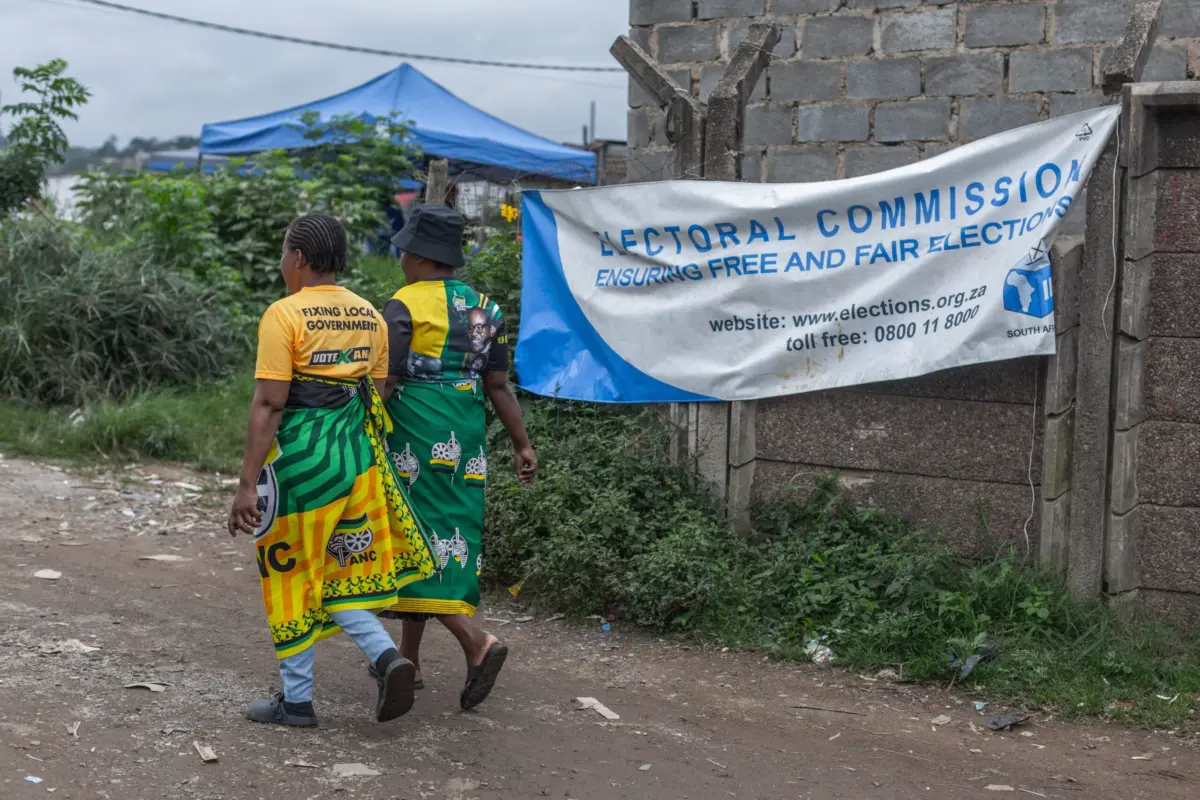
When the long-anticipated implosion of the African National Congress (ANC) finally materialized in South Africa’s 2026 local government elections, the scale of the decline was no less dramatic for having been foreseen. Although the historic liberation movement managed to remain the country’s largest single political party, its share of the popular vote plummeted to an unprecedented low of 32.5 percent. The result effectively reconfigured the ANC into a primarily rural party, where its exercise of governance power is no longer assured and relies almost entirely on complex, precarious coalition arrangements in urban centers.
The electoral shift underscores a profound demographic and social realignment across South Africa. The ANC has effectively transformed into a Black African party almost entirely stripped of minority voters. At the same time, substantial segments of the Black middle class, along with key sections of the Black African rural and working classes, signaled their deep disaffection through direct defection to rival parties or widespread voter abstention.
This political retreat leaves the ANC reliant on coalition partners to maintain any presence in municipal governance across major metropolitan areas and cities. Concurrently, it faces a confident and emboldened white community, which has expressed surprise at the speed with which Black political power could be diluted just three decades after the end of apartheid. Yet, an examination of South Africa’s post-apartheid political history reveals that the seeds of this electoral crisis were planted across three distinct nine-year leadership phases over the past quarter-century.
Nine developing years (1999–2008)
The first major evolution in the post-Mandela era took shape during the nine developing years under President Thabo Mbeki. While Mbeki’s tenure suffered from significant policy failures—most notably his administration’s controversial handling of the devastating HIV/AIDS epidemic—it nevertheless bequeathed substantial economic and fiscal advantages to his political successors.
Under Mbeki’s leadership, South Africa achieved robust economic momentum, recording a gross domestic product (GDP) growth rate of 5.4 percent, while unemployment was brought down to 25 percent. Furthermore, the administration accumulated significant public savings intended to fund ambitious national infrastructure expansion projects.
These economic dividends translated into formidable electoral dominance. In the 2006 local government elections, the ANC secured a commanding 65.7 percent of the popular vote, driven in part by the highest proportion of minority voter support the party would ever achieve.
However, beneath these macroeconomic achievements lay growing ideological tensions. The Mbeki era’s fiscal discipline and market-oriented policies inadvertently sowed the seeds of a left-wing impatience within the party’s broader alliance. Critics within the trade unions and communist faction argued that the benefits of national economic growth were being redistributed far too slowly to the impoverished majority, laying the groundwork for a populist back-lash.
Nine devastating years (2009–2018)
The policy foundations and economic surpluses built during the Mbeki administration were systematically squandered during the nine devastating years of President Jacob Zuma’s tenure, a period marked by steep economic decay and severe electoral damage.
Operating under the rhetoric of "radical economic transformation," the reality of this era was defined by systemic state capture. Multiple judicial inquiries later documented the widespread perversion of public institutions under Zuma’s watch. The Madlanga Commission exposed how key elements of South Africa’s criminal justice system were compromised to shield political allies. The Nugent Commission revealed deep-seated larceny and institutional destruction within the South African Revenue Service.
Meanwhile, the landmark Zondo Commission vividly dramatized how vital state-owned enterprises were converted into private cash cows for corrupt networks at the direct expense of public infrastructure, leading to the decay of critical water, energy, and road networks. To facilitate this systemic looting, highly loyal but demonstrably incompetent individuals were embedded throughout the state bureaucracy. In total, the direct economic cost of state capture during this nine-year period has been estimated at up to 500 billion rand ($30 billion).
The mounting scandals of state capture eventually forced Zuma from office and propelled Cyril Ramaphosa to the political foreground on a swell of public optimism known as "Ramaphoria." Citizens and market analysts alike embraced Ramaphosa as the indispensable midwife of national renewal. Armed with an unprecedented mandate, Ramaphosa’s personal popularity remained remarkably resilient, even enduring the severe economic and administrative disruptions caused by the COVID-19 pandemic lockdowns.
However, the high expectations surrounding Ramaphosa’s presidency gradually faded as his tenure transitioned into its own troubled chapter, sparking widespread concern that his generation of leaders might ultimately act not as the midwives of ANC renewal, but as its undertakers.
Nine dithering years (2018–present)
The term "dithering" has come to define the third nine-year phase of the modern ANC, serving as shorthand for perpetual hesitation, indecision, and executive uncertainty. Throughout this period, even when moral clarity on key policy and legal issues was evident, the administration appeared to lack the political courage to decide or act firmly.
This indecision stemmed from a confusing set of priorities that created an ongoing trade-off: attempting to preserve a fragile, tenuous unity within the ANC base versus seeking the broader approval and trust of the nation. Whereas Zuma governed through deliberate crimes of commission, Ramaphosa’s tenure became defined by damaging acts of omission—defined largely by what he failed or refused to execute.
A primary example of this dynamic involved the judicial accountability of former President Zuma. Following legal rulings that Zuma should serve prison time for contempt of court, Ramaphosa transferred Zuma’s national intelligence chief to the position of commissioner of Correctional Services. This administrative move directly facilitated Zuma’s swift release on medical parole.
Even after South African courts subsequently ruled the medical parole unlawful and recommitted Zuma to prison, Ramaphosa issued a general executive remission order that ensured Zuma spent only two hours of his 15-month sentence behind bars. This reluctance to enforce legal accountability allowed Zuma to organize a powerful political alternative. Zuma’s newly formed uMkhonto weSizwe Party (MKP) capitalized on this weakness, capturing nearly 15 percent of the national vote in 2024 and maintaining almost 10 percent in the 2026 local elections.
Furthermore, the ANC entered the 2026 campaign burdened by unresolved scandals of governance. Party members implicated in severe malfeasance—ranging from the corruption of state enterprises and COVID-19 relief fraud to the misappropriation of government tenders and shadowy intelligence funds—were frequently tolerated or even elevated to senior posts. In practice, the legal shield of "innocent until proven guilty" consistently trumped the party’s internal "step aside" rule, institutionalizing a culture of impunity.
Thirdly, despite being fully aware of the dire condition of municipal service delivery and rising public outrage prior to the 2026 elections, the party failed to enact urgent local governance reforms. Rather than taking decisive measures to rehabilitate municipality management and rebuild citizen trust, top leadership sent damaging public signals during the campaign. President Ramaphosa publicly praised the governance standards of the opposition Democratic Alliance (DA), while the ANC national chairperson candidly remarked that ANC municipal councillors were capable of singing but not governing.
Accompanied by devastating socio-economic indicators—including youth unemployment reaching an alarming 63 percent—the political consequences of these omissions were swift. The ANC’s electoral support experienced a continuous decline, dropping from 57.5 percent in the 2019 national election to 47.5 percent in the 2021 local elections, then to 40.2 percent in the 2024 national election, and finally bottoming out at 32.5 percent in 2026. Along the way, the party was systematically cannibalized by political insurgencies on multiple fronts, including Zuma’s MKP, Julius Malema’s Economic Freedom Fighters (EFF), and a increasingly independent South African Communist Party (SACP).
From renewal to survival?
In the aftermath of the 2026 election, the immediate focus of the ANC’s beleaguered leadership has mirrored past electoral setbacks: fierce internal recriminations—initiated publicly by former President Thabo Mbeki—dismissive denialism centered on the defense that the ANC remains the single largest party, and urgent coalition horse-trading to regain at the negotiating table what was lost at the ballot box.
However, political analysts argue that these short-term political maneuvers must give way to a strategic evaluation of how the party can survive, reform, and eventually re-emerge. This sequence offers the only path to addressing the existential poly-crisis facing the 114-year-old movement—a crisis encompassing interconnected electoral, organizational, ideological, and moral dimensions.
The coalition choices facing the party in its immediate quest to govern carry significant risks:
Following the 2024 national election, the ANC chose the center-right Democratic Alliance as its primary partner. That arrangement allowed the DA to demonstrate performative governance, leverage its business support base, and ultimately further erode the ANC’s urban voting demographic. Replicating that coalition model risks further marginalizing the ANC’s core working-class support. Conversely, forming municipal coalitions with radical left insurgencies risks re-incorporating the very political factions associated with state capture, which could deepen the party’s moral crisis and accelerate its political cannibalization.
Organizationally, the party faces a visible deficit of strategic talent, increasingly relying on defensive political rhetoric to maintain its core base. While calls for the immediate resignation of the current top leadership are growing within party structures, such a drastic move risks turning an electoral implosion into a complete organizational collapse, potentially ending a century-long legacy without a viable path toward internal reform.
This presents a critical leadership dilemma: whether the current executive team has the capacity to acknowledge these systemic governance failures, maintain stability until the party’s planned 2027 elective conference, and establish an empowered transitional leadership framework capable of driving meaningful organizational renewal before South Africa’s next general election in 2029.