
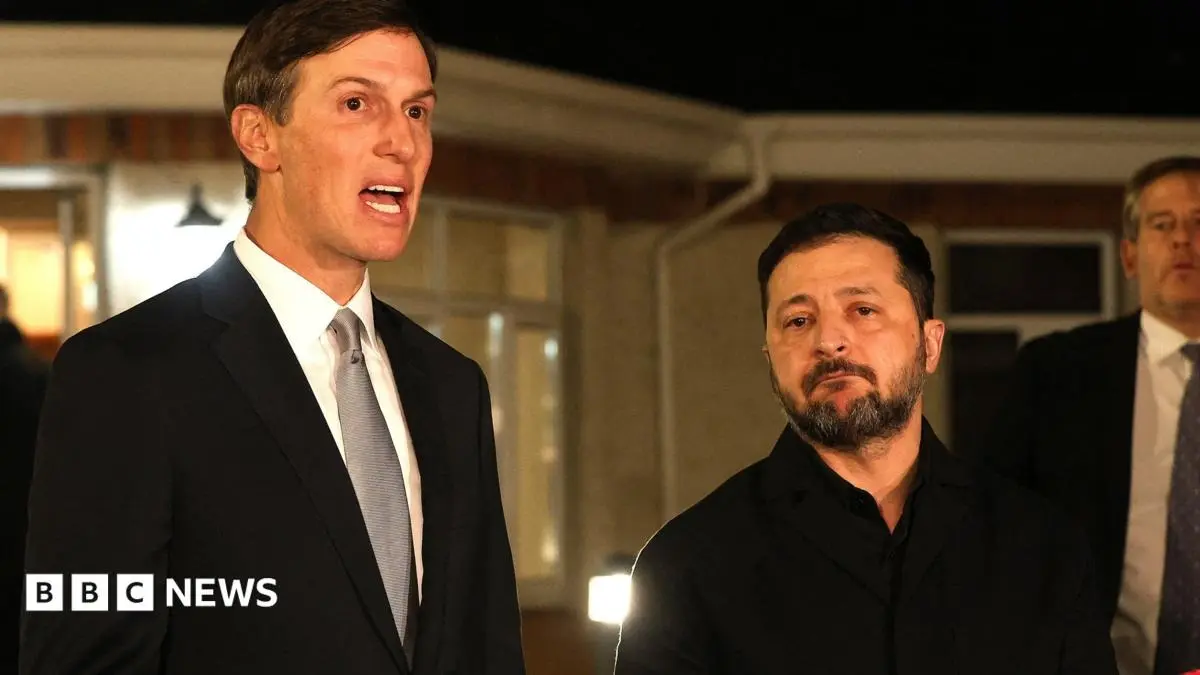
In a dramatic development within international diplomatic efforts to bring an end to the war in Eastern Europe, Ukrainian President Volodymyr Zelensky has revealed that American negotiators raised the possibility of Ukraine withdrawing its remaining military forces from the eastern Donbas region in exchange for full NATO membership. The revelation marks the first time such a trade-off has been directly introduced into official discussions by Washington, signaling a notable shift in the ongoing diplomatic maneuvers orchestrated by envoys representing US President Donald Trump.
The Ukrainian leader disclosed details of the discussion during remarks made on Friday, which were officially released by his office on Saturday. According to Zelensky, the proposition was put forward by US envoys during recent high-level diplomatic engagements aimed at brokering a resolution to the devastating conflict that began when Russia launched its full-scale invasion of Ukraine in February 2022. The potential trade-off touches upon two of the most sensitive and contested issues at the heart of the war: Kyiv’s long-cherished ambition to join the Western military alliance and its unwavering commitment to preserving its territorial integrity.
"The Americans raised a question: ‘What if Ukraine joins Nato? Would Ukraine withdraw from Donbas?’ This was the first time this had been raised," Zelensky said, describing the precise moment the proposal was introduced to Ukrainian officials. For Kyiv, the notion that NATO membership could be on the table represents a significant pivot, as the United States and several other alliance members have historically opposed or stalled Ukraine’s accession, fearing direct confrontation with Moscow. Furthermore, Russia has repeatedly stated that the presence of another NATO member state directly on its border is entirely unacceptable and constitutes a fundamental threat to its national security.
The discussion occurred during an intense round of shuttle diplomacy led by US envoys Jared Kushner and Steve Witkoff. The two American representatives traveled to the Irish capital, Dublin, on Thursday to conduct face-to-face talks with President Zelensky. That meeting followed directly on the heels of a series of high-stakes discussions in Moscow, where Kushner and Witkoff met with Russian President Vladimir Putin to gauge the Kremlin’s appetite for a negotiated settlement. The quick succession of meetings in Moscow and Dublin underscores Washington’s active push to bridge the immense divide separating the two warring nations.
Reflecting on the exchange with the American envoys, Zelensky noted that the inquiry regarding a potential compromise made him believe that "Nato is back on the agenda" in a meaningful way. Securing formal inclusion in the transatlantic security alliance has been a foundational pillar of Ukrainian foreign policy for years, viewed by Kyiv as the only definitive safeguard against future aggression from Moscow. However, despite the potential opening presented by the US negotiators, Zelensky maintained a realistic assessment of the diplomatic landscape, warning that significant obstacles remain. "You have also heard Putin’s signals, and this is an extremely difficult conversation," the Ukrainian president cautioned, pointing to the deeply entrenched positions held by the Kremlin.
While the concept of ceding territory remains deeply fraught in Ukraine, Zelensky outlined the specific conditions under which he would be prepared to put such a peace proposal directly to the Ukrainian public. The president stated that if he received a comprehensive, formal proposal that provided ironclad security guarantees, placed no constraints on the size or capabilities of Ukraine’s armed forces, and guaranteed substantial international funding to rebuild the war-torn country, he would submit the plan to a national referendum. By placing the ultimate decision in the hands of the electorate, Zelensky underscored that any potential concession regarding sovereign territory would require the explicit consent of the Ukrainian people.
The Donbas, an industrial heartland comprising the eastern Donetsk and Luhansk regions, has been the focal point of intense military struggle since 2014 and the principal theater of heavy combat during Russia’s full-scale invasion. At present, Russian forces control the vast majority of the region. Overall, Russia currently occupies roughly a fifth of all Ukrainian territory. While Ukraine retains control over only relatively small portions of the Donbas, ceding these remaining strongholds would carry profound strategic and symbolic significance for Kyiv. Zelensky has consistently maintained that Ukraine is unwilling to surrender its sovereign territory, having previously articulated a vision of liberating all Russian-controlled land across four Ukrainian regions, as well as the Crimean peninsula, which Moscow annexed in 2014.
Despite the US diplomatic initiative, public comments and private signals from President Putin and Kremlin officials indicate that Russia’s overarching position on the war has not shifted. Moscow’s demands regarding territorial concessions and Ukrainian neutrality continue to far exceed anything Kyiv or its public would be prepared to consider. In previous negotiations, Moscow has insisted on severe limits being placed on the overall size and operational capacity of Ukraine’s military forces, alongside sweeping territorial cessions and a constitutionally guaranteed commitment to permanent neutrality as prerequisite conditions for any formal peace agreement.
Ukraine has repeatedly rejected Moscow’s proposed restrictions on its military, arguing forcefully that accepting caps on defense capabilities would leave the nation vulnerable to future Russian aggression. Kyiv maintains that a weakened, neutral military posture would essentially grant Russia the ability to invade again at a time of its choosing without fear of effective resistance. Consequently, Ukrainian officials have insisted that any final settlement must ensure the nation retains a fully capable, unconstrained military force alongside robust external security guarantees to stave off potential future conflict.
Compounding the complexity of the ongoing negotiations, Russia has recently raised the stakes further by reviving security demands originally presented in late 2021, prior to the full-scale invasion. At that time, Moscow demanded that NATO officially halt all further expansion near Russian borders and roll back its military infrastructure and deployments from Central and Eastern European nations that joined the alliance following the dissolution of the Soviet Union. When the United States and its Western allies dismissed those demands in late 2021 as unacceptable infringements on sovereign decision-making, Moscow launched its full-scale invasion of Ukraine just a few months later. By reintroducing these sweeping security demands into current dialogues, Russia is signaling that its geopolitical objective extends beyond Ukrainian territory to a broader restructuring of the European security architecture.
These broader questions of European security were a central topic of discussion during a recent round of talks involving representatives from Ukraine, Russia, and the United States in Abu Dhabi. However, fundamental disagreements over the sequencing of a peace process continue to impede progress. Russia has steadfastly insisted that it will not agree to any temporary pause or permanent cessation of fighting until a final, legally binding peace deal is fully established. Moscow insists that such a comprehensive deal must explicitly resolve all territorial settlements and formalize broad security arrangements simultaneously, rejecting Ukrainian calls for an immediate ceasefire prior to long-term political negotiations.
The recent diplomatic push by US envoys comes against a backdrop of fraught and increasingly complicated relations between Kyiv and Washington. Tensions have mounted over specific military tactics employed by Ukraine, notably long-range strikes against oil processing and storage facilities deep inside Russian territory. US President Donald Trump had specifically requested that Ukraine pause these deep-strike operations, arguing that maintaining Russian diesel production was necessary to facilitate global fuel supplies and ease international energy prices. The disagreement highlighted a growing strategic divergence between Washington’s broader economic considerations and Kyiv’s tactical military objectives.
Following friction over the energy strikes, relations deteriorated further when Zelensky publicly accused US officials of restricting Ukraine’s access to Starlink satellite internet services. The Starlink network serves as a vital operational backbone for the Ukrainian military, providing critical real-time communications used to coordinate defensive operations and battlefield intelligence across the front line. Amid these rising tensions, Trump publicly criticized the Ukrainian leadership, stating that it was "time for Ukraine to get a new president" and calling for immediate fresh elections in the war-torn nation.
The call for new elections touches upon complex legal and political realities within Ukraine. National elections are currently suspended under Ukrainian law while the country remains under martial law, a state of emergency continually renewed since the 2022 invasion. However, Zelensky has previously expressed a willingness to navigate these political hurdles under specific circumstances. The Ukrainian president has stated that he would be prepared to hold national elections within months of a formal peace agreement being secured. Furthermore, Zelensky has indicated that he would be willing to step down from the presidency entirely if doing so would directly facilitate Ukraine’s full accession to NATO, underscoring the vital importance Kyiv places on long-term alliance membership.
As diplomatic talks proceed across multiple international venues—from Dublin and Moscow to Abu Dhabi—the landscape remains fraught with immense strategic challenges. While the proposal raised by US negotiators offers a potential pathway to NATO integration that was previously deemed unattainable, it forces Ukraine to confront the painful prospect of official territorial withdrawals from parts of the Donbas. Meanwhile, Russia’s steadfast refusal to halt military operations without comprehensive territorial and alliance concessions, coupled with its renewed demands regarding NATO’s wider presence in Eastern Europe, underscores the immense distance that remains between the belligerents as the war continues.