
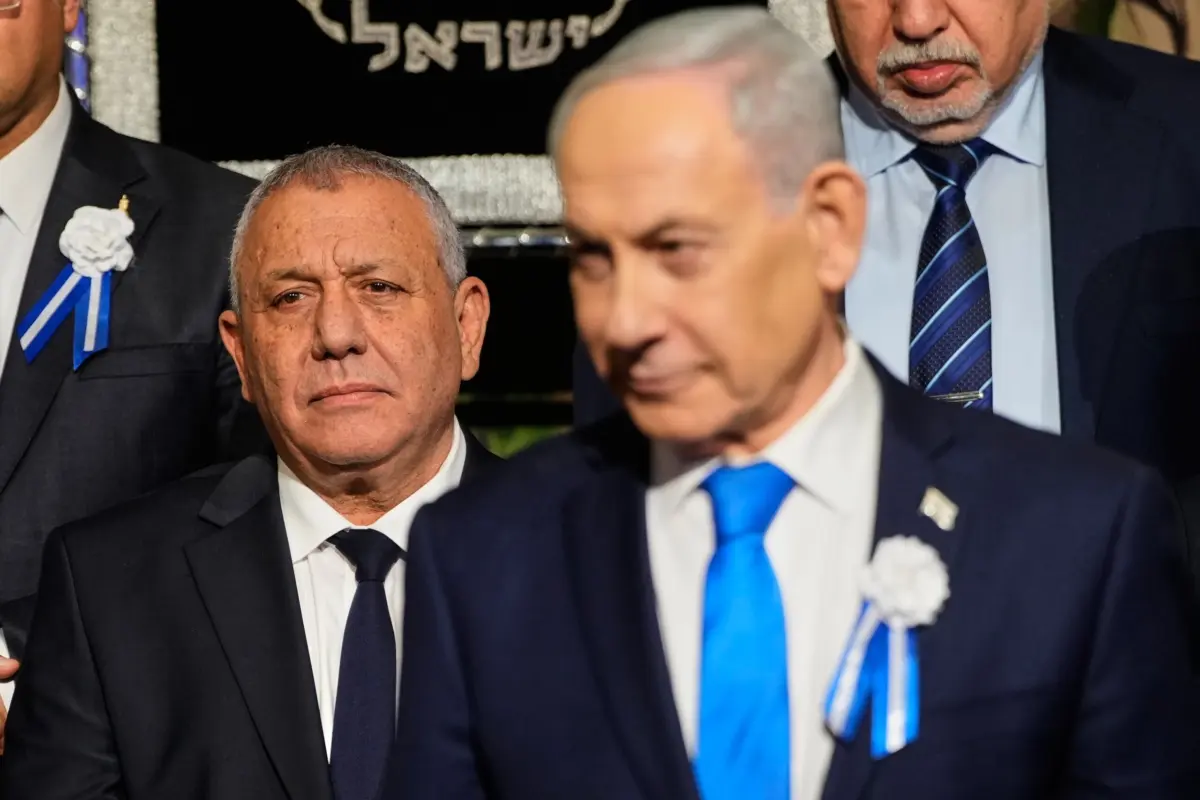
In a sharp escalation of Israel’s post-election political standoff, caretaker Prime Minister Benjamin Netanyahu’s renewed public overture for a national unity government has been swiftly and forcefully rejected by his chief political rival, Gadi Eisenkot. The exchange marks a fiery opening phase in the official effort to construct a viable governing coalition following a deeply divided parliamentary election.
Addressing the nation in a videotaped statement on Saturday, Netanyahu framed a joint administration between his right-wing bloc and Eisenkot’s faction as an urgent, non-negotiable imperative for Israel’s national security. Citing high-stakes geopolitical pressures, the veteran leader argued that only a broad, combined government could adequately safeguard the country against external threats, making specific reference to regional security concerns regarding Iran.
However, within minutes of the video’s release, Eisenkot—a former military chief of staff who has been formally charged by the president with forming the next government—flatly dismissed Netanyahu’s call as a disingenuous public relations tactic designed to undermine ongoing cabinet-building negotiations. Characterizing the move as a transparent maneuver by an outgoing leader seeking to retain power, Eisenkot made clear he had no intention of falling for what he characterized as political gamesmanship.
The public clash underscores the profound division gripping Israeli politics following the inconclusive results of the October 27 national election. With parliamentary deadlines looming and a critical vote to elect the Speaker of the Knesset set for Tuesday, both leaders are locked in an intense battle over legislative control, political legitimacy, and the mathematical reality of forming a stable majority in the 120-seat parliament.
Security Imperatives vs. Political Ploy: The Unity Debate
In his Saturday evening address, Netanyahu sought to elevate the coalition debate above standard party politics, appealing directly to the public on grounds of national defense and existential survival. Reflecting on a face-to-face meeting held between the two leaders on Thursday, the caretaker prime minister declared that the discussion had only deepened his conviction that a unified political front was indispensable.
According to Netanyahu, a broad national unity government represents the only political configuration capable of decisively confronting regional adversaries. He placed particular emphasis on Tehran’s nuclear ambitions, asserting that an undivided government in Jerusalem was required to eliminate the Iranian nuclear threat once and for all. Warning that Iranian leaders would not hesitate to deploy nuclear weapons against Israel if given the opportunity, Netanyahu pressed Eisenkot to abandon preconditions and enter immediate executive negotiations.
"Let’s meet in one room, without preconditions," Netanyahu urged in his video message, presenting himself as ready to negotiate a shared governance agreement for the sake of national stability.
Eisenkot’s reaction to the appeal was swift, uncompromising, and deeply skeptical. Speaking shortly after Netanyahu’s address aired, the former military chief rejected the premise of the prime minister’s public invitation, portraying it as a calculated attempt to bypass the formal negotiation channels already in motion.
Eisenkot pointedly noted that Netanyahu was appealing for talks behind closed doors at the very moment structured coalition dialogue was actively taking place. Emphasizing his view that the prime minister was attempting to mask the reality of the election outcome, Eisenkot declared that Netanyahu was fully aware he had failed to win a mandate to lead.
"Netanyahu is calling for negotiations while they are already underway," Eisenkot stated firmly, dismissing the caretaker leader’s public posturing. "These tricks don’t work on me."
Eisenkot’s refusal to engage with Netanyahu’s video appeal reflects a calculated stance rooted in his newly assigned constitutional mandate, as well as a fundamental distrust of the caretaker prime minister’s strategic motives.
Who Has the Numbers? The Parliamentary Arithmetic
At the heart of the political impasse is the complex and highly fragmented composition of the newly elected Knesset. Neither Netanyahu’s traditional coalition of right-wing and religious parties nor Eisenkot’s alliance secured an outright 61-seat majority in the October 27 vote, leaving both sides dependent on complex legislative maneuvers to secure control of the executive branch.
The official election breakdown established a tightly contested legislature:
- Netanyahu’s Right-Wing and Religious Bloc: 53 seats
- Eisenkot’s Four-Party Bloc: 48 seats
- Arab-Led Parties: 19 seats (a record parliamentary standing)
Despite Netanyahu’s alliance holding a larger single-bloc seat total than Eisenkot’s four-party group, President Isaac Herzog formally entrusted Eisenkot with the primary mandate to assemble a government last week. Herzog’s decision followed statutory consultations with all elected parliamentary factions, during which 67 members of the Knesset explicitly endorsed Eisenkot to lead the next administration. By contrast, Netanyahu received recommendations from only 46 lawmakers.
Crucially, Eisenkot’s decisive endorsement total was made possible by the support of Arab-led political parties, whose 19 lawmakers backed his candidate designation to prevent Netanyahu from retaining the prime ministership.
Under Israeli law, Eisenkot now holds an initial 28-day window to finalize a governing coalition, with the possibility of requesting a 14-day extension from President Herzog if substantial progress is demonstrated. However, translating his 67 parliamentary endorsements into a functioning cabinet presents significant political and structural challenges.
Eisenkot has explicitly ruled out inviting Arab-led parties to serve as executive cabinet ministers in his prospective government. To navigate this constraint, Eisenkot’s team has devised a strategy aimed at establishing a minority "national emergency government."
Under Eisenkot’s proposed framework, his core four-party alliance would rely on its 48 lawmakers to vote in favor of swearing in the new administration, successfully outvoting the 46 lawmakers aligned with Netanyahu’s primary camp. The remaining 26 lawmakers in the Knesset—comprising representatives from the Arab-led factions as well as ultra-Orthodox parties—would abstain during the vote of confidence.
Because Israeli parliamentary procedures permit a government to be sworn in based on a simple majority of votes cast—rather than requiring an absolute majority of 61 lawmakers—the planned abstentions would allow Eisenkot to assume office without establishing a formal coalition with the Arab-led parties or relying on their direct ministerial participation.
Netanyahu and his political allies have fiercely condemned Eisenkot’s minority government plan. The caretaker prime minister has issued stern public warnings against such an arrangement, claiming that an administration dependent on the passive acquiescence or abstention of Arab-led parties would lack basic national legitimacy and inevitably precipitate Israel’s complete political and security "collapse."
Points of Contention: Ideological Fault Lines and Racist Rhetoric
The debate over government formation has extended far beyond seat totals, laying bare profound ideological fractures regarding national identity, political inclusion, and the influence of far-right movements within the state apparatus.
Netanyahu’s vision for a national unity government rests on a coalition composed exclusively of Jewish political parties drawn from the political center and the right, while strictly excluding Arab-led political factions from any role in the nation’s governance. In building the narrative for his proposed coalition, Netanyahu and his right-wing allies have repeatedly attacked the legitimacy of the election results, raising unsubstantiated claims that Arab-led parties "stole" the vote through irregularities.
These claims have provoked sharp condemnation from Eisenkot. In public remarks delivered on Friday, the prime-minister-designate directly confronted Netanyahu’s rhetoric, characterizing the caretaker leader’s sustained political campaign against Palestinian citizens of Israel and their elected representatives as blatantly "racist."
Eisenkot’s strong rebuke underscores the deep personal and political divide between the two leaders, even as both face public pressure to bring stability to a fractured political landscape.
Despite his rigid opposition to Netanyahu’s current political posturing, Eisenkot has not completely shut the door on broad national collaboration. He has indicated a willingness to partner with select elements of Netanyahu’s own Likud party, as well as lawmakers from Bezalel Smotrich’s Religious Zionism faction, provided their stated commitment to national unity proves to be "sincere" rather than tactical.
However, Eisenkot has established an unyielding line regarding far-right political factions. The prime-minister-designate has repeatedly insisted that any government he leads must mark a decisive "break with the extremists." In particular, Eisenkot has ruled out any political alliance, cabinet representation, or governance cooperation with far-right figures and supporters associated with controversial minister Itamar Ben-Gvir.
This firm ideological boundary places Eisenkot at direct odds with Netanyahu’s existing political framework, which relies heavily on the parliamentary support of Ben-Gvir and his far-right base. Eisenkot’s insistence on excluding these elements highlights the fundamental incompatibility between the coalition structures proposed by the two leaders.
The Looming Knesset Speaker Vote: A Critical Test of Power
As political negotiations continue behind closed doors, the immediate battleground between the two rival camps will shift to the floor of the Knesset on Tuesday, when lawmakers convene to elect a new Speaker of the Knesset.
The election of the parliamentary speaker serves as far more than a ceremonial routine; it represents the first binding operational vote of the new legislative term and acts as a definitive test of which bloc controls the working flow of the Knesset. The speaker holds broad procedural power over the legislative schedule, committee assignments, and the timing of votes—authority that could prove decisive in either enabling or delaying Eisenkot’s attempts to present his minority government for approval.
The post is currently held by Amir Ohana, a prominent Likud lawmaker and a steadfast political ally of Netanyahu. Ohana’s continued tenure as speaker provides Netanyahu’s camp with a vital procedural lever to influence parliamentary proceedings and resist opposition initiatives.
In a direct challenge to Netanyahu’s legislative influence, the opposition bloc led by Eisenkot has put forward Matan Kahana, a former military officer and seasoned politician, as their candidate to replace Ohana.
Tuesday’s speaker vote will force every faction in the newly elected Knesset to take a public stance, providing the first clear indication of whether Eisenkot’s fragile alignment of supporters and abstaining factions can hold together under legislative pressure. A victory for Kahana would grant Eisenkot’s camp vital momentum and operational control over the parliamentary agenda as he continues to navigate his 28-day coalition deadline. Conversely, if Ohana retains the speakership, Netanyahu will hold a crucial legislative stronghold from which to disrupt Eisenkot’s path to the premiership.
With negotiations proceeding rapidly and political tempers flaring, the upcoming parliamentary vote stands as a pivotal milestone that will shape the trajectory of Israel’s national leadership in the critical days ahead.