
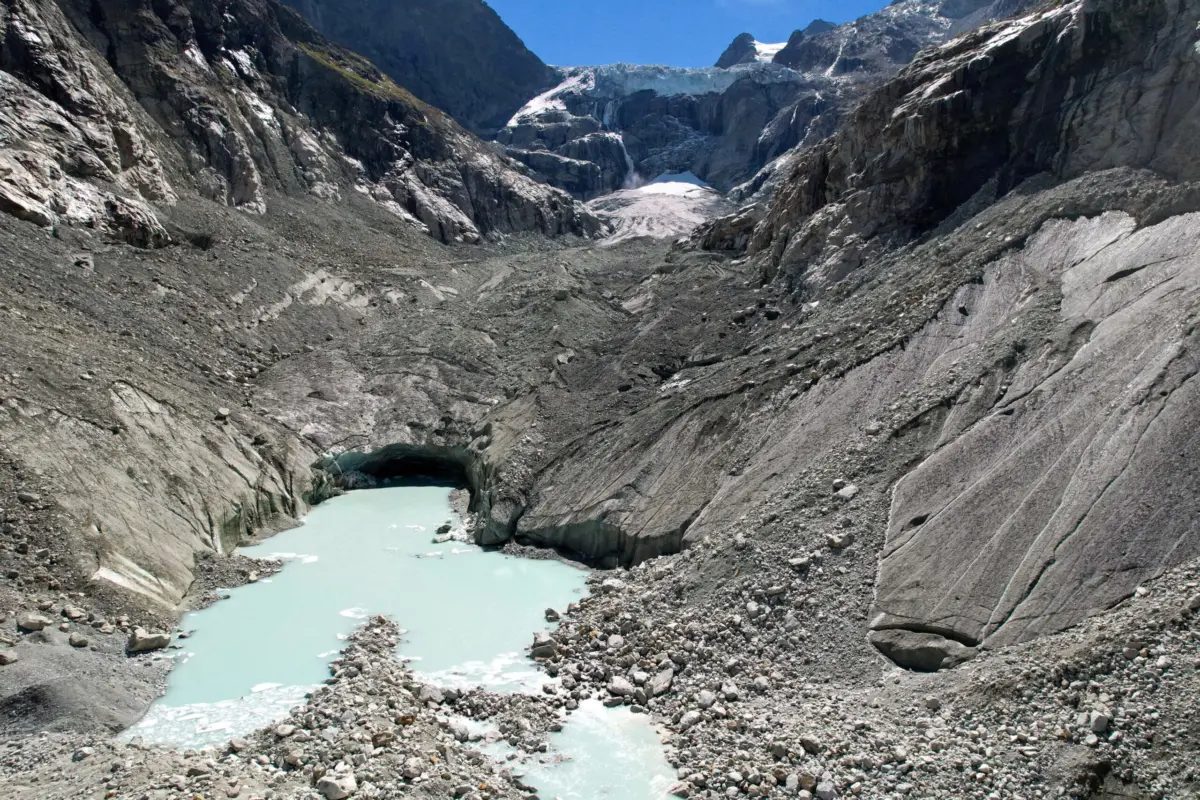
Switzerland’s iconic Alpine glaciers are shrinking at an unprecedented pace, driven by a relentless combination of dry, low-snow winters and record-shattering summer temperatures across Europe. According to an official assessment published by the Swiss Glacier Monitoring Network (GLAMOS) in partnership with the Swiss Commission for Cryosphere Observation of the Swiss Academy of Sciences (SCNAT), the nation has surrendered nearly one-fifth of its total glacial ice volume in a span of just five years.
The report, released following the conclusion of the 2026 hydrologic year on September 30, reveals that Swiss glaciers suffered an aggregate ice loss of 5.5 percent over the preceding twelve months. This extraordinary contraction compounds half a decade of severe retreat, confirming that one of the world’s premier winter sports destinations and a vital European water tower is undergoing a swift physical transformation.
Researchers emphasize that the double blow of meager winter snowfall—which leaves ice masses exposed early in the season—and intense summer thermal stress has pushed even high-altitude glaciers past sustainable boundaries. The rapid retreat threatens not only the country’s multi-billion-dollar tourism sector and regional identity, but also its long-term energy security, freshwater management, and downstream river ecosystems that sustain millions across continental Europe.
What Have Scientists Discovered?
The annual evaluation conducted by GLAMOS relies on direct physical monitoring and empirical field measurements taken across the Swiss Alps. In September 2026, scientific teams conducted field assessments across a representative sample of 23 individual glaciers, measuring the cumulative impact of summer melt against winter snow accumulation.
The stark reality of the crisis was vividly illustrated during field investigations at the Scex Rouge glacier, located in the Western Swiss Alps near Les Diablerets within the Glacier 3000 resort area. Speaking regarding the findings, GLAMOS chief and ETH Zurich glaciologist Matthias Huss described a dramatic reference point set up by researchers earlier in the summer.
In July, the scientific team drilled a four-meter (13-foot) measuring pole deep into the ice of the Scex Rouge glacier to serve as a baseline for tracking ice mass loss. When glaciologists returned to inspect the site in early September, they discovered that three meters (10 feet) of the pole had been exposed above the ice line.
Huss emphasized that this three-meter loss of solid ice occurred during the months of August and September alone, entirely separate from the early-season heatwaves that swept through Europe in June and July. Occurring at an elevation of nearly 3,000 meters (9,843 feet)—an altitude historically cold enough to buffer glaciers against extreme seasonal melt—the loss demonstrates the sheer intensity of modern warming.
"This clearly indicates these conditions that we had this summer, they are just inconsistent with the survival of these small glaciers in the Alps," Huss explained, underscoring that smaller ice masses are increasingly reaching points of complete collapse where year-round ice preservation is no longer physically viable.
Why Are Glaciers in Switzerland Losing Ice?
The underlying mechanisms driving this rapid cryospheric collapse stem from a combination of long-term climatic shifts and acute seasonal anomalies. According to the GLAMOS and SCNAT report, individual glaciers across Switzerland lost between 2.5 and 4 meters of mean ice thickness over the course of the 2026 hydrologic year. The damage was even more pronounced at glacier tongues—the narrow, elongated lower reaches of glaciers extending down valleys—where local ice thickness plummeted by as much as 10 meters over the summer months.
Huss unequivocally linked the catastrophic losses to human-driven climate change, noting that 2026 registered as the hottest summer ever recorded in Swiss meteorological history. The severe summer heat was compounded by winter weather patterns that produced minimal snow accumulation. Under normal conditions, a thick winter snowpack acts as a reflective white blanket, protecting the dense glacial ice beneath from solar radiation well into the summer. Without this protective shield, the underlying ice was exposed to direct heat far earlier in the year.
While GLAMOS monitoring indicates that accelerated melting affected glaciers of all sizes across Switzerland, the physical manifestations vary based on the scale of the ice mass. Smaller glaciers, lacking the massive volume needed to absorb sustained thermal stress, are shrinking at breakneck speed, with several smaller formations disappearing entirely from the landscape. Conversely, larger glaciers retain massive physical footprints and remain imposing features of the High Alps, yet they too are surrendering unprecedented absolute volumes of ice.
The sheer volume of water released during this melting process is staggering. Researchers calculated that between July and September 2026 alone, Swiss glaciers discharged approximately 2.2 trillion liters (581 billion gallons) of meltwater into local streams and rivers. To put this hydrological shift into perspective, the report notes that this single-season runoff exceeds four times the total annual drinking water consumption of every household in Switzerland combined.

What Does This Mean for Switzerland?
The transformation of the Alpine cryosphere carries profound economic, environmental, and infrastructure implications for Switzerland. As a global focal point for winter sports and mountain recreation, the Swiss economy relies heavily on Alpine tourism, a sector that accounts for approximately 4 percent of the nation’s total workforce. The loss of glacial ice directly alters the landscape that attracts millions of visitors annually.
Huss highlighted this visual and cultural shift, noting that the quintessential image of the Swiss Alps is being fundamentally altered as pristine white glaciers retreat to reveal exposed, dark rock and muddy debris. Beyond aesthetics and winter sports infrastructure, the loss of glacial ice directly threatens Switzerland’s broader economic stability, particularly through its impacts on energy production and continental hydrology.
Glacial meltwater is a primary resource used to fill high-altitude storage reservoirs and power hydroelectric facilities, which generate a major share of Switzerland’s clean electricity. Furthermore, Alpine ice fields serve as the headwaters for several of Western Europe’s largest river networks, feeding key waterways that support navigation, agriculture, and industrial cooling across multiple nations.
While the immediate surge in meltwater might temporarily boost streamflows, experts warn that this hydrological windfall is inherently short-lived. Harry Zekollari, a glaciologist and associate research professor in the Department of Water and Climate at Vrije Universiteit Brussel, explained that glaciers act as natural water towers that release stored reserves during hot, dry summer months when rainfall is scarce and water demand peaks.
According to Zekollari, climate warming initially causes a transient surge in summer runoff as ice reserves melt rapidly. However, as the overall volume of the glacier shrinks, the remaining ice mass becomes insufficient to sustain high melt volumes, leading to an inevitable downward trajectory in summer water availability. For the European Alps, Zekollari warned, this critical "peak water" threshold has already passed, meaning that downstream communities and ecosystems must prepare for steadily diminishing summer water contributions in the years ahead.
In addition to long-term water security concerns, the rapid decay of glacial structures increases localized natural hazards, including rockfalls, ice avalanches, and glacial lake outburst floods caused by unstable terrain. Furthermore, because the vast majority of melted Alpine ice ultimately drains into the sea, the disappearance of Swiss glaciers contributes directly to global ocean volume, extending the environmental consequences of Alpine ice loss far beyond the landlocked borders of Switzerland to coastal regions worldwide.
Is There a Solution?
Despite the sobering trajectory outlined in the GLAMOS report, glaciologists emphasize that the long-term outcome for remaining ice masses remains tied to immediate global climate action. According to Zekollari, stabilizing global average temperatures as rapidly as possible is the single most critical factor in preserving the remaining Alpine ice cover.
Scientific modeling for the European Alps and Swiss glaciers reveals two starkly divergent futures depending on global greenhouse gas emissions. Under optimistic climate scenarios where atmospheric emissions are drastically reduced and warming is halted, researchers estimate that approximately one-third of the present Alpine ice mass could be preserved through the end of the century.
Conversely, if greenhouse gas emissions continue at high levels and drive severe warming, current projections indicate that Swiss and Alpine glaciers will suffer near-total devastation, losing more than 90 percent of their volume by the year 2100.
While global ice loss projections vary across different regions—with larger polar and high-mountain glacier systems demonstrating greater resilience than the relatively vulnerable European Alps—emissions trajectories remain the decisive factor worldwide. On a global scale, effective climate mitigation could restrict glacier volume loss to roughly 25 percent by 2100, whereas unmitigated warming could see global glacier losses exceed 50 percent.
Glaciologists stress that because ice masses respond slowly to atmospheric changes, the decisions made today will dictate glacial health for centuries to come. Every fraction of a degree of warming avoided—specifically every 0.1 degree Celsius—holds tangible value in safeguarding the remaining ice of the Swiss Alps and preserving the critical hydrological systems that depend on them.