
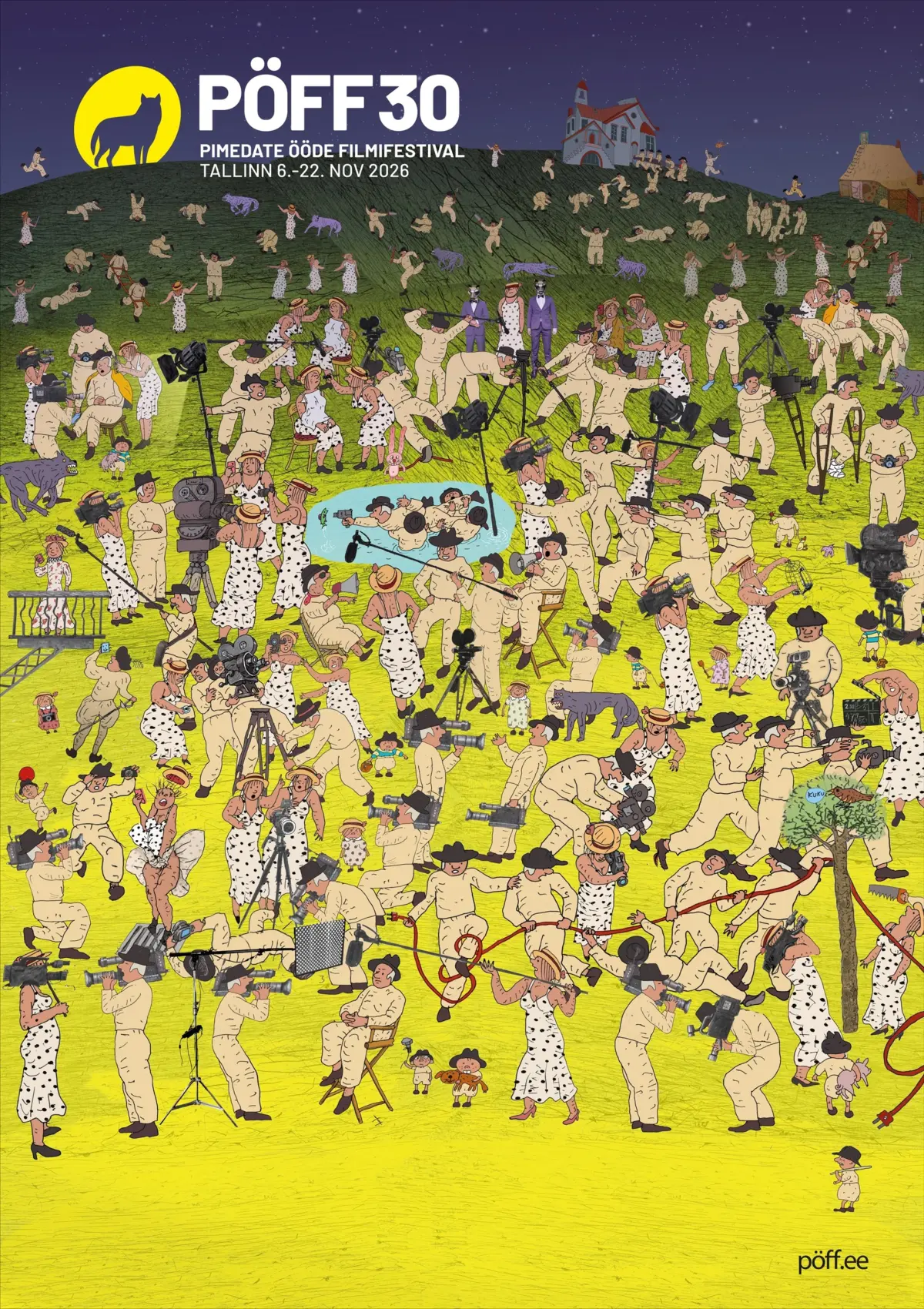
As it prepares to celebrate a major milestone, Estonia’s prestigious Tallinn Black Nights Film Festival (PÖFF) is looking forward to its next decade by breaking with tradition. For the first time in its three-decade history, the festival commissioned a custom, artist-driven visual identity to mark its 30th anniversary, turning to one of Estonia’s most celebrated creative icons to spearhead the milestone project.
The festival, which runs annually in November and has grown into one of Northern Europe’s most significant cinematic gatherings, announced the historic initiative late this summer. Maria Plees, the head of marketing for PÖFF, noted that the organization wanted to enter its upcoming decade with a fresh perspective while actively establishing new creative traditions. To bring this vision to life, the festival team approached legendary Estonian cartoonist and animation filmmaker Priit Pärn, tasking him with drafting the creative concept for the 2026 edition.
Pärn unveiled his striking design on the occasion of his 80th birthday, offering insight into the playful yet deeply cultural inspiration behind the art. When he was approached for the commission, the primary requirement from the festival and its collaborators was absolute originality—a concept entirely distinct from any promotional poster used in the history of the event.
"It did not take me long to decide that it would feature the Kilplased, the foolish yet resourceful folk of Estonian folklore, making a film," Pärn recalled of the creative process.
Explaining the choice, the veteran animator pointed out that these iconic folklore figures had never before promoted a film festival, nor had they ever been documented in the act of making a motion picture. Now, however, they have arrived en masse. Emphasizing the communal spirit of the characters, Pärn remarked that it is an established fact that when a large group of Kilplased sets out to accomplish a task together, failure is completely off the table and success is guaranteed.
The whimsical characters designed by Pärn will extend far beyond a single poster, coming to life across a wide array of advertisements, physical decorations, and visual elements for the landmark 30th edition of PÖFF, which is scheduled to take place from November 6 to 22.
The development of PÖFF’s inaugural visual identity was carried out in close collaboration with the creative agency AD Angels. According to festival organizers, the overarching goal of the initiative is to present audiences with a visually distinctive and artistically ambitious concept year after year, while simultaneously providing a dedicated platform to showcase an accomplished Estonian artist and their body of work. Through this cultural venture, PÖFF aims to celebrate culture on a broader scale, foster a meaningful dialogue between cinema and other artistic mediums, offer local creators fresh professional opportunities, and introduce their art to both domestic and international audiences.
For Pärn, the collaboration represents a natural extension of a lifelong artistic engagement with the Kilplased. The filmmaker has been illustrating the antics of these folklore figures since 1974, when he served as an artist on Rein Raamat’s animated film The Kilplased. Over the decades, his connection to the characters deepened through published works, including the comic books The Kilplased and The Kilplased Go Global, as well as his illustrations for Eno Raud’s book of the same name.
Reflecting on the collaboration and the creative journey behind the poster, Pärn shared deeper insights into the project in an email exchange with industry publication The Hollywood Reporter.

Discussing how he came to be chosen for the historic assignment, Pärn explained that the advertising agency AD Angels—having won the competitive pitch to design the visual style for the festival’s 30th anniversary—approached him directly. To ensure everything went smoothly, he brought his wife and fellow animator, Olga, along to the initial meeting in the playful role of a "security expert," joking that one never quite knows what to expect when dealing with "Angels." Ultimately, the agency proved to be a delightful partner, with Olga even contributing to the final poster as a technical expert.
While the agency had a long roster of leading Estonian artists to choose from, Pärn expressed quiet pride in being approached first, noting that it had not initially crossed his mind that he would be the first filmmaker invited to design a PÖFF poster. He pointed out, however, that his background extends well beyond filmmaking; he began his career as a caricaturist and continues to work as a graphic artist and illustrator who has crafted numerous posters over the years.
Regarding the creative parameters set for the project, Pärn revealed that he received virtually no restrictive guidelines, save for the required proportions and the strict mandate that the work be entirely original. Describing his mental process, he evaluated the traditional markers of a successful poster—a striking design, instant readability from a distance, and a clear, concise message—before deciding to invert those very principles.
"So, what would be the opposite of that? Wallpaper!" Pärn said. "And from there, it was a short leap to the ‘Kilplased,’ the foolish folk of Kilpla. The whole process took about five minutes."
For international audiences unfamiliar with the folklore, Pärn placed the Kilplased within a broader European and global context of satirical storytelling. He explained that many European cultures feature similar archetypes representing villages of foolish or eccentric folk, such as the "Gothamists" of Gotham in England, while noting structural similarities to the trickster figures found in North American Indigenous traditions.
The Estonian Kilplased trace their literary lineage back to the German town of Schilda, where they originated as the "Schildbürger." An Estonian writer, Friedrich Reinhold Kreuzwald, later translated these German tales and published them under his own name, only for another writer, Eno Raud, to subsequently adapt and rewrite the stories for a new generation. Pärn observed wryly that these authors proved themselves to be somewhat cleverer than the folklore characters they wrote about. He added that the most definitively "Estonian" versions of the characters can now be found in his own recent book, Kilplased globaliseeruvad (The Kilplased Go Global), where Estonians lead the way while the Kilplased follow close behind—or perhaps the other way around.
The resulting festival poster is packed with visual activity, and Pärn hopes it evokes a specific emotional response from viewers. Having observed public reactions, he noted that people immediately break into smiles upon seeing the artwork, which confirms to him that the design has struck the right chord.
Describing the aesthetic atmosphere of the poster, Pärn compared its initial visual impact to vibrant wallpaper flashing across a dark November night. He highlighted the glowing yellow tones harmonizing with textile elements, contrasted against black cinema tools that function visually like rhythmic drumbeats, all capped by a narrow strip of a starry night sky—likening the overall impression to a glass of brut champagne illuminated by a flash of lightning on a cold autumn evening.
Upon closer inspection, viewers are drawn into a chaotic flurry of filmmaking activity as the industrious folk attempt to produce a movie about themselves. Pärn suggested that imaginative viewers will easily picture the next logical step: a world where the Kilplased screen a film for an audience of fellow Kilplased, creating a self-contained cinematic universe. True to the egalitarian nature of the characters, the artist noted that no single figure tries to stand out from the rest, with one tiny exception: because it is a movie production after all, a star simply had to be included somewhere in the frame.
When asked whether the Kilplased might ever leap from the poster into their own full-scale film or series adventure on screen, Pärn expressed doubt, despite having a thoroughly original concept in mind. He envisioned a massive screen crowded with hundreds of identical characters—the women looking precisely like one another, and the men matching identically—all frantically busy without any clear purpose or explanation. Describing it as a thriller centered on a battle of wills, Pärn acknowledged the eternal practical hurdle of modern filmmaking: figuring out where the necessary financing would come from. Consequently, he concluded, that particular cinematic adventure is likely destined to remain unrealized.