

The value of the S&P 500 index has climbed approximately 57 percent over the past two years, more than doubling over the past five. For millions of retail investors and retirees who maintain the bulk of their savings in broad-market index funds, this unprecedented run has dramatically reshaped net worth statements. Individuals who felt they were only halfway toward their retirement goals during the pandemic era may suddenly find themselves crossing the finish line much earlier than anticipated. Conversely, long-standing retirees are confronting a different psychological hurdle: watching portfolios swell to heights that spark urges for luxury real estate or other discretionary spending.
This meteoric rise has naturally triggered widespread anxiety across financial forums and inboxes alike. A central question dominates modern personal finance discussions: Is this historic market expansion a reflection of genuine economic strength, or is it a fragile bubble driven by financial illusion and technological hype?
To address these concerns properly, financial analysts suggest examining the fundamental mechanics of what a stock actually represents. At its core, a stock is simply a formalized business arrangement—essentially a more liquid, fractional version of owning a rental property. When an investor purchases a rental house, their primary entitlement is the collection of tenant rent. After covering maintenance, insurance, and operating expenses, the remainder constitutes profit.

If the average market value of rental properties in a specific neighborhood surges while tenants continue paying the exact same monthly rent, the higher valuation looks impressive on paper, but it yields no immediate change in cash flow unless the property is sold. Even then, selling high typically forces the investor to reinvest in another similarly inflated asset. An owner’s actual income remains stagnant unless they actively improve the profitability of the rental business through strategic renovations, expense streamlining, or space optimization.
When that property is eventually transferred to a new buyer, the purchase price should logically be anchored to its projected future income stream. For example, a rental property generating $24,000 annually in net income and selling for $240,000 represents a price-to-earnings ratio of 10. If an enthusiastic buyer offers $480,000 for that exact same property, the transaction occurs at a P/E ratio of 20. While this outcome favors the seller, it signals a significantly diminished return for the incoming buyer.
Translating this economic principle to the broader stock market reveals a striking parallel. An investment of $100,000 placed into the market in 2019 with dividends reinvested would have grown to approximately $256,960 by 2025, marking a 157 percent gain on the original principal. However, over that exact same timeframe, the aggregate share of corporate earnings generated by that basket of equities grew from $5,290 to $7,540—a modest 42 percent increase, according to historical financial analysis data. Consequently, the overall price-to-earnings ratio of the market has expanded from roughly 20 to approximately 30.

Current stock market participants find themselves in the exact position of real estate investors confronting doubled property prices while rental yields lag far behind. While owning equities remains a viable long-term wealth-building strategy, basic mathematical realities dictate that purchasing assets at elevated price-to-earnings multiples will yield lower future returns compared to buying during market downturns.
The Driving Force: The Magnificent Seven and Corporate Earnings
Market valuations can also rise under circumstances where future earnings are projected to expand rapidly. For instance, an investor might willingly pay a premium for a rental property if municipal announcements confirm that a major corporate headquarters will soon be constructed nearby, driving up rental demand and revenue for years to come.
Individual stock prices frequently behave in this manner. During the COVID-19 pandemic, consumer demand for home exercise equipment caused sales for companies like Peloton to surge. Investors briefly treated this temporary lifestyle shift as a permanent structural change, bidding up share prices until economic reality reasserted itself and valuations corrected downward.

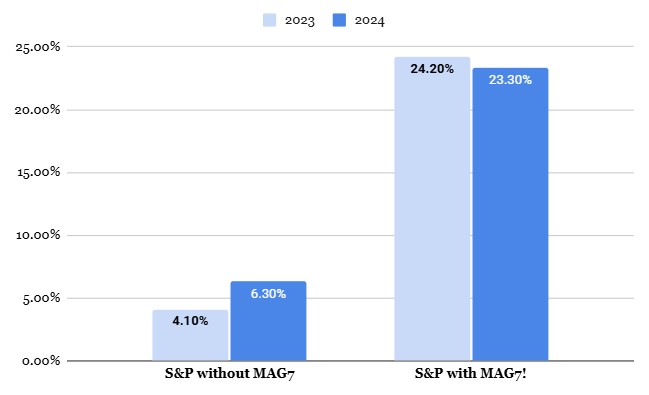
Yet, when an entire market index climbs to record heights, it raises questions about whether the aggregate U.S. economy is projected to accelerate at a matching pace. Data from the S&P 500 indicates that broader economic growth does not entirely account for the current market enthusiasm. Approximately three-quarters of recent index gains trace back to just seven dominant technology corporations: Apple, Nvidia, Microsoft, Amazon, Alphabet, Meta, and Tesla.
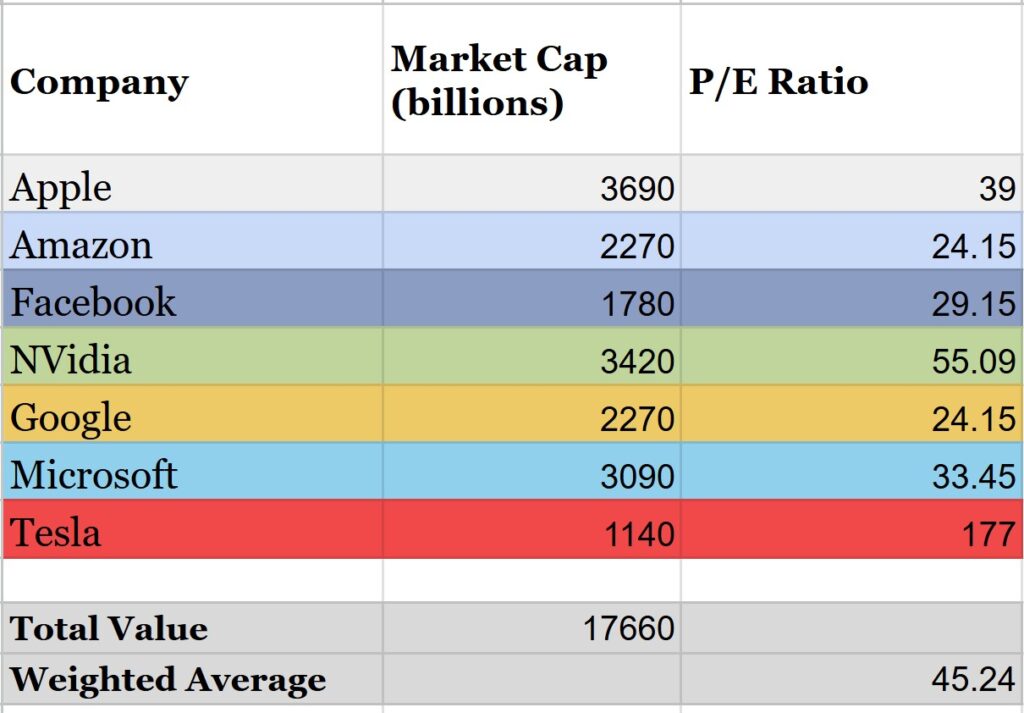
Collectively known as the "Magnificent Seven," these highly profitable firms account for over 25 percent of the total market capitalization—representing roughly $17.66 trillion—and command an average P/E ratio of approximately 45. Excluding these seven heavyweights and analyzing the remaining 493 corporations reveals a more moderate, though still elevated, P/E ratio of 20. This divergence suggests that while investors anticipate a reasonably healthy baseline economy, they are pricing in exceptionally rapid growth projections specifically for major technology leaders.
Artificial Intelligence and the Infrastructure Supercycle
The unifying catalyst behind the recent dominance of mega-cap technology firms is the sudden acceleration of artificial intelligence. Recent breakthroughs have equipped software with advanced reasoning capabilities across numerous sectors, sparking intense corporate investment.
Six of the Magnificent Seven companies are currently committing hundreds of billions of dollars to construct massive server infrastructure projects housing specialized supercomputers. Meanwhile, Nvidia benefits directly from this capital expenditure cycle as the primary manufacturer of the high-performance chips powering these systems.
Beyond foundational infrastructure, corporations across nearly every industry are exploring how AI can drive unprecedented operational productivity. Current capabilities allow systems to analyze extensive legal documents, write and debug complex software code, assist in medical diagnostics, and power autonomous robotics. Proponents argue that humanity is approaching an era where labor and cognitive output are no longer strictly constrained by a finite workforce, potentially unlocking massive corporate profits.
Whether these lofty profit forecasts materialize remains a central debate among economists. Skeptics point to potential risks, including severe cost overruns, intense competitive pressures, regulatory hurdles, and broader socio-economic disruptions stemming from labor market shifts.
Historical Context and Long-Term Outlook
Long-term historical data provides a grounding perspective against short-term market speculation. Over successive decades, real U.S. economic growth adjusted for inflation has hovered around a remarkably consistent average of three percent annually. Notably, recent decades have actually experienced slightly slower-than-average GDP growth, making the current divergence in stock valuations even more pronounced.
Financial professionals emphasize that attempting to time market peaks and valleys remains an unreliable strategy. Even if stock valuations eventually compress toward historical norms, corporate earnings are expected to continue expanding over the long term, supporting sustained portfolio growth even if future returns moderate.
Alternative asset classes offer different risk-reward profiles in the current economic climate. Vanguard’s ten-year annualized return projections suggest that international equities and fixed-income bonds may outperform domestic U.S. stocks over the coming decade. This projection is largely anchored in valuation disparities, noting that international stock funds trade at significantly lower average P/E ratios than their U.S. counterparts. However, forecasters acknowledge that prior international return predictions have consistently lagged behind U.S. markets, largely due to the concentration of technology innovation domestically.

Other investment strategies, such as multi-asset robo-advisor portfolios, seek to capture balanced returns across global equities and bonds while offering automated rebalancing. Meanwhile, institutional figures like Warren Buffett’s Berkshire Hathaway have maintained substantial cash reserves, signaling caution amid limited market bargains and elevated valuation multiples.
For individual homeowners navigating high interest rate environments, balancing mortgage paydown strategies against index fund investing involves both mathematical trade-offs and personal risk tolerance. While historical models often favor maintaining low-rate debt while investing surpluses, guaranteed returns from eliminating high-interest mortgages remain an attractive option for risk-averse savers.
Ultimately, financial commentators continue to advocate for a disciplined, long-term perspective. Rather than reacting to daily market headlines or economic speculation, maintaining consistent investment habits and focusing on non-financial pursuits remains the standard prescription for navigating market cycles.