
In the bustling culinary landscape of Chicago, few figures have been as prolific or as multifaceted as chef and restaurateur Zubair Mohajir. Over the course of his career, Mohajir has helped shape the city’s dining scene through a diverse portfolio of acclaimed concepts, including Lilac Tiger, Mariela, Mirra, Sarima, and his long-running venture, Coach House. Yet, despite his extensive track record of successful openings, his latest project represents a profound departure from anything he has attempted before.
Named simply Muhājir, the restaurant is designed as an exploration of history, heritage, and the complex narratives of global migration. It serves as the centerpiece of Mohajir’s most personal culinary statement to date—one that bridges ancient global trade routes with contemporary, live-fire cooking.
The opening of Muhājir is being featured as part of Now Open, a yearlong editorial series celebrating some of the most exciting restaurant debuts across major metropolitan areas, including Chicago, New York City, and Washington, D.C. The series offers a rare, behind-the-scenes look at the realities of launching a high-profile hospitality concept, culminating in exclusive dining experiences hosted as part of Dinner Party, presented by Capital One. For Mohajir, the journey of bringing Muhājir to life has been an exercise in personal archaeology, historical research, and a long-awaited return to cooking in his own kitchen.
What Did You Want to Explore With Muhājir That You Hadn’t Been Able to Do Yet With Your Previous Restaurants?
For Zubair Mohajir, the inspiration behind his latest venture is deeply rooted in his own family history and linguistic heritage. The restaurant’s name carries a direct personal connection.
"Muhājir is such a personal story for me, because my last name is Mohajir, and the meaning of ‘muhājir’ in Arabic and Urdu is ‘one who migrates,’" Mohajir explains. The historical weight of the term traces back to the partition of India and Pakistan, when displaced Muslim populations moving from India to Pakistan were designated as muhājirs.
Growing up, Mohajir and his family often reflected on the origins of their surname. Before transitioning into the culinary world—a path he pursued after initially working in finance—his late maternal grandfather dedicated significant time to mapping the lineage of the family name. Their research ultimately pointed back to Southern Basra, Iraq, a region historically recognized as a pivotal nexus along ancient global spice routes.
This discovery resonated deeply with Mohajir’s evolving culinary philosophy. For five years at Coach House, he spent time examining ancient recipes from southern Spain and southern Portugal. Those regional cuisines reflect an intricate layering of pre-Crusade Muslim, Christian, and Jewish culinary traditions, further shaped by Southeast Asian traders traversing the Mediterranean, North Africa, and the Iberian Peninsula.
"I’m just obsessed with history, and it started to become very evident for me that I really wanted to feed people, but with the context of where the food came from," Mohajir notes.
At Muhājir, that historical curiosity dictates the entire menu trajectory. The culinary narrative follows the historic spice road running westward from Portugal through the Mediterranean, traversing the Levantine region, extending out of Basra into the Persian Gulf, and ultimately reaching southern India, where Mohajir’s family roots lie. "We’re all muhājirs—you know, all of our families came from somewhere, and that really has been the driving force for me."

Why Did You Decide to Build the Restaurant Around Live Fire?
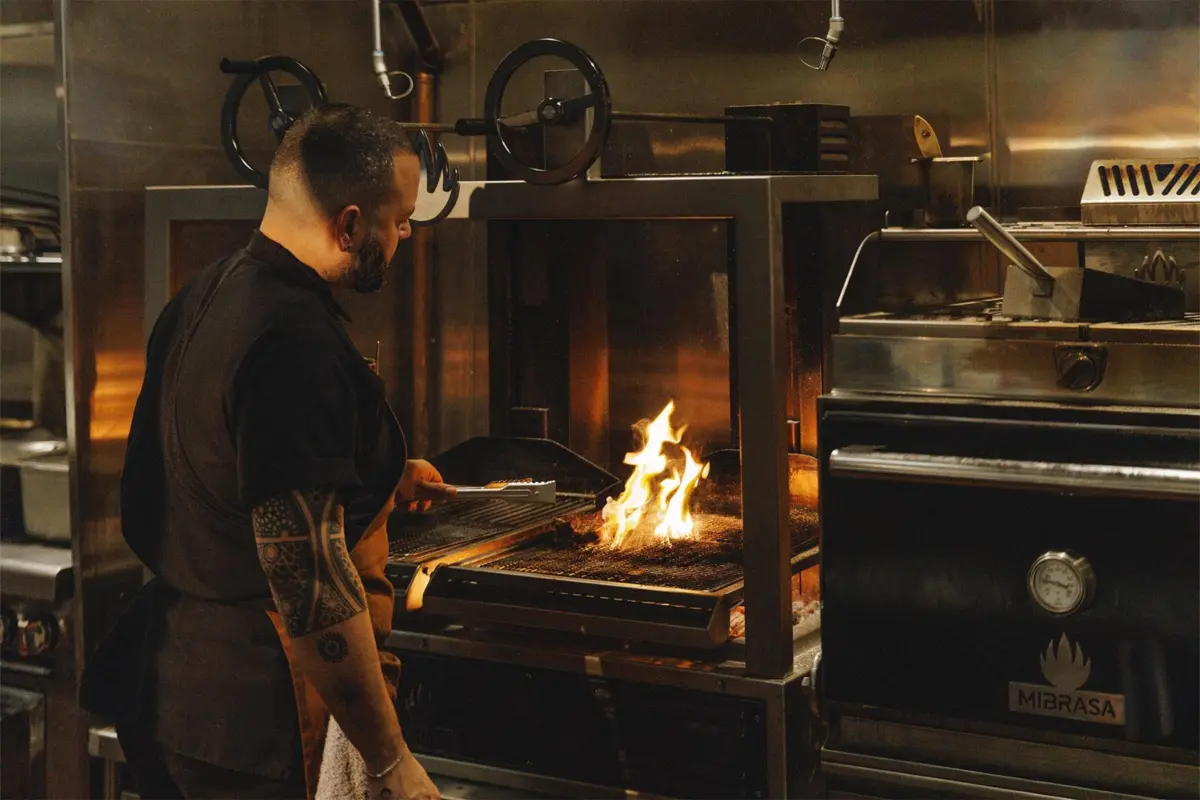
Translating centuries of historical migration and spice-trade routes onto the plate required a deliberate shift in cooking methodology. Rather than relying on conventional commercial kitchen setups, Mohajir made the foundational decision to center the entire restaurant around the primal element of wood fire.
"I’d never cooked on live fire, but we’re cooks, and it was going back to core things," he says. The decision was informed by childhood memories of visiting his grandmother in India, where contemporary gas stoves were not ubiquitous features of every home. When the concept for Muhājir began to solidify, Mohajir realized that modern convenience equipment would not serve the story he wanted to tell.
"When I decided that I was going to do Muhājir, it became so obvious to me that it couldn’t just be a sauté pan on a stove," Mohajir explains. "The story that we wanted to tell had to be told through wood fire."
Is There a Dish That Feels Especially Representative of Muhājir?
Among the menu items being served at the restaurant, a complex duck preparation stands out as the ultimate embodiment of the restaurant’s cross-cultural historical ethos. The dish draws inspiration from a 927-year-old recipe discovered in southern Spain, reflecting a fusion of Roman garums alongside Muslim and Jewish culinary influences.
The preparation is extensive and treated as a multi-part dining experience. The kitchen begins with a whole duck, which is butchered in-house, leaving the crown to dry-age for a full seven days. The wings are utilized to build a rich jus, while the legs are rendered into a traditional confit.
During service, the duck crown is blasted over the open flame and subsequently finished in a brasa grill, offering diners seated in the dining room a clear view of the birds hanging directly over the fire.
When the dish is brought to the table, it is presented on an ornate Turkish platter designed to highlight the various textures and flavor profiles. The presentation includes a side of black raspberry achaar, a saucier filled with the concentrated duck jus, a dedicated duck rice preparation, and medallions of crispy duck skin resembling duck chicharrón.
At the center is the roasted duck breast itself, featuring skin crisped over the live fire and seasoned with a spice blend derived directly from the centuries-old text. The rub incorporates cumin, coriander, cardamom, toasted pine nuts, red wine vinegar, and fish sauce, creating a complex flavor profile that serves as a tangible testament to historical cross-cultural collaboration.
You Have a Bar Called Bobo Behind the Restaurant. How Do the Two Spaces Complement Each Other?
Beyond the main dining room, the Muhājir experience extends into an adjoining hospitality concept: a bar named Bobo, located directly behind the restaurant. The creation of Bobo stems from a close collaboration between Mohajir and his business partner, Jacob Dela Cruz, with whom he previously developed Sarima.

It was Dela Cruz who originally suggested the name Muhājir, emphasizing the universal nature of human migration. In a reciprocal nod to collaboration, when the team turned their attention to developing the beverage program and adjacent bar space, Mohajir looked to honor Dela Cruz’s background.
The bar is named in affectionate tribute to Dela Cruz’s father, whose name is Bho. In Tagalog, the word "bobo" carries a playful, endearing meaning translated as "silly" or "stupid," reflecting a lighthearted counterweight to the deeply researched, history-driven dining room up front.
"We always say that as Spice Road-driven and transformative the food experience at Muhājir is, we still like to have fun," Mohajir explains.
The physical layout of the building encourages a fluid transition between the two concepts. Guests arriving early for dinner reservations are frequently invited back to Bobo for a drink, while diners often stop by the bar for a nightcap following their meal. Because accessing Bobo requires walking through the restaurant itself, the spaces naturally feed into one another’s energy. A guest sitting in Bobo might feel enticed to experience the main dining room next time, while diners at Muhājir frequently look toward the back corridor, curious about the activity happening behind the scenes.
What Has It Been Like to Run Muhājir So Far?
Launching and operating a restaurant of this scale comes with inevitable hurdles, but Mohajir approaches the daily operations with a sense of hard-won composure. Rather than reacting to unforeseen obstacles with panic, he has cultivated a methodical, team-oriented problem-solving framework. Furthermore, the financial structure of the business remains independent of private equity firms, relying instead on the direct support of the restaurant’s guests. Navigating daily challenges, he notes, simply becomes more manageable with repetition and experience.
For Mohajir, the opening represents a professional milestone. While previous restaurant projects involved building concepts where other chefs took the lead in the kitchen—such as working with chef Rishi Kumar at Mirra—Muhājir represents a space where Mohajir is fully hands-on, inhabiting the kitchen environment he spent his entire career working toward.
"I’m living a dream," Mohajir reflects. "Here, it’s the home that I’ve been yearning for and working toward my whole career. I plan to be old in this place. Things have been so crazy and wild and amazing, but slowly, every day, I sit more and more in that moment where I’m like, ‘This is home.’"