
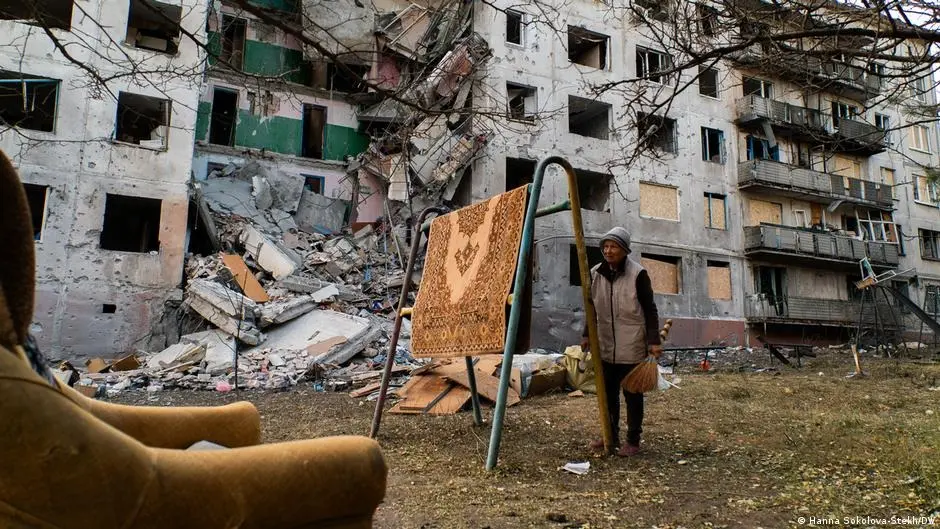
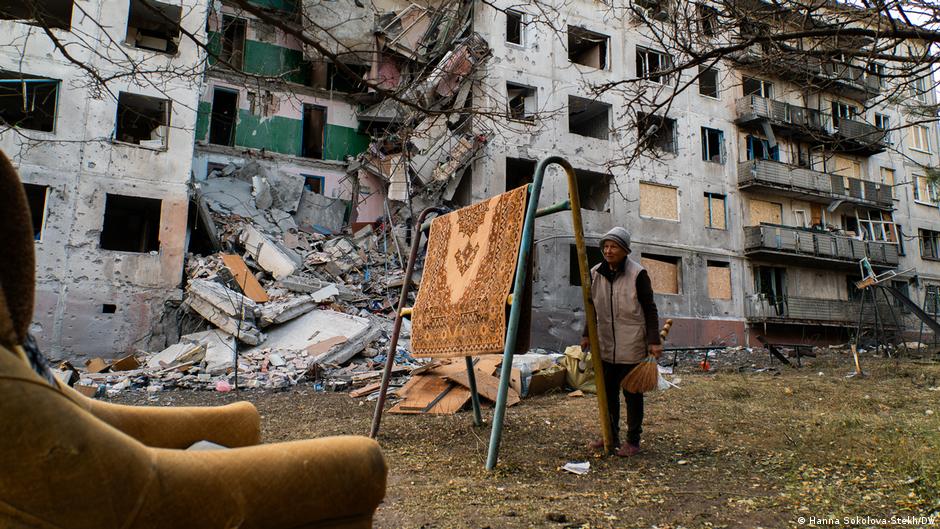
A few days ago, three Russian aerial bombs crashed into a residential neighborhood on the outskirts of Sloviansk, shattering the fragile quiet of a city that has spent months existing directly on the edge of the front lines. One of the high-explosive munitions scored a direct hit on a five-story apartment block, tearing through residential units and injuring seven people.
Together with its neighboring sister city of Kramatorsk, Sloviansk stands as one of the last major urban centers in the eastern Donetsk region still under Ukrainian government control. Since the summer, the city has been drawn inexorably into an active combat zone, subjected to regular barrages of glide bombs, tactical missiles, and swarms of loitering drones.
In a communal courtyard framed by battered, blast-damaged apartment blocks, an ordinary domestic chore carries the surreal weight of wartime survival. A dusty, heavy carpet hangs over the metal frame of a children’s swing set. Tetjana, an elderly pensioner who lives across the street, brought it out from her debris-strewn living room to beat away the pulverized concrete and plaster dust. She had been standing in her kitchen when the munitions detonated outside.
"The bomb hit the second floor, and a woman who lived on the fourth floor was screaming," Tetjana recalled. Emergency crews rushed to the scene amid choking smoke and unstable masonry. "They managed to rescue her before that entire section of the building collapsed," she said.
Local authorities continue to urge civilians to leave the area, offering organized evacuation routes away from the approaching Russian forces. Yet Tetjana remains in Sloviansk, held back by an insurmountable economic reality that confronts hundreds of thousands of low-income and elderly Ukrainians across the Donbas.
"I don’t know where I would go," she explained.
Finding private rental accommodation in safer regions further west can cost as much as €400 ($449) per month—a sum entirely out of reach for someone surviving on a monthly state pension of just €67 ($75). Even when factoring in monthly state relocation subsidies for internally displaced persons, which amount to roughly €40 ($45), the arithmetic of displacement simply does not add up.
"I couldn’t live on that. Nowhere!" Tetjana said.
Her immediate neighborhood retains limited municipal running water and electricity, but the central gas network has been severed by repeated strikes against infrastructure across the province. Deprived of heating fuel as the colder months approach, residents are left to fend for themselves with electric heaters or improvised stoves.
Despite the devastation around her, Tetjana clings to optimism. "We’ll get through this," she said. "Everything will be OK. That’s what I tell everyone. I want that so much."
Residents reluctant to evacuate without pets
Only days after the strike on Tetjana’s neighborhood, the few residents who stayed behind were still clearing broken glass and shattered brickwork from their apartments when another volley of Russian bombs hit.
This time, the ordnance struck a municipal building that housed a state-run emergency resilience center and an operational hub for the Red Cross. The facility had been serving as a lifeline for residents seeking basic assistance, power, and medical relief. As firefighters fought back the blaze, rescue teams and local volunteers worked frantically to pull supplies and personal belongings from the burning interior, stepping over heaps of shattered window glass. Eight people were wounded in the attack.

"I was on the balcony when there was a deafening bang. It felt as if someone had hit me over the head," said Natalja, a pensioner who witnessed the strike.
Natalja regularly walks across the city to this heavily targeted neighborhood to care for her ailing twin sister, who has lost the ability to move independently. The challenges of basic caretaking have grown increasingly severe as supply chains in the city strain under fire.
"She can no longer get around. Today, I couldn’t bring her bread, only crispbread," Natalja said. While a handful of vendors continue to operate stalls around the perimeter of the city’s burned-out central marketplace, essential staples like fresh bread are no longer delivered on a reliable daily schedule.
Natalja has spent weeks pleading with her sister to consider leaving Sloviansk before the ground fighting moves closer, but logistical rules and personal loyalty have brought their plans to a standstill.
"I tried to persuade my sister to leave. I would go to a nursing home and she would go to a hospital," Natalja said. "But her dog is sick, and I have one, too."
Official evacuation buses, temporary collective centers, and specialized medical transit services strictly prohibit companion animals. For the two sisters, abandoning their pets is unthinkable.

"I can’t leave my sister behind. She is worried and angry with me, as if everything were my fault," Natalja said quietly. "I have no strength left."
Gathering her bags, she began the long walk back toward her own home. "I have to get there before dark," she noted. Her destination in the city center lies nearly 4 kilometers (2.5 miles) away.
Municipal transit across the district has ground to a halt. Public bus lines were suspended after an artillery strike in neighboring Kramatorsk destroyed two passenger buses, killing 30 people and underscoring the lethal peril facing mass transit systems anywhere near the front.
"We’re used to living under fire"
The center of Sloviansk now bears deep scars from months of shelling and aerial bombardments. Its wide avenues are largely empty, lined with boarded-up storefronts and blast-shattered facades. Before the full-scale Russian invasion in 2022, the industrial and administrative hub was home to roughly 100,000 people. Today, only about 20,000 remain. The vast majority of those who stayed behind are retirees and elderly residents whose health, lack of savings, or family ties prevent them from relocating.
In a rare open cafe, Vasyl, a pensioner from the small village of Mayaky just north of the city, sat down to eat lunch. A neighbor had agreed to drive him into Sloviansk to run essential errands.
"We’re used to living under fire by now," Vasyl said, reflecting on the constant backdrop of artillery fire and air-raid sirens. "But it’s a bad habit. We should have broken it long ago."

While Vasyl longs for an end to the violence that has reshaped his homeland, he expressed firm defiance against political concessions, specifically rejecting Russian President Vladimir Putin’s demands that Ukraine cede the remainder of the Donetsk region to Moscow.
Outside on the street, protective mesh netting hangs suspended over roads and public walkways—a physical defense deployed to catch or detonate incoming Russian first-person-view (FPV) attack drones before they can reach civilian cars or pedestrians below.
Beneath the canopy of anti-drone nets, two elderly women paused to speak in hushed tones.
"I can’t remember the last time I slept through the night," said Iryna, a pensioner living nearby. "It’s terrible, but I have nowhere to go. I’m supposed to leave my two cats behind, but I love them so much. They’re all I have."
She described an existence reduced to sheer endurance and sheltering from sudden explosions. "We can only hide, trembling, and pray to God that everything will be all right," Iryna said. "When I have to go to the market, I don’t know if I’ll make it there alive."
Her anxiety is well-founded. Several weeks ago, Russian drones struck the central market directly, injuring at least three civilians. Since that incident, foot traffic has plummeted, with many vendors packing up their stalls permanently and shoppers avoiding prolonged exposure in open squares.

"We dream of staying here"
Despite the persistent danger, parts of the central market continue to function. In one aisle, Valeriya stands behind a counter selling women’s underwear. Because local kindergartens and schools were forced to close their doors due to security risks, her 5-year-old daughter, Sofia, accompanies her to work each morning.
Their residential district in Sloviansk has not yet been placed under the Ukrainian government’s mandatory evacuation order for families with young children, leaving Valeriya to balance economic survival with the safety of her child.
"We’re used to this life by now," Valeriya said. "We were evacuated in 2022, but later returned. Now we’re waiting to be evacuated again."
Nearby, Sofia dashes through the concrete aisles playing tag with 6-year-old Anya. Anya’s mother is currently deployed as a soldier in the Ukrainian armed forces, fighting on the front lines to defend her home region. In her mother’s absence, Anya is cared for by her grandmother, Tetjana, who sells men’s clothing from an adjacent stall while keeping a constant eye on the child.
With the security situation around Sloviansk deteriorating, grandmother Tetjana has begun preparing for the worst. Piece by piece, she has started boxing up her family’s personal belongings and shipping them west to the Dnipropetrovsk region, hoping to carve out a viable path for a new life. She is rushing to send the packages while the local postal branch still manages to operate.
"It hurts to see our Ukraine being destroyed," Tetjana said, fighting back tears as she watched the two young girls weave between clothing racks. "Who will rebuild our cities?"

Like many here, she dreams of the day she might return home permanently, but the precedent of other cities across Donetsk tempers her hope with dread.
"Look at Bakhmut. There are no houses left," she said. Located roughly 50 kilometers (31 miles) southeast of Sloviansk, Bakhmut was pulverized by months of urban combat before Russian forces captured its ruins in 2023. "I’m counting on our boys to hold our cities, even though it’s very difficult."
Among the market traders, discussions of diplomatic settlements or a negotiated ceasefire are met with skepticism.
"Putin won’t want one," Tetjana said flatly. "And our younger generation will ask us what we fought for in the first place." Like many residents enduring the shelling, she insisted that lasting peace can only come through a full withdrawal of Russian military forces from Ukrainian soil.
As she spoke, the high-pitched electrical whine of a drone sounded from the sky above the market stalls, followed quickly by bursts of small-arms fire from nearby air defense units attempting to track and down the aircraft.
"It’s hard for our boys to shoot them down," Tetjana said, listening as the gunfire echoed across the concrete stalls. "But they’re doing their best."