
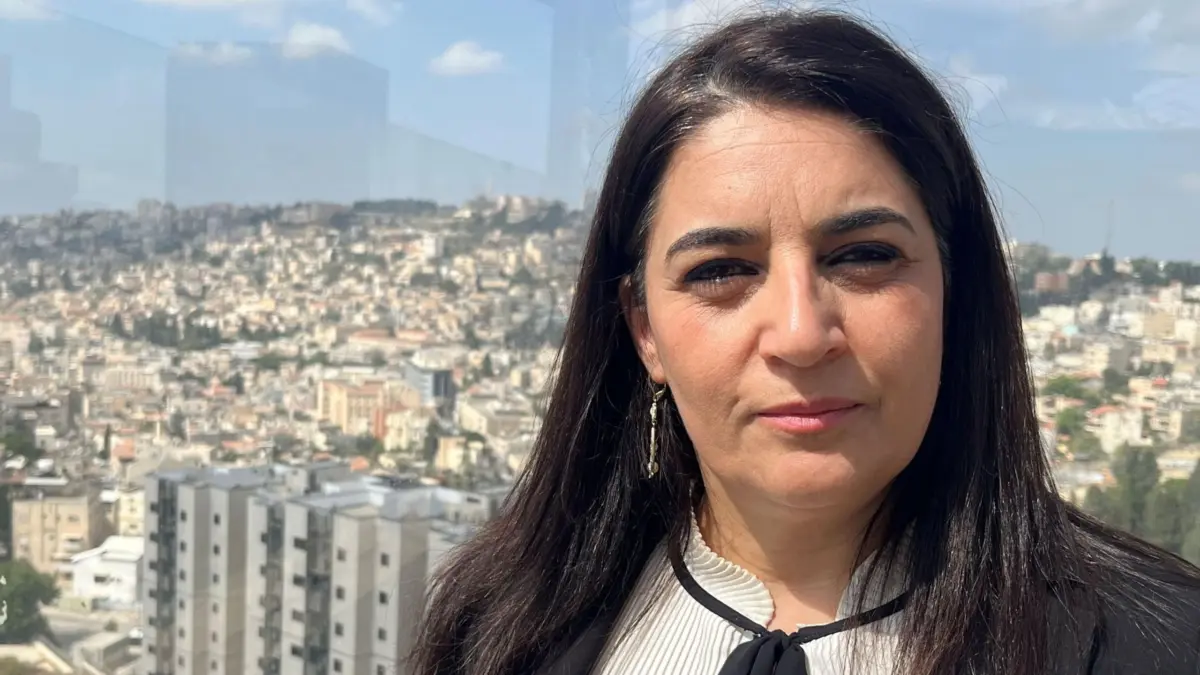
NAZARETH — At rush hour in Nazareth, the largest Arab-majority city in Israel, young student volunteers weave through idling traffic, handing out campaign leaflets through driver-side windows. Their urgent appeal to passing motorists reflects a pivotal moment in Israeli politics: urging Arab citizens to turn out in force for a closely fought general election where Arab-majority parties could end up holding the critical balance of power in the nation’s parliament.
Historically, political disaffection and deep-seated systemic frustration have driven down voter turnout among Arab Israelis, who make up roughly one-fifth of the country’s population and frequently identify as Palestinian citizens of Israel. However, in the run-up to this election, a concerted grassroots mobilization is underway, driven by a determination to unseat the most right-wing governing coalition in Israel’s history—an alliance anchored by veteran Prime Minister Benjamin Netanyahu alongside far-right nationalist and ultra-Orthodox parties.
"I see it as our duty to bring down this extremist government. They treat us as second-class," said Arkan Badran, a 23-year-old student assisting with the leaflet campaign along the busy Nazareth roadway. "I call on all young men and women to vote for Arab lists, which represent us, because this is our future."

The electoral arithmetic facing the country underscores why Arab voters could prove decisive. Most recent opinion polls indicate a tight political deadlock. Neither Prime Minister Netanyahu and his religious-nationalist allies nor the primary opposition "Change Bloc"—led by centre-right former military chief Gadi Eisenkot—currently commands a clear path to a 61-seat majority in the 120-seat Knesset.
Survey data released this week suggests that Eisenkot’s opposition bloc and Netanyahu’s right-wing alliance are projected to win roughly 50 seats each. Meanwhile, Arab-majority political slates are poised to capture a combined total of 13 to 14 seats. Should those projections hold on election day, anti-Netanyahu factions seeking to construct a governing coalition would face a stark dilemma: either renege on explicit pledges not to partner with Netanyahu or strike a historic deal with Arab-majority parties to secure a parliamentary majority.
Navigating that math is further complicated by existing political pledges. Eisenkot has repeatedly ruled out forming a coalition government with Arab parties, explicitly citing a lack of shared values.
The political atmosphere across Israel has been fundamentally reshaped by the deadly and unprecedented Hamas-led assault on October 7, 2023, and the subsequent war in Gaza. In the wake of those events, social fractures have widened sharply, accompanied by heightened public mistrust and hostility toward Israel’s Arab minority.

"After October 7, we were treated as enemies of this country," said Suha Salman Mousa, executive director of the Mossawa Center, a Nazareth-based civil rights organization advocating for equal rights for Arab citizens. "There was shrinking space for freedom of speech. There were major arrests, there was also firing of people from their workplaces because they put something on social media or they went out against the war on Gaza."
Salman Mousa accused members of the current cabinet of engaging in "systematic discrimination and incitement" against Arab Israelis. Civil rights groups point out that the government has disproportionately trimmed public budgets designated for Arab municipalities and local development. The government, for its part, maintains that nationwide budget adjustments and spending reductions are necessary to finance wartime defense and national security operations.
The societal tension has extended into everyday civic life. Human rights advocates note that recent months have seen politicized pressure campaigns aimed at Arab physicians working in Israeli public hospitals, as well as racially motivated physical and verbal attacks against Arab bus drivers by Jewish Israelis.
Certain political campaigns have actively sought to leverage these divisions for electoral gain. Far-right Finance Minister Bezalel Smotrich has openly pledged to "Judaise" portions of the northern Galilee and southern Negev regions—areas where the vast majority of Arab citizens reside—explicitly drawing parallels between those efforts and the expansion of Israeli settlements in the occupied West Bank.

The majority of Arab citizens in Israel are descendants of the Palestinians who remained within the newly drawn borders following the 1948 war surrounding the creation of the state, during which hundreds of thousands of Palestinians were displaced or fled their homes. Within Israel’s current political discourse, right-wing leaders often frame this minority community as a demographic and security threat to the state’s Jewish identity. Prime Minister Netanyahu has repeatedly warned his voter base that his political rivals intend to align with Arab lawmakers to assemble what he labels a "dangerous government."
To reinforce that message, Netanyahu’s campaign has erected prominent billboards across the country, including at a strategic highway junction at the main entrance to Nazareth. The advertisements present voters with a stark binary choice: "Right or Palestine"—featuring images of key opposition figures, including right-wing members of the opposition, cast as representatives of Palestinian interests. The campaign has also deployed artificial intelligence-generated video clips online depicting opposition figures embracing prominent Arab political leaders.
At the studios of Radio Nas, a widely followed Arabic-language radio station operating in Nazareth, news anchor Mohammed Magadli offered a stark assessment of the political rhetoric. Magadli, who also serves as a prominent political analyst for Israel’s Channel 12, possesses a personal window into Israeli political history; his father, Raleb Magadli, made history between 2007 and 2009 when he served as Israel’s first Muslim cabinet minister, representing the Labour Party.
Reflecting on the decision by Change Bloc leadership to rule out formal alliances with Arab factions, the younger Magadli did not mince words.

"In a word its racism. But if we’re trying to explain why, it’s because of the political interests of Benjamin Netanyahu," Magadli said. "He’s trying all the time to pull the legitimacy of the Arab parties—because they’re Arab, because they’re Palestinian. This is affecting the majority of the Jewish parties in Israel."
The parliamentary footprint of the Arab electorate is currently divided between two distinct political groupings: the Joint Arab List—an alliance comprising Hadash, Balad, and Taal—and the United Arab List, an Islamist party led by lawmaker Mansour Abbas, also known by its Hebrew acronym, Ra’am.
While Ra’am originated as the political wing of the southern branch of the Islamic Movement in Israel, maintaining socially conservative positions, Abbas has gained international attention for his willingness to break long-standing political taboos by partnering directly with mainstream Jewish political parties. His strategy focuses heavily on securing practical, tangible resources and policy adjustments for Arab citizens within Israel, while allocating relatively less rhetorical emphasis to the broader Israeli-Palestinian conflict in the West Bank and Gaza.
Abbas has already demonstrated the viability of this pragmatic approach. In 2021, he made history by joining a broad, diverse coalition government led by Naftali Bennett—the right-wing politician who is currently a key figure within Eisenkot’s Change Bloc.

For the upcoming election, Abbas took another unorthodox step by placing Yoav Segalovitz, a Jewish former senior police official and centrist member of parliament, in the number two slot on his party’s electoral list. Abbas expressed confidence that opposition leaders, including Eisenkot, will prove far more receptive to working with his party once the final votes are counted, insisting that his party fully intends to enter the next governing coalition.
"We’ve reached the conclusion that parliamentary representation is not enough to serve Arab society. We decided to take responsibility, to become part of the solution to our problems and to offer hope to both Arabs and Jews," Abbas said. "That’s why our approach has been driven by a desire to reach a position of influence, not merely representation."
In contrast, the Joint Arab List—composed primarily of secular parties—focuses its platform on fighting for civil equality within Israel, ending the Israeli military occupation of Palestinian territories, and establishing an independent Palestinian state through a two-state solution. Rather than seeking direct cabinet appointments in a coalition government, the Joint List proposes offering an external "safety net" to a center-left or opposition government, agreeing to vote with the administration on crucial parliamentary confidence measures in exchange for specific policy commitments and funding guarantees for Arab communities.
Beyond national security and civil rights, the single most driving issue for Arab voters in this election cycle is the catastrophic rise of violent gang crime within their communities.

A study conducted in September by the Israel Democracy Institute think tank revealed that violent crime was the primary consideration for 53.5% of Arab citizens when determining which political party to support. According to data compiled by the Abraham Initiatives, a joint Jewish-Arab organization advocating for civil equality and peaceful coexistence, homicides within the Arab community reached an unprecedented peak of 252 deaths last year—a rate approximately five times higher than the homicide rate recorded among Jewish Israelis over the same period.
In Jaffa, an ancient mixed Arab-Jewish city that is now part of the Tel Aviv-Yafo municipality, local resident Ziad Samouni stood near his home where his son, Hussein, was gunned down in November by two unidentified assailants riding a motorcycle. Months after the shooting, no arrests have been made.
Given the notoriously low clearance rate for homicides occurring in Arab towns and neighborhoods, many residents accuse law enforcement and national authorities of systemic negligence and apathy.
"It seems they’re interested in making sure we reach a situation where the killer is never caught, allowing Arabs in Arab society to keep killing one another," said Samouni, who has since joined Israeli-Palestinian Bereaved Families for Peace, an organization bringing together families affected by violence.

Responding to inquiries, the Israeli police stated that the investigation into Hussein Samouni’s murder remains active and open, maintaining that law enforcement treats "every case of violence and crime with the utmost seriousness."
For Samouni, the personal tragedy has highlighted the broader need for civil participation. "As a father who’s lost a son, of course, I want this bloodshed to end," Samouni said. "I wish every Arab citizen who believes there needs to be a change sees that this is a time to go to vote."
The intense political friction surrounding Arab political participation reached the nation’s highest judicial body earlier this month. Israel’s Supreme Court formally struck down and overruled a decision by the Central Elections Committee that had attempted to disqualify both the United Arab List and the Joint List, along with two individual Arab lawmakers, from contesting the election.
The Central Elections Committee—a body heavily influenced by representatives of the current ruling coalition—had claimed that the Arab parties violated electoral laws banning candidates who deny Israel’s existence as a Jewish state. Both parties and their candidates strongly rejected the allegations, characterizing the disqualified effort as a politically motivated attempt at disenfranchisement, a position ultimately upheld by the Supreme Court’s intervention.

With polling day just around the corner, the political tension across the country remains palpable. Back on the streets of Nazareth, motorists honk in support as they display flags representing their chosen political lists from car windows. With parliamentary majorities hanging by a thread, Arab citizens find themselves navigating a pivotal moment—aware that their turnout could ultimately decide who leads Israel’s next government, as well as shape their own status and rights within the country for years to come.