
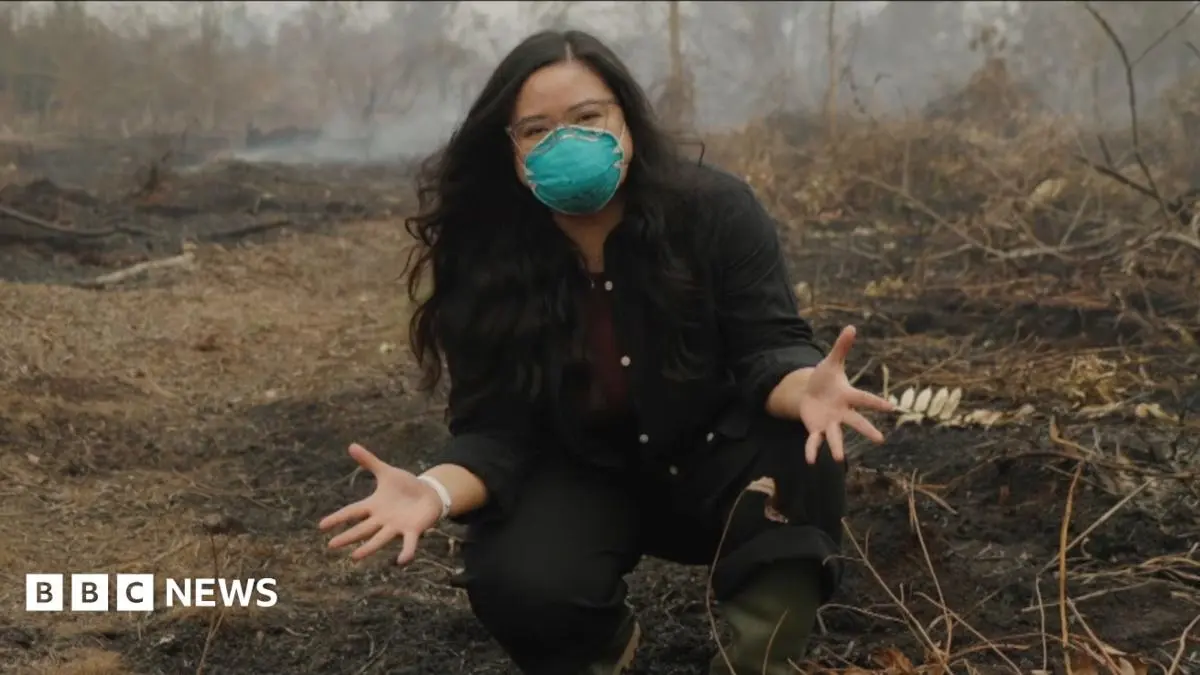
Reporting from the heart of Central Kalimantan, BBC correspondent Liza Tambunan brings into sharp focus a severe environmental crisis as Indonesia battles its most destructive wildfire season in a decade. Dense, acrid plumes of toxic haze have blanketed vast swathes of the Indonesian archipelago, suffocating millions of residents in local communities and expanding into an acute transboundary environmental emergency that has enveloped neighboring nations, including Singapore and Malaysia.
The ongoing blazes have transformed daily life across large parts of Southeast Asia into a struggle against degraded air quality, health warnings, and severely impaired visibility. While forest fires occur periodically across the region, the extraordinary severity of this year’s crisis has drawn intense focus to the underlying driver of the most intractable blazes: Indonesia’s vast, highly vulnerable peatlands.
In Central Kalimantan, located on the island of Borneo, the sky has frequently been reduced to a murky, yellowish-orange gloom as thick smoke sits heavy over towns, villages, and dense tropical terrain. For millions of local residents, the air has become a continuous health hazard, prompting public health alerts, driving people indoors, and straining regional healthcare infrastructure.
The impact, however, extends far beyond the immediate vicinity of the flames. Driven by seasonal atmospheric wind patterns, the choking haze has traveled hundreds of kilometers across international borders and maritime corridors, including the Malacca Strait and the South China Sea. In both Singapore and Malaysia, authorities and residents have experienced sharp declines in air quality, renewed debate over transboundary pollution, and widespread disruptions to outdoor activities, transportation, and daily routines.
To understand why these fires are so severe, so damaging, and so notoriously resistant to control, it is essential to examine the unique nature of peat soil and the complex mechanics of peatland blazes.
Peat is an accumulation of partially decayed organic matter, consisting primarily of vegetation, trees, leaves, roots, and plant debris that has gathered over thousands of years. In its natural state, a peatland is a lush, waterlogged wetland ecosystem. Because the soil is permanently submerged or saturated with water, oxygen levels within the ground remain extremely low. This lack of oxygen halts the natural process of decomposition, allowing layer upon layer of organic material to build up over millennia, forming deep beds of carbon-rich organic soil that can extend several meters into the earth.
Central Kalimantan and surrounding regions across Borneo and Sumatra contain some of the largest concentrations of tropical peatlands in the world. Under pristine conditions, these water-saturated peat swamps act as vital ecological buffers and powerful global carbon sinks, storing massive quantities of carbon that would otherwise enter the atmosphere as greenhouse gases.
However, when peatlands are altered, drained, or subjected to prolonged dry spells, their fundamental environmental function is radically inverted. To prepare peatland areas for human use, such as agricultural development, forestry, or land clearing, deep networks of drainage canals are frequently cut through the terrain. These canals draw moisture out of the boggy ground, lowering the water table and exposing the ancient layers of organic material to the surrounding air.
As the saturated peat dries out, it loses its natural moisture retention and transforms from a wet carbon vault into a highly combustible mass of organic fuel. Dried peat is essentially a natural layer of dense fuel—similar in many respects to low-grade coal or charcoal—sitting directly beneath the surface of the land. When high temperatures and prolonged dry weather settle over the region, these desiccated peatlands become volatile tinderboxes requiring only a minor spark or surface fire to ignite.
The primary reason peatland fires are far more dangerous and difficult to manage than conventional forest fires lies in how they burn. A standard vegetation or forest fire burns predominantly above ground, consuming leaves, brush, and standing trees. While such surface fires can burn with great intensity and high flames, they are generally visible, direct, and susceptible to standard firefighting techniques, such as aerial water drops, chemical suppressants, and physical firebreaks designed to halt the forward momentum of the flames.
Peatland fires operate on an entirely different physical mechanism known as smoldering subterranean combustion. Rather than producing dramatic, high-sweeping flames in the canopy, a peat fire ignites the ground itself and burrows deep underground. The fire creeps through the dry organic soil layers, moving slowly beneath the surface through complex networks of dried roots, buried vegetation, and porous peat soil.
Because the fire burns beneath the surface, it creates an array of extraordinary challenges for emergency response crews on the ground in places like Central Kalimantan.
First, surface firefighting tactics often prove largely ineffective against deep peat blazes. When firefighting aircraft drop thousands of liters of water from above, or when ground crews spray water onto the surface of the land, the liquid frequently washes over the top layer of dirt and ash without penetrating deep into the subterranean layers where the core of the fire is actively burning. The hydrophobic nature of dry peat—which can actually repel water when severely dried out—further prevents moisture from reaching the underground hot spots.
Second, the peat soil itself acts as an extraordinarily effective thermal insulator. Deep underground, trapped beneath layers of earth and ash, subterranean fires can maintain extreme temperatures for weeks, months, or even longer, shielded from wind, surface rain, and atmospheric cooling. Even if rain falls on the surface or firefighters succeed in extinguishing visible surface blazes, the deep underground embers continue to smolder quietly. Once the surface dries or atmospheric conditions shift, these buried hot spots can easily break back through to the surface, rekindling active open fires far from where the initial blaze was fought.
Third, subterranean peat fires do not move in predictable paths. They can travel sideways through underground root networks and dry peat seams, creeping undetected beneath fire lines, roads, and containment trenches. Fire crews working on the ground may find themselves standing on seemingly calm terrain, unaware that an intense smoldering fire is actively burning just meters beneath their feet. This creates severe structural safety hazards for firefighters, as the underground burning hollows out the soil, causing the ground above to collapse unexpectedly into pits of superheated ash and burning embers.
The physical terrain of Central Kalimantan compounds these operational hurdles. Deep tropical peat swamps are frequently located in remote, difficult-to-reach areas characterized by dense vegetation, unstable ground, and minimal road infrastructure. Moving heavy earth-moving equipment, high-capacity water pumps, or large teams of personnel into swampy, trackless terrain is physically arduous and logistically complex.
Furthermore, during severe dry periods, local water sources such as small rivers, streams, and shallow wells often dry up or drop to extremely low levels, leaving ground crews without the vast quantities of water required to saturate the soil. Extinguishing a single hectare of deep peat fire typically requires hundreds of thousands—if not millions—of liters of water, injected directly into the ground using specialized nozzles and high-pressure pumps designed to pierce the surface layer and flood the subterranean fire bed.
The nature of peat combustion also explains the extraordinary volume and toxicity of the haze currently choking the region. Because peat fires burn through slow, low-temperature, smoldering combustion rather than rapid, high-temperature flaming combustion, the organic material undergoes incomplete burning. This process releases vast quantities of dense, particulate-heavy smoke containing high concentrations of fine particulate matter (PM2.5), carbon monoxide, volatile organic compounds, sulfur dioxide, and airborne ash.
Fine particulate matter is particularly hazardous to human health because the microscopic particles are small enough to penetrate deep into the lungs and enter the bloodstream. For residents across Central Kalimantan, as well as those in affected areas of Singapore and Malaysia, prolonged exposure to this toxic cocktail causes severe acute symptoms, including burning eyes, throat irritation, persistent coughing, and acute respiratory infections, while significantly aggravating chronic conditions such as asthma, bronchitis, and cardiovascular diseases.
Beyond the immediate public health crisis and regional economic disruption, the peat blazes carrying across Southeast Asia carry profound long-term global environmental implications. When thousands of years of accumulated organic soil are burned away in a matter of weeks, massive volumes of stored carbon are oxidized and released back into the earth’s atmosphere as carbon dioxide and methane. This transforms critical ecosystem guardians into significant contributors to atmospheric greenhouse gas concentrations.
As Liza Tambunan reports from Central Kalimantan, firefighters, local volunteers, and emergency personnel continue to labor under taxing conditions, battling low visibility, choking air, and treacherous ground terrain in an effort to contain the crisis. Yet, given the deep, hidden nature of peatland combustion, complete containment remains a daunting challenge, with many underlying hot spots expected to smolder quietly until heavy, continuous seasonal rains arrive to fully saturate the deep layers of the earth.