
Long before he became a focal point of art historical retrospectives, Gustave Fayet assembled a collection of Paul Gauguin works so vast and immersive that it effectively transformed his Paris residence into a de facto museum dedicated to the pioneering post-Impressionist master. Yet, despite occupying a central, pivotal position within the vibrant cultural and avant-garde ecosystem of early-20th-century France, Fayet has largely remained an enigmatic figure to the broader public—overshadowed by the legendary artists, designers, and creators he championed, collaborated with, and financially supported.
That relative obscurity is poised to lift dramatically this autumn. The Fondation Louis Vuitton is preparing to unveil Gustave Fayet, Collector–Designer, the latest installment in its monumental Icons of Modern Art exhibition series. Scheduled to run from October 9 through March 8, the landmark exhibition will occupy the entirety of the striking, sculptural Frank Gehry–designed building in Paris. By taking over the entire architectural complex, the show offers a sweeping, comprehensive exploration of Fayet’s diverse and deeply influential roles throughout his lifetime, examining his impact not only as an elite art patron and visionary collector, but also as a dedicated entrepreneur, curator, and remarkably inventive artist in his own right.

Born in 1865 into an affluent, established French family of landowners and wine merchants, Fayet was immersed in the arts from an early age. He cultivated his passion for painting alongside his father and uncle, both of whom were enthusiastic amateur artists. As a young man making his rounds through the bustling European art fairs, Fayet immersed himself in the contemporary creative discourse. His early promise eventually earned him a prestigious appointment as a curator at the Musée de Béziers. During his tenure there, he forged a close working relationship with Louis Paul, a talented sculptor who had previously studied under the legendary Auguste Rodin. Together, Fayet and Paul pushed into new aesthetic territory, producing a series of striking, Japonisme-inspired ceramics that were eventually showcased at one of Paris’s most important and influential commercial galleries of the era.
The trajectory of Fayet’s life shifted profoundly in 1899 when he inherited the substantial family estate. With newfound financial independence, he began collecting art in earnest, acquiring his inaugural pieces by master colorists like Pierre-Auguste Renoir alongside his growing cache of Gauguins. Many of the masterworks that flowed through Fayet’s hands during this prolific period of acquisition went on to become defining treasures of modern art history. Iconic paintings that once graced his collection—such as Vincent van Gogh’s haunting Self-Portrait With Bandaged Ear, Paul Cézanne’s monumental The Great Pine, and Gauguin’s evocative Three Tahitians—will feature prominently in the upcoming Fondation Louis Vuitton exhibition, reuniting works that help tell the story of his unerring eye. For a period during these intense years of curation and acquisition, Fayet became so deeply consumed by the mechanics of collecting and supporting his contemporaries that he temporarily set aside his own personal creative practice.

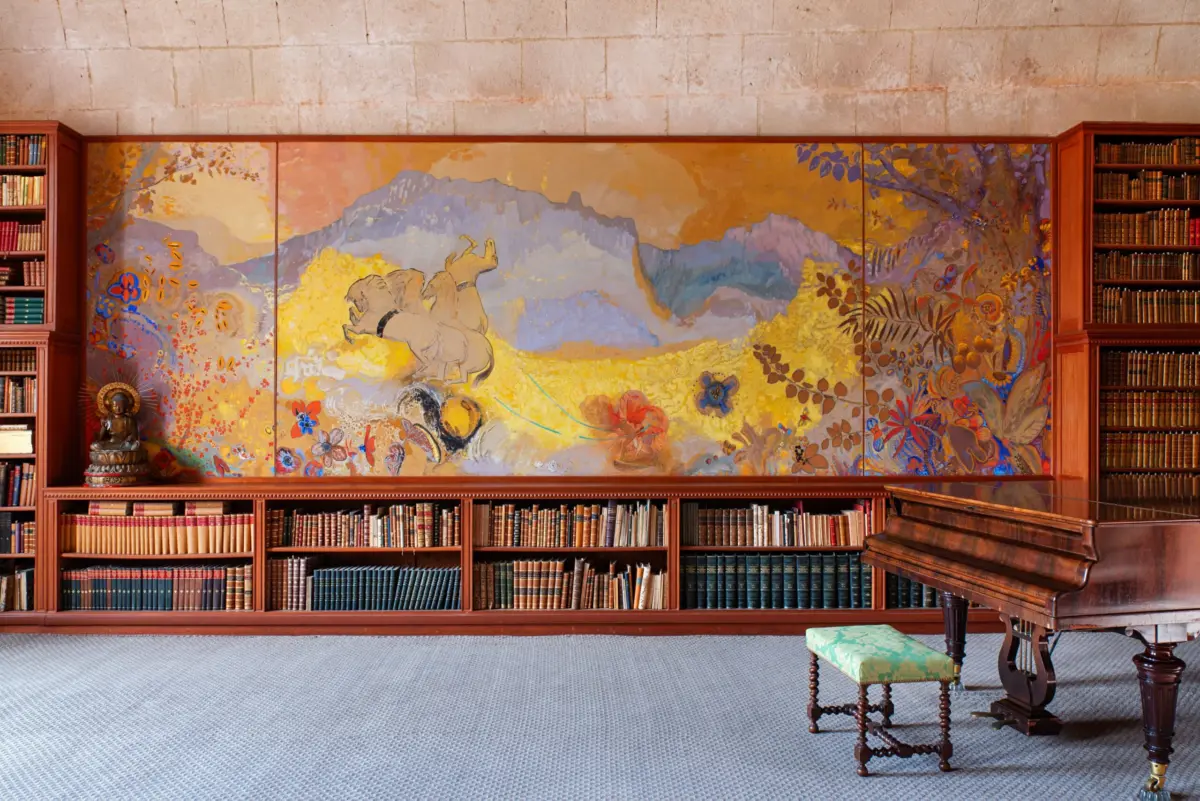
That dynamic phase began to evolve around 1908, when Fayet and his wife, Madeleine, made a life-altering acquisition: the purchase of the abandoned Abbaye de Fontfroide, a historic monastic site located near Narbonne in the south of France. Fayet envisioned breathing new life into the desolate stone structure, transforming it into a holistic "total work of art" or Gesamtkunstwerk. To realize this grand architectural and aesthetic dream, he gathered an intimate circle of kindred creative spirits, a group that would come to be known as his "Fontfroideans." Among them was the visionary symbolist painter Odilon Redon, who was commissioned to create three remarkable, large-scale murals—titled Day, Night, and Silence—specifically for the abbey’s library. In a major coup for the upcoming exhibition, these transcendent Redon panels will be placed on public view for the very first time outside their permanent home as part of the Fondation Louis Vuitton retrospective.
The serene and inspiring environment of Fontfroide also acted as a powerful catalyst for Fayet’s own artistic rebirth, steering him toward fresh and unexpected creative impulses. In 1911, he developed an idiosyncratic, highly experimental artistic technique, applying delicate watercolors directly onto humble blotting paper. This unusual medium allowed him to generate a large and cohesive body of floral works characterized by an ethereal lightness. Robert Carsen, the exhibition’s artistic director, notes the striking nature of these pieces: "The drawings demonstrate an almost childlike spontaneity at a time when Gustave Fayet was a mature man."

This blossoming of Fayet’s personal artistry quickly spilled over into decorative design. Prominent interior decorator Paul Dumas began reproducing Fayet’s delicate watercolors as sophisticated fabrics and high-end wallpaper designs. Seeking to expand their commercial reach, Fayet and Dumas jointly founded the Atelier de la Dauphine to manufacture these patterns as luxury rugs. Prime examples of these textiles have been meticulously restored for the exhibition, where they will be displayed directly alongside Fayet’s original watercolor artworks and historical photographs of their installation in spaces like the Maison Losseau in Mons, Belgium. As his creative confidence grew, Fayet expanded his output into illustration as well, providing intricate illuminations for works of poetry and even crafting a bespoke, illustrated book dedicated to his grandchildren.
Long before these late-career design ventures, Fayet had already firmly established himself as a central catalyst in the Parisian avant-garde. Beyond his legendary accumulation of Gauguins, he demonstrated an extraordinary knack for spotting nascent talent decades before the mainstream art establishment caught up. Notably, Fayet organized one of the very first French public exhibitions for the work of a young Pablo Picasso, who at the time of the outing was not yet even 20 years old. Fayet’s influence extended seamlessly across the broader creative industries of early-20th-century Paris. Famed fashion designer Jeanne Lanvin commissioned Fayet to create bespoke rugs for her private apartment, while legendary couturier Paul Poiret was tapped to design the wedding dress for Fayet’s daughter.

Reflecting on the breadth of Fayet’s multifaceted career, exhibition artistic director Robert Carsen observes that the collector was "truly exploring new territory, venturing deeper and deeper into the new genre he was exploring with each new endeavor." Ultimately, an unbounded and restless imagination served as the invisible through line connecting everything Fayet touched, whether he was curating a museum, nurturing the early career of Picasso, commissioning masterpieces from Redon, or weaving vibrant patterns into the fabric of French domestic design.