
Gustave Fayet once owned enough works by Paul Gauguin to transform his Paris residence into a de facto museum dedicated entirely to the post-Impressionist master. Beyond assembling an astonishing private cache of late-nineteenth and early-twentieth-century art, Fayet organized one of the very first French exhibitions showcasing the work of a young Pablo Picasso, who at the time had not yet celebrated his twentieth birthday. His influence stretched across the upper echelons of the French creative world: couturier Jeanne Lanvin famously commissioned Fayet to create custom rugs for her apartment, while legendary designer Paul Poiret crafted the wedding dress for Fayet’s daughter. Despite occupying a position at the absolute epicenter of the cultural and artistic scene in early-twentieth-century France, Fayet has largely remained an enigmatic, lesser-known figure to the general public.

That historical oversight is set to be corrected this fall as the Fondation Louis Vuitton unveils Gustave Fayet, Collector–Designer, the latest installment in its monumental Icons of Modern Art exhibition series. Running from October 9 through March 8, the expansive exhibition will take over the entirety of the iconic Frank Gehry-designed building in Paris. The landmark show offers a comprehensive exploration of Fayet’s multifaceted life and career, examining his influential roles as an ambitious art patron, an astute entrepreneur, an independent curator, and a prolific creator in his own right.
Born in 1865 into a wealthy, established family of landowners and wine merchants, Fayet grew up immersed in an environment that valued both commerce and culture. He learned the fundamentals of painting alongside his father and uncle, both of whom were passionate amateur artists. As a young man, he made the rounds of the vibrant Parisian art fairs, immersing himself in the burgeoning creative currents of the era. His early promise led to an appointment as a curator at the Musée de Béziers. In this municipal role, he collaborated closely with Louis Paul, a talented sculptor who had previously studied under the legendary Auguste Rodin. Together, Fayet and Paul produced a series of distinctive, Japonisme-inspired ceramics that ultimately earned display in one of the most prestigious and important galleries in Paris.

A significant turning point arrived in 1899, when Fayet inherited the family estate. With newfound financial independence, he began collecting art in earnest, making strategic acquisitions that included his very first works by Pierre-Auguste Renoir and Paul Gauguin. Over the following years, Fayet’s hands passed some of the most iconic masterpieces of modern art history. Many of the legendary works that flowed through his private collection—such as Vincent van Gogh’s emotionally charged Self-Portrait With Bandaged Ear, Paul Cézanne’s monumental landscape The Great Pine, and Gauguin’s evocative Three Tahitians—will feature prominently in the upcoming Fondation Louis Vuitton exhibition, offering contemporary audiences a rare glimpse into the discerning eye of a visionary collector. For a period during these intense years of acquisition and curation, Fayet became so completely consumed by his patronage and stewardship of other artists’ work that he temporarily set aside his own personal creative practice.
All of that began to change around 1908, when Fayet and his wife, Madeleine, made a bold and transformative real estate acquisition: the abandoned Abbaye de Fontfroide, located near Narbonne in the south of France. Fayet harbored a grand, romantic vision of restoring the historic medieval abbey as a "total work of art," a comprehensive environment where architecture, nature, and the fine arts would coalesce into a single immersive experience. To help realize this ambitious dream, he assembled a tight-knit circle of artists, kindred spirits, and creative collaborators who would come to be known as the "Fontfroideans."

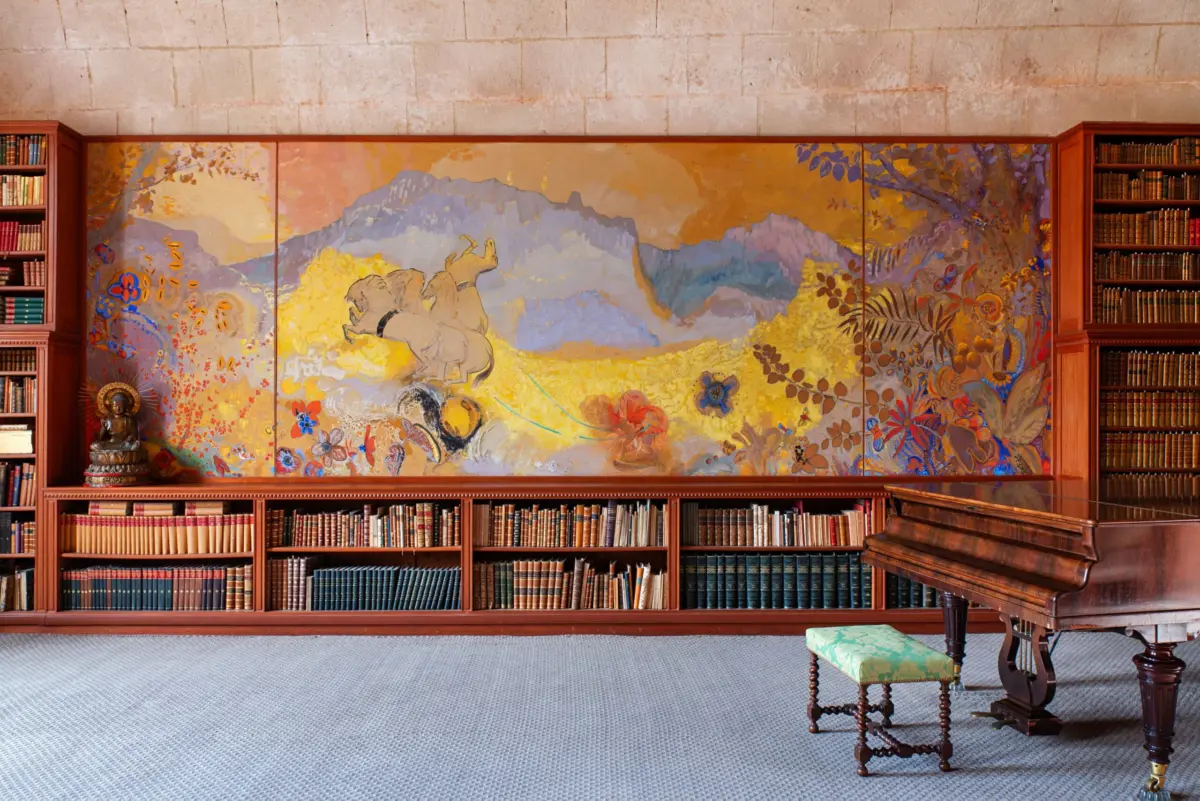
Among this celebrated group was Odilon Redon, the pioneering symbolist painter who accepted an invitation to create three remarkable, monumental murals for the abbey’s library. Titled Day, Night, and Silence, these ethereal panels represent a high-water mark of symbolist interior decoration. Significantly, the upcoming exhibition at the Fondation Louis Vuitton will mark the first time these treasured Redon panels have been brought out of the abbey for public viewing, offering visitors an unprecedented encounter with a rarely seen masterpiece of early-twentieth-century environmental art.
The serene and inspiring environment of Fontfroide also acted as a powerful catalyst, sparking a renewed wave of artistic impulses within Fayet himself. In 1911, he developed an idiosyncratic, highly original art form, experimenting with watercolor applied directly onto humble blotting paper. This technique allowed him to produce a large, vibrant body of delicate floral and botanical works characterized by a striking looseness and fluid movement.

Robert Carsen, the artistic director of the exhibition, notes the remarkable nature of these late-career explorations. "The drawings demonstrate an almost childlike spontaneity at a time when Gustave Fayet was a mature man," Carsen observes, highlighting the artist’s ability to maintain a fresh, unjaded perspective well into his later years.
Fayet’s distinctive visual vocabulary did not remain confined to works on paper. The prominent interior decorator Paul Dumas soon began reproducing Fayet’s watercolors as luxurious fabrics and intricate wallpapers. Building on this commercial and aesthetic success, Fayet and Dumas jointly founded the Atelier de la Dauphine, a specialized enterprise dedicated to manufacturing these designs as high-end rugs. Prime examples of these rare textiles have been meticulously restored specifically for the Fondation Louis Vuitton exhibition, where they will be displayed directly alongside the original watercolor artworks that inspired them, illustrating the seamless transition of Fayet’s vision from fine art to applied design. In his later years, Fayet expanded his creative output even further into the realm of illustration, illuminating works of poetry and even crafting a bespoke, hand-illustrated book intended specifically for his grandchildren.

Reflecting on the unifying thread of Fayet’s eclectic career, Carsen emphasizes the restless, exploratory nature of his output. "He was truly exploring new territory, venturing deeper and deeper into the new genre he was exploring with each new endeavor," Carsen says. Ultimately, a boundless imagination served as the through line connecting everything Fayet touched, whether he was curating avant-garde masterpieces, commissioning cutting-edge interior elements, or experimenting with novel watercolor techniques in the quiet cloisters of Fontfroide.