
As millions of Americans prepare to cast their ballots on Tuesday in the 2026 United States midterm elections, nationwide polling presents a picture of an electorate unsettled by persistent economic strains, shifting policy priorities, and sharply divided views over the governance and economic leadership of President Donald Trump.
While voters across the political spectrum share widespread concerns regarding inflation and the elevated cost of living, recent surveys highlight significant partisan divides in how Democrats and Republicans evaluate the national economy, rate the president’s performance during his second term, and prioritize key legislative issues.
Broad dissatisfaction with the economic climate remains a defining hallmark of the election cycle. In an NBC News poll published on November 1, 75 percent of registered voter respondents expressed dissatisfaction with the state of the US economy, while 51 percent reported being dissatisfied with their personal financial situations. Comprehensive survey data gathered throughout October by major nonpartisan polling organizations and media outlets provides detailed insight into how voters from both major political parties view their financial health and the overarching stakes of Tuesday’s vote.
What issues matter most to Democrats and Republicans?
While the general state of the economy serves as the primary concern for the American public, Democratic and Republican voters diverge significantly on the relative importance of secondary policy matters, including healthcare access, immigration enforcement, violent crime, and the protection of democratic institutions.
According to a Pew Research Center survey conducted between September 28 and October 4, 84 percent of registered voters identified the economy as a "very important" factor in determining their midterm vote. The economy commanded top billing among both major partisan coalitions, with 82 percent of respondents who back Republican candidates and 88 percent of those supporting Democratic candidates describing economic conditions as central to their decisions at the ballot box.
Beyond the economy, however, party affiliations reveal stark differences in voter priorities. The Pew survey indicated that approximately 85 percent of Democratic supporters considered the future of democracy to be a very important issue, compared with 69 percent of Republicans. Healthcare similarly emerged as a dominant concern for the Democratic base, with 82 percent of Democratic respondents ranking it as a major priority, whereas only 53 percent of Republican respondents felt the same.
Conversely, Republican voters demonstrated a stronger focus on border security and law enforcement. Immigration stood out as a paramount issue for Republican supporters, with 72 percent categorizing it as very important, compared to 53 percent of Democrats. Violent crime was also cited as a key priority by 64 percent of Republican voters, compared to 37 percent of Democratic respondents.
Partisan preferences regarding economic management and specific policy challenges were further detailed in a survey conducted from September 16 to 21 by the Kaiser Family Foundation (KFF), an independent nonprofit organization. The KFF poll found that 42 percent of registered voter respondents expressed greater trust in Democrats to manage healthcare costs, compared to 22 percent who favored Republicans on the issue. When asked about managing the general cost of living, 39 percent of respondents trusted Democrats more, while 25 percent indicated greater trust in the Republican Party.
The broader focus of voters has also evolved compared to previous election cycles. The Pew Research Center noted that issues such as abortion access and gun policy were less central to Democratic voters than they had been during the 2022 midterm elections. Among Republican voters, education policy and energy policy saw a decline in priority ranking compared to four years prior.
What grade do Democrats and Republicans give Trump’s second term?
Public evaluations of President Trump’s overall job performance and economic record during his second term remain intensely polarized along traditional party lines.
Data from the Pew Research Center survey showed that an overwhelming 91 percent of Democratic respondents and Democratic-leaning voters believed President Trump’s economic policies had actively worsened national conditions. Republican respondents offered a much more fractured assessment of the administration’s economic record: 39 percent stated that his policies had improved the economy, 35 percent argued they had made conditions worse, and 25 percent reported that the policies had made little difference either way.
This internal variation among Republicans contrasts with broader national assessments of the president’s tenure. The November 1 NBC News poll found that 40 percent of registered voter respondents approved of Trump’s overall job performance, while 60 percent expressed disapproval.
How do Democrats and Republicans feel about the economy?
Although economic anxiety remains a universal sentiment among the electorate, Democratic voters are significantly more likely than Republican voters to articulate severe dissatisfaction with macro-level economic conditions.
In a Pew Research Center survey published in October, 36 percent of Republicans rated the US economy as "excellent" or "good," whereas a mere 9 percent of Democrats and Democratic-leaning voters held a positive view of the economy.
Despite these differing overarching assessments, majorities in both political camps voiced intense worry about the price of everyday essential goods and service categories:
- Food and Consumer Goods: 82 percent of Democrats and Democratic leaners expressed deep concern regarding food and consumer prices, compared with 62 percent of Republicans and Republican leaners.
- Healthcare Expenses: Concerns over the cost of medical care and prescription drugs weighed on 80 percent of Democratic voters and 57 percent of Republican voters.
- Energy and Transportation: Energy and fuel prices worried 81 percent of Democrats, alongside 65 percent of Republicans.
This widespread anxiety was corroborated by a Fox News poll released on October 14, in which 74 percent of registered voters rated national economic conditions negatively, and 60 percent identified the rising cost of living as their single greatest economic burden. Even within the president’s own party, economic frustration remains substantial; the November 1 NBC News poll indicated that 53 percent of Republican respondents expressed overall dissatisfaction with the state of the economy.
Are Americans satisfied with their financial situation?
A key indicator of voter temperament ahead of Election Day is the personal financial health of households across the nation. The NBC News poll published on November 1 revealed that 51 percent of registered voters reported being dissatisfied with their personal financial situation, while 49 percent expressed satisfaction. This marked the first instance in 30 years of NBC polling where personal financial dissatisfaction outweighed satisfaction among respondents.
Data from an NPR/PBS News/Marist poll conducted October 19-20 reinforced these findings, showing that 38 percent of likely voters felt their household finances had worsened over the preceding year. Meanwhile, 44 percent reported that their financial standing had remained roughly the same, and just 15 percent stated that their finances had improved.
The Marist poll also underscored a distinct partisan divide in personal financial perceptions, with 51 percent of likely Democratic voters reporting that their personal finances had deteriorated over the past year, compared to 21 percent of Republican voters.
A separate Reuters/Ipsos survey, conducted from September 30 to October 5, highlighted the impact of inflation on household budgets, finding that 71 percent of Democrats and 57 percent of Republicans felt their personal incomes had failed to keep pace with rising prices.
Political analysts argue that specific administration policies and global developments have intensified these domestic economic pressures. Eric Ham, a former Democratic congressional staffer and Senate national security adviser, highlighted the compounding effects of foreign policy decisions and commercial tariffs on American consumers.
"Americans are paying more not just in terms of self-inflicted wounds that President Donald Trump implemented through tariffs, but also if you look at this war of choice," Ham told Al Jazeera, referring to the administration’s global trade tariffs and the ongoing US-Israel conflict with Iran.
Are Democrats or Republicans more enthusiastic about voting?
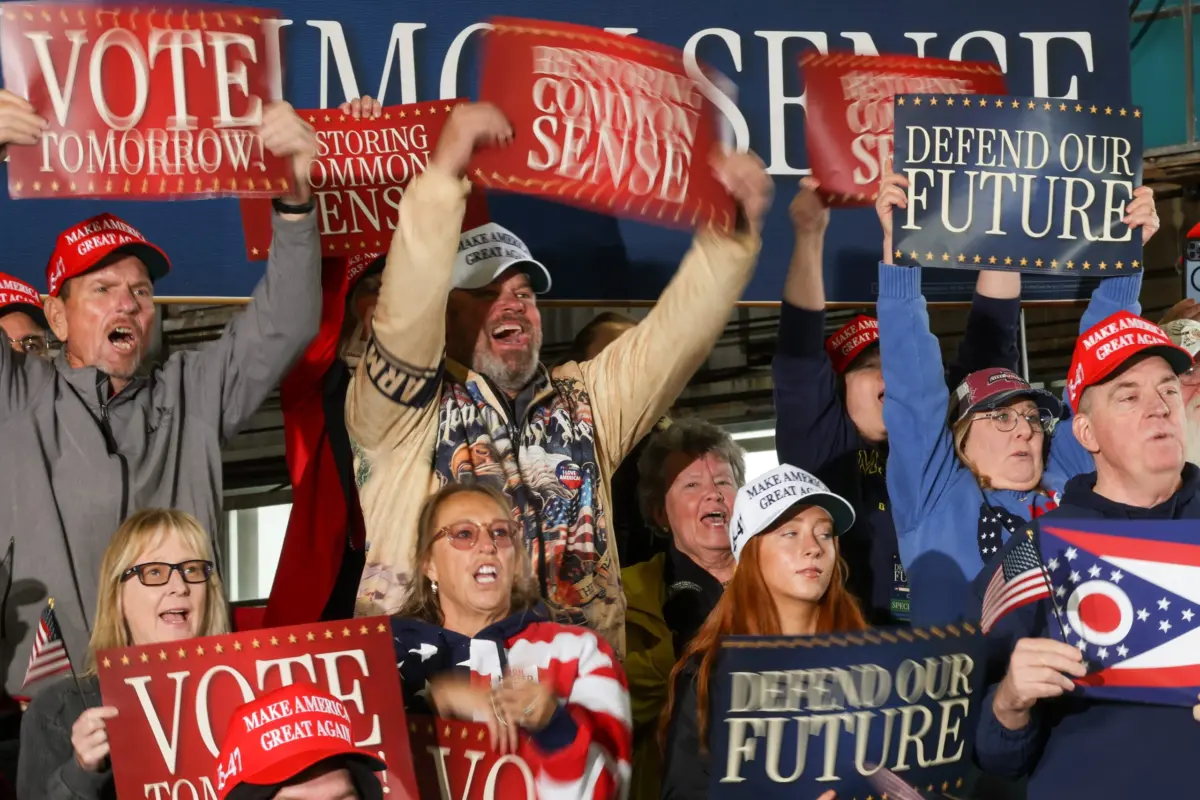
As candidates make their final pitches to the electorate, voter enthusiasm and base mobilization have emerged as decisive factors for both major political parties.
The NPR/PBS News/Marist poll indicated a notable enthusiasm gap favoring the opposition party, with 91 percent of likely Democratic voters reporting that they were "enthusiastic" or "very enthusiastic" about participating in the midterms, compared with 86 percent of Republicans and 76 percent of Independents.
This trend was echoed in the KFF survey, where supporters of Democratic candidates were 25 percentage points more likely than supporters of Republican candidates to describe themselves as "more motivated" than usual to cast a ballot (63 percent versus 38 percent).
Despite these motivation gaps between parties, overall public engagement with the midterms remains exceptionally elevated. The November 1 NBC News poll registered high interest across the board, with 70 percent of registered voters rating their interest in the upcoming election at a 9 or a 10 on a 10-point scale.
Strategists from both parties acknowledge that turnout execution will dictate the ultimate outcome of closely contested races nationwide. John Fury, a former Republican congressional staffer, emphasized that the campaign’s closing stretch was primarily focused on mobilizing core voters rather than persuading undecided elements of the electorate.
"This is not a persuasion election. This is a get-out-the-base election," Fury stated, reflecting the strategy adopted by party operatives in the election’s final hours.
Who are Americans planning to vote for?
National generic ballot polling conducted in the weeks leading up to Tuesday’s voting suggests that the broader public favors Democratic control of Congress over Republican stewardship.
An NBC News poll conducted October 28-30 and released on November 1 showed that 52 percent of registered voters preferred Democratic control of Congress, compared with 45 percent who favored maintaining Republican control.
Similarly, a Reuters/Ipsos survey conducted between October 22 and October 26 indicated that 53 percent of likely voters planned to vote for—or leaned toward—the Democratic candidate in their specific congressional district, compared to 44 percent who supported the Republican candidate.
While these national generic ballot surveys offer an overview of broad voter sentiment across the country, political analysts emphasize that they do not predict the outcomes of individual, highly competitive local district races that will ultimately determine the balance of power in Congress.