
My immersion into the menswear landscape happened fast, altering my sartorial perspective in ways I could not have anticipated. Within a couple of weeks of accepting a job overseeing the beat for a luxury title—after spending more than a decade covering womenswear—I found myself bound for Pitti Uomo. A biannual industry trade show, Pitti has long since outgrown the physical walls of the fortress that historically houses it, spilling out into the narrow, sun-drenched streets of Florence. There, it transforms into an influencer-heavy scene populated by suiting aficionados who are visibly determined to out-peacock one another, 100-plus-degree temperatures in June be damned. Yet, amidst the occasionally over-the-top spectacles and heavy performance of menswear tropes, an invaluable personal and sartorial shift quietly occurred.
I had long been drawn to tailoring whenever I wanted to feel particularly pulled together, a preference that was no doubt a result of the comforting ease of the school uniform I wore during my youth. As a fashion journalist, however, my focus was so intensely fixated on writing about rapidly shifting seasonal trends that I couldn’t fathom having the time, energy, or inclination to properly embrace everyday suiting. Even when I did lean toward structured pieces, I was far more likely to pair an orphan blazer casually with jeans. Wearing a full suit felt wildly archaic, restrictive, and, if I am being completely frank, a bit boring.

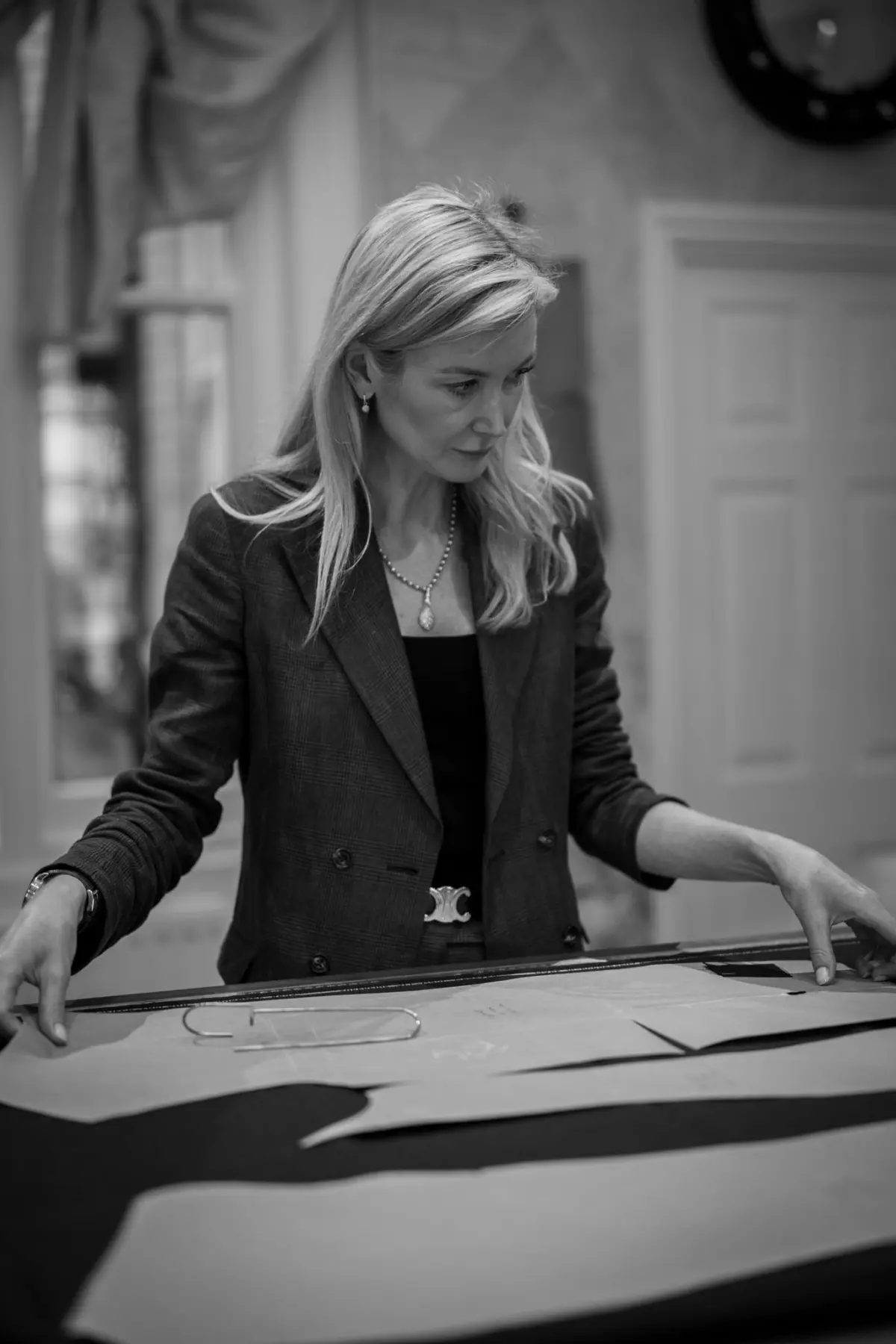
Those preconceived notions rapidly faded en route from Florence to Milan for the subsequent menswear shows, where I first caught a glimpse of my male colleagues’ impossibly minuscule suitcases. The “secret,” I would soon learn, lay entirely in their strategic approach to suiting, which they mixed and matched with aplomb over the course of nearly two weeks of constant travel and tight schedules. It was enough to finally convince me that I needed a suit of my own—one crafted specifically for my needs and proportions. When the time eventually came to commission it, I knew immediately that Savile Row’s Caroline Andrew, whom I had first met at a Pitti dinner in Italy, was the absolute perfect tailor for the job.
“Right now, about 30% of my clients are female, many of them based in the U.S.,” Andrew tells me during a conversation about the evolving demographic of bespoke tailoring. It is a surprisingly impressive figure given that, on “the Row,” bespoke tailoring has historically been an exclusive service geared almost entirely toward men, with many traditional houses not even accustomed to cutting traditional patterns for the female form. Among Andrew’s growing clientele, she counts notable creative figures such as jewelry designer Jessica McCormack, gallerist Louisa Guinness—from whose namesake gallery Kendall Jenner famously procured those ultra-rare Alexander Calder artist earrings—and Fiona Dreesman of the popular Belgravia homewares boutique Fiona’s Finds.
Those same female clients are also frequently looking for something a bit left of center, moving away from conventional womenswear options that often sacrifice quality for fleeting trends. Where most traditional tailors on Savile Row maintain a strict house style to which they rigidly adhere, Andrew keeps a close eye on contemporary fashion while retaining a refreshing willingness to collaborate directly with her clients. “Suiting for me is like a uniform,” Dreesman tells me, noting also that bespoke construction ensures the absolute perfection of sleeve lengths for her tall frame. “I get up and don’t have to think about things going together. It is chic and sharp and you are always well dressed from day to night.”

Investing in a bespoke Savile Row suit is, by any standard, a significant financial and stylistic commitment. Semi-bespoke suits typically start around £3,000, roughly $4,000, while fully bespoke options start at £5,000, or roughly $6,600, reflecting the fact that every single garment is entirely handmade by skilled artisans. My personal goal for the project was singular: a single garment that could comfortably get me through the myriad formal occasions of the festive winter season, rather than purchasing multiple evening dresses that would inevitably take up precious New York City closet real estate. Looking ahead to the fall—as the process from start to finish is roughly a six-month endeavor involving three distinct fittings—I ultimately decided on a tuxedo.
While the sheer number of customization options can initially feel overwhelming, it was ultimately an easy decision to make, though one that immediately begged detailed questions regarding lapel widths, buttonholes, interior and exterior fabrics, and proper trouser length. To spare myself any unnecessary stress, I decided to defer entirely to Andrew’s expert aesthetic judgment, a choice I would highly recommend to anyone embarking on bespoke tailoring for the first time.
Together, we landed on a double-breasted number featuring a hidden placket, which felt distinctly more modern, executed in a rich black wool barathea—widely regarded as the most traditional of all tuxedo fabrics. We paired this with a silk-satin peak lapel and clean jetted pockets. At this preliminary stage, which marked our first official fitting, there was of course no finished garment to speak of, other than the inspiring visions captured on a mood board I had put together. Countless precise measurements were taken during this session, and it was decided that the coordinating trousers would be designed in a slightly wide, straight-leg style with fine satin tape running the length of the outside hem. Recognizing the clean look required, Andrew eliminated belt loops entirely in favor of tonal side adjusters.

A few months later, Andrew was back in New York for subsequent fittings, and the tuxedo was steadily taking shape. With the intricate, hand-stitched patterns and the structural horsehair canvas fully visible beneath the unfinished cloth, it was impossible not to marvel at the sheer amount of work, patience, and rigorous training required for the construction of such a garment. Apprenticeship lengths on Savile Row typically range from two to six years, with the shorter end usually reserved for those specializing exclusively in the delicate making of trousers. Andrew forged her own distinct path through an industry that was historically dominated by an old boys’ network, earning her degree at the London College of Fashion and gaining invaluable hands-on experience through internships at Burberry, Edward Sexton, and Henry Poole.
When I met up with Andrew again in New York in mid-September for the final reveal, I could not have been more thrilled with the result. For clients who cannot easily make the journey to London, Andrew maintains a robust and active trunk-show schedule across the United States. Beyond the polished exterior, which is entirely customized to your personal preferences and precise anatomical measurements, the interior architecture of a Savile Row garment is like nothing you will ever find off the rack. A hidden interior canvas constructed of horsehair and wool is meticulously placed between the jacket’s outer fabric and inner lining, allowing the garment to naturally mold to the wearer’s unique figure over time. This ensures that it hangs and moves impeccably while enduring for decades. Furthermore, clever interior seam allowances enable seamless future alterations, should one’s weight or measurements fluctuate.
“Having bespoke means I am never walking into a room wearing the same as anyone else. It is timeless,” says Dreesman, who particularly enjoys adding idiosyncratic individual touches, such as opting for six decorative buttons on her jacket sleeves.

Since my initial meeting with Andrew, much has changed in my professional and personal life. My intense Pitti Uomo days are now firmly behind me, and instead of frantically running around Fashion Week venues, I am navigating the complex maze that is the D&D building as an interior designer—frequently dressed in sharp tailoring now that the weather has turned cooler. Curiously, I find myself enjoying the daily process of getting dressed more than I ever did when working in fashion full-time. Perhaps it is simply the comforting ease of suiting, combined with the enduring challenge of embracing something genuinely new.