
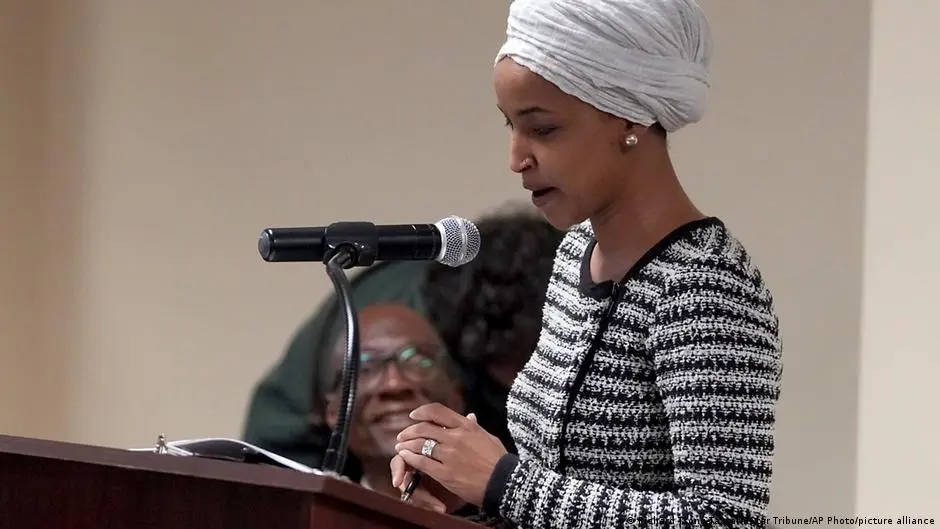
"Ilhan Omar, whatever the hell her name is, with the little — with the little turban, I love her. She comes in, does nothing but bitch."
"Ilhan Omar is garbage. She’s garbage. Her friends are garbage. […] These aren’t people that work. These aren’t people that say, let’s go. Come on, let’s make this place great. These are people that do nothing but complain."
"She comes in from a country without laws, without police, without military, where all they do is shoot each other. And she comes into our country, and she says, ‘I have a constitutional right.’ She’s telling us about the constitution, and she comes from one of the worst countries anywhere on the planet."
These inflammatory statements represent only a fraction of the frequent, intensely personal verbal assaults that Donald Trump has directed at Democratic Representative Ilhan Omar of Minnesota. Over the course of his political career, few public figures have been targeted by the Republican leader with as much sustained ferocity.
From insults aimed at her background and religious attire to sweeping dismissals of her civic legitimacy, the ongoing confrontation between the former president and the congresswoman has come to encapsulate the sharp ideological, racial, and cultural divisions defining contemporary American politics. Yet the persistent intensity of these attacks raises an enduring question: why has Trump consistently singled out Ilhan Omar for such hostility, and what does the confrontation reveal about the broader political landscape as another high-stakes election season approaches?
Who is Ilhan Omar?
To understand why she has become such a polarizing lightning rod in national politics, one must examine the path that brought Omar to the halls of power in Washington.
The 44-year-old lawmaker was born Ilhan Abdullahi Omar in Mogadishu, the capital city of Somalia. When a catastrophic civil war engulfed the nation during her childhood, her family was forced to flee their home. They spent four formative years living in an austere refugee camp across the border in neighboring Kenya, navigating the profound uncertainties and deprivations familiar to millions displaced by armed conflict.
In 1995, at the age of 12, Omar and her family finally secured resettlement in the United States, beginning a new chapter in a country vastly different from the one she had left behind. She went on to become a naturalized American citizen in 2000, embracing civic engagement and ultimately entering formal politics as a member of the Democratic Party’s progressive left wing.
Omar’s political ascent gained historic momentum in November 2018. When she was elected to represent Minnesota’s 5th Congressional District — an area encompassing Minneapolis and surrounding communities that house the largest Somali American population in the country — she took office in January 2019 as one of the first two Muslim women ever elected to the United States Congress.
Her very presence in the Capitol challenged long-standing traditions. Omar is an observant, practicing Muslim who wears a traditional hijab. In order for her to serve without violating chamber protocol, Congress had to amend a 180-year-old internal rule that explicitly prohibited members from wearing head coverings on the floor of the House of Representatives.
Throughout her tenure in public office, Omar has consistently championed robust progressive priorities, frequently drawing an explicit connection between her Islamic faith and her enduring commitment to social justice, universal human rights, and the vigorous protection of marginalized minority communities.
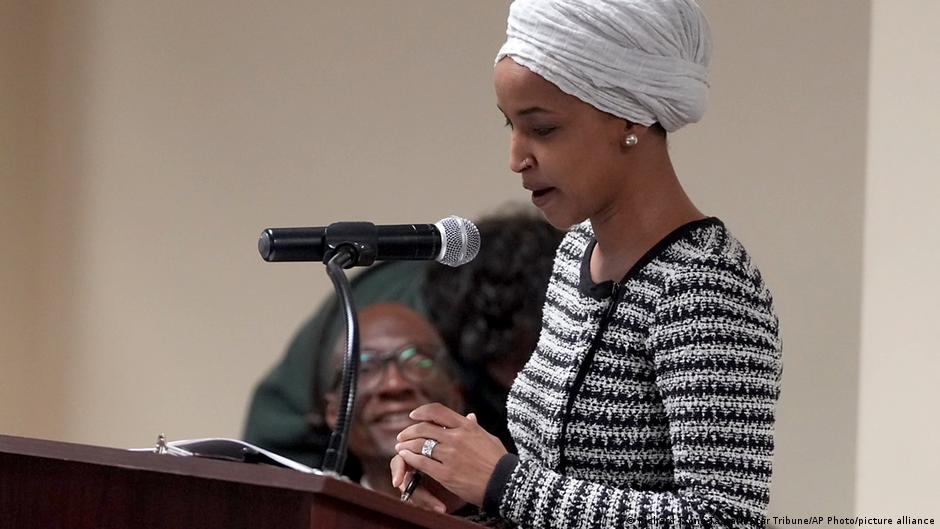
Her legislative platform and campaign priorities reflect that progressive core. Omar has consistently mobilized support around proposals for universal, government-funded healthcare coverage, substantial increases to the national minimum wage, aggressive federal policies aimed at climate protection, and the comprehensive cancellation of federal student loan debt.
Simultaneously, Omar has established herself as one of Trump’s most outspoken and uncompromising adversaries in Congress. She has repeatedly and publicly accused him of harboring racist views and of systematically inciting public animosity against racial minorities, foreign-born immigrants, and the American Muslim community.
Furthermore, the Minnesota representative has regularly and fiercely condemned immigration enforcement crackdowns overseen by the U.S. Immigration and Customs Enforcement agency (ICE), famously characterizing such enforcement raids as an aggressive, "militarized campaign of fear" targeted at vulnerable populations. Omar has also repeatedly confronted Trump directly on governance, leveling stark accusations of official corruption against his administration.
Criticism of Israel and accusations of antisemitism
Demographically, politically, and stylistically, Omar represents the stark antithesis of the 80-year-old Republican leader. She is young, female, foreign-born, unapologetically outspoken, Muslim, and positioned firmly on the progressive wing of the Democratic Party, contrasting directly with Trump’s older, conservative, and populist base.
However, Omar’s combative posture has not only drawn the ire of Republicans; she has also frequently found herself at the center of fierce friction and debate within her own party.
Much of this friction stems from foreign policy, where Omar has emerged as one of the most uncompromising and high-profile critics of the state of Israel in modern American congressional history. Throughout her time on Capitol Hill, she has consistently challenged the conventional, bipartisan consensus regarding Washington’s extensive financial, military, and diplomatic backing of Israel, openly questioning whether such unconditional support aligns with human rights standards.
These recurring critiques have repeatedly generated fierce blowback, with opponents from across the political spectrum accusing her of engaging in antisemitic rhetoric. Among the most controversial positions she has taken is her explicit support for the Boycott, Divestment and Sanctions (BDS) movement, an international campaign that seeks to apply financial, cultural, and political pressure on Israel by encouraging boycotts of its institutions and commercial enterprises.
While many critics have denounced BDS as discriminatory and fundamentally aimed at delegitimizing Israel, Omar has consistently defended the movement as a fully legitimate form of peaceful, non-violent political protest protected under the First Amendment principles of free expression. In 2019, she introduced a formal resolution in the House of Representatives designed to affirm and bolster the fundamental constitutional right of American citizens to engage in political boycotts, specifically seeking to counter state and federal legislative initiatives aimed at curtailing BDS activism.
Tensions surrounding her foreign policy commentary reached a boiling point early in 2023. Following the Republican takeover of the House of Representatives, the GOP-led majority voted to strip Omar of her assignment on the prestigious House Foreign Affairs Committee.
Republicans cited a history of controversial public statements and past social media posts as justification for the move. Primary among the cited grievances was a contentious statement made in 2021, in which Omar was widely condemned for appearing to draw a moral equivalence between the official military operations of the United States and Israel and the atrocities carried out by non-state militant entities, specifically the Afghan Taliban and the Palestinian militant organization Hamas, which the U.S. and numerous international allies officially designate as a foreign terrorist group.
Accusations of embezzlement and immigration fraud
Alongside foreign policy disputes, conservative opponents and right-wing commentators have repeatedly sought to tether Omar to financial improprieties and public corruption investigations within her home state of Minnesota.

During the height of the COVID-19 pandemic, a massive fraud scheme was uncovered in Minnesota involving the misappropriation of roughly $250 million (€220 million) from a federally funded program intended to provide nutritional support and meals to underprivileged children. Omar had previously advocated for expanding access to relief resources and easing bureaucratic rules for child nutrition initiatives during the health emergency to ensure aid flowed quickly to struggling communities.
When federal investigators uncovered that a substantial portion of the stolen funds had been siphoned off through fraudulent non-profit entities, the subsequent indictments and convictions revealed that many of the individuals involved were members of Minnesota’s Somali American diaspora.
Political adversaries, including Trump himself, immediately seized upon these demographic and geographic ties to publicly imply that Omar was intimately connected to or complicit in the historic fraud. Despite these persistent public insinuations, law enforcement agencies and federal prosecutors handling the complex embezzlement prosecutions have never accused Omar of any criminal wrongdoing, financial impropriety, or personal involvement in the scheme.
More recently, attacks against the congresswoman have shifted back to her personal origins and her initial entry into the country decades ago. For years, right-wing critics have pushed unverified allegations claiming that Omar submitted fraudulent documentation during her family’s immigration process. Some conservative internet commentators and opponents have gone as far as alleging that she engaged in a sham marriage with her own biological brother in a fraudulent attempt to secure a U.S. entry visa for him.
The long-simmering dispute over her immigration status escalated sharply on October 12, when federal agents executed an official search warrant at Omar’s personal residence. The investigative operation was reportedly initiated over allegations that Omar’s father may have made false representations regarding her actual age on official documentation submitted during the family’s original immigration application process in the late 1990s.
During the search, personnel from the Department of Homeland Security were observed removing property from the lawmaker’s residence, including brown evidence boxes marked as seized property, carrying out an extraordinary federal enforcement action against an incumbent member of the United States Congress.
Controversial house search
The unprecedented raid on a sitting federal legislator’s private home immediately ignited a fierce political and legal firestorm.
Omar forcefully denied all allegations of wrongdoing, vehemently denouncing the federal search as a transparent and abusive "campaign of political intimidation" orchestrated by her ideological adversaries. She characterized the operation as a blatant, partisan effort to weaponize executive power in order to target and silence prominent political enemies.
Her outrage was quickly echoed by numerous influential figures within the Democratic Party. Senior Democratic leaders rushed to Omar’s defense, issuing scathing public statements that accused the Trump administration of actively compromising the independence of the Department of Justice and the Department of Homeland Security by deploying federal law enforcement assets as political instruments against domestic opponents.
The tactical necessity of the raid was also met with skepticism by former career officials. Multiple former federal immigration officers told reporters at the Reuters news agency that staging a physical search of a private residence to resolve an inquiry of this nature was extremely irregular and out of character for such investigations. Former personnel noted that if the core inquiry centered on whether Omar’s late father had misstated demographic details or manipulated her age on entry forms decades earlier, the federal government itself would already possess all of the pertinent primary source files, archival records, and historical immigration paperwork within its own repositories.
Beyond the logistical justifications, the timing of the enforcement action drew immense criticism. The raid was executed merely three weeks before congressional elections in which Omar was actively standing for re-election to retain her House seat.

Historically, the Department of Justice and federal law enforcement agencies have adhered to a long-standing, unwritten operational norm commonly known as the "60-Day Rule." Under this institutional convention, prosecutors, federal investigators, and enforcement agencies strictly avoid taking overt, highly public investigative actions against active political candidates in the two months leading up to an election, specifically to prevent law enforcement operations from improperly influencing voter behavior or shifting the outcome of a democratic race.
Civil rights advocates, legal scholars, and Democratic lawmakers argued that disregarding this established guideline to execute a disruptive home raid over a bureaucratic formality dating back 26 years crossed a dangerous line, representing what they condemned as direct election interference.
Other Muslim politicians also targeted
The escalating confrontation with Omar comes at a delicate political moment for the administration. As crucial midterm elections approach, Donald Trump has been grappling with plummeting public approval ratings and deep political headwinds, prompting a campaign strategy that increasingly relies on grievance, base mobilization, and sharp cultural confrontations.
Within this broader electoral context, Omar is far from the only prominent Muslim political figure to find themselves subjected to hostile and inflammatory rhetoric from the former president.
Another frequent target of Trump’s public broadsides has been Dr. Abdul El-Sayed, the Democratic nominee campaigning to represent the state of Michigan in the United States Senate.
Speaking to a packed crowd at a political campaign rally on a recent Saturday in Tennessee, Trump took aim directly at the Michigan Senate hopeful, using openly disparaging language regarding his identity.
Addressing the audience, Trump stated: "I call him Mohammed. Somebody said, ‘His name isn’t Mohammed, it’s Abdul.’ I said, ‘To me, it’s Mohammed.’ I’m the president. I can call him whatever the hell I want. To me, he’s Mohammed, and he’s a radical jihadist."
The inflammatory rhetoric from the rally stage stands in direct opposition to El-Sayed’s actual background and public record. There is no intelligence, law enforcement information, or evidence of any kind suggesting that the Michigan Democrat maintains any ties to extremist networks or radical groups.
The 41-year-old physician and epidemiologist was born and raised in Michigan. After completing his undergraduate education in the state, he earned a Rhodes scholarship to the University of Oxford, where he completed a doctorate in public health before obtaining his medical degree. He subsequently went on to serve as the executive health director for the city of Detroit, earning professional acclaim for managing the city’s health challenges following its municipal bankruptcy.
Like Omar, El-Sayed aligns politically with the progressive wing of the Democratic Party, organizing his Senate campaign around addressing systemic socio-economic hardships.
Throughout his campaign across Michigan, El-Sayed has repeatedly pushed back against the administration’s rhetoric, emphasizing to voters that progressive candidates and immigrant communities bear no responsibility for the economic anxieties facing American families. Instead, the physician-turned-politician has pointed to the sharp rise in grocery prices, skyrocketing housing and rental costs, and broad social grievances, placing the blame squarely on what he characterizes as the failed domestic and economic policies of the administration in Washington.