
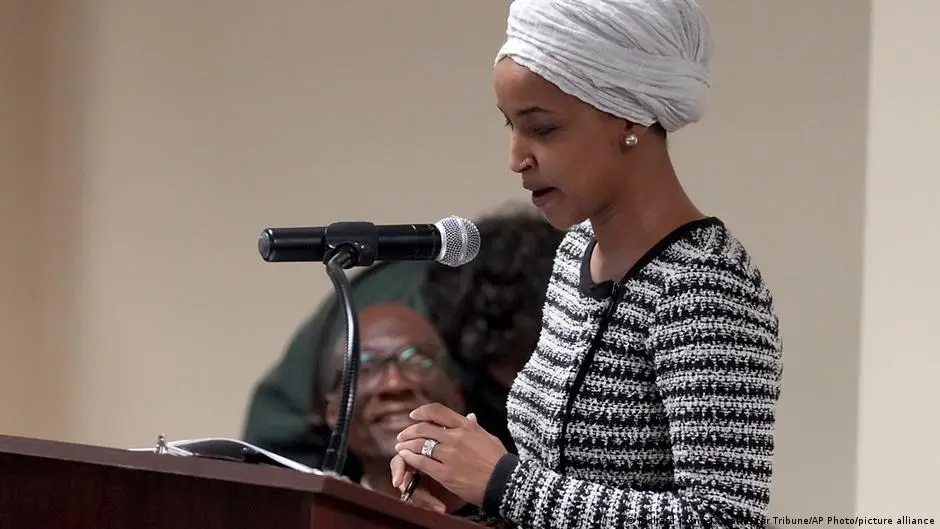
"Ilhan Omar, whatever the hell her name is, with the little — with the little turban, I love her. She comes in, does nothing but bitch."
"Ilhan Omar is garbage. She’s garbage. Her friends are garbage. […] These aren’t people that work. These aren’t people that say, let’s go. Come on, let’s make this place great. These are people that do nothing but complain."
"She comes in from a country without laws, without police, without military, where all they do is shoot each other. And she comes into our country, and she says, ‘I have a constitutional right.’ She’s telling us about the constitution, and she comes from one of the worst countries anywhere on the planet."
These inflammatory statements represent only a fraction of Donald Trump’s persistent, high-profile rhetorical assaults directed at Democratic Representative Ilhan Omar of Minnesota. Over the course of his political career, few figures have been singled out by the former president with such unyielding ferocity. The escalating hostility has intensified significantly following an aggressive federal law enforcement action at the congresswoman’s residence, reviving deep debates about civil liberties, immigration politics, and the alleged political weaponization of executive power against prominent minority lawmakers.
Who is Ilhan Omar?
Ilhan Abdullahi Omar, 44, has lived an extraordinary trajectory that embodies the global upheavals of the late twentieth century. Born in the Somali capital of Mogadishu, her early childhood was shattered by the outbreak of the catastrophic Somali civil war. Fleeing the violence with her family, she spent four formative years living in a refugee camp in neighboring Kenya, facing the privations shared by hundreds of thousands displaced by the Horn of Africa’s conflicts.
Omar arrived in the United States in 1995 at the age of 12, eventually settling in the metropolitan center of Minneapolis, Minnesota, which hosts the largest Somali diaspora community in the nation. She became a naturalized U.S. citizen in 2000. Embracing grassroots organizing and public service, she aligned herself with the Democratic Party, rising through the ranks of its progressive left wing. In January 2019, Omar achieved a historic breakthrough by entering the U.S. House of Representatives, becoming one of the first two Muslim women ever elected to Congress alongside Rashida Tlaib of Michigan.
As an observant, practicing Muslim who wears a hijab, Omar’s entrance into the national legislature required dismantling an institutional barrier: Congress voted to modify an antiquated 180-year-old house rule that had long prohibited head coverings of any kind on the floor of the House of Representatives.
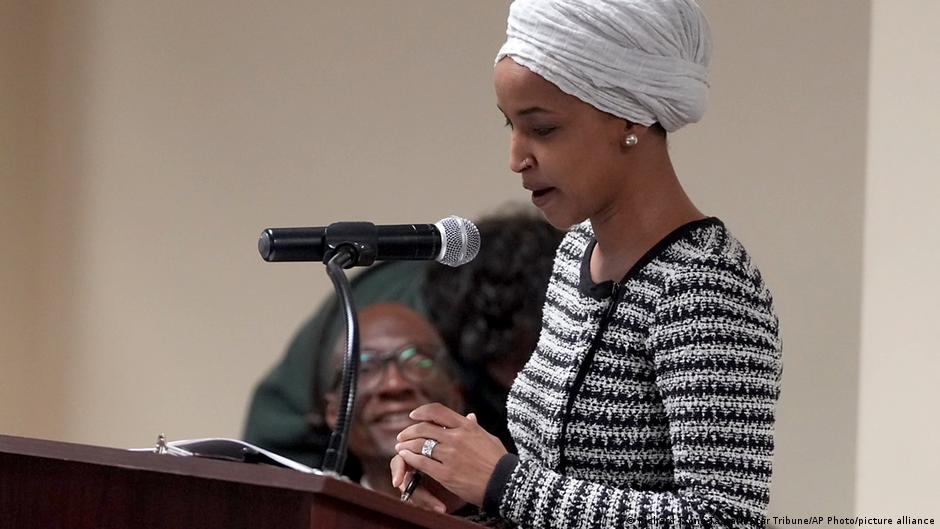
Throughout her legislative tenure, Omar has closely tethered her personal Islamic faith to a platform centered on social justice, human rights, and the protection of vulnerable minorities. Championing bold policies on the progressive wing of the Democratic Party, she has fought for universal healthcare coverage, significant hikes to the minimum wage, robust government climate protection policies, and broad student loan debt cancellation.
Concurrently, Omar has established herself as one of the most visible and unflinching adversaries of Donald Trump. She has repeatedly accused him of engaging in open racism and intentionally cultivating hostility against racial minorities, immigrants, and Muslims. Her critiques have frequently taken aim at immigration enforcement mechanisms, specifically raids carried out by the U.S. Immigration and Customs Enforcement agency (ICE), operations she has sharply denounced as a "militarized campaign of fear." She has regularly pointed to what she identifies as profound ethical compromises and institutional corruption inside his administration.
Criticism of Israel and accusations of antisemitism
While Omar presents an almost symmetrical cultural and political contrast to the 80-year-old Republican Trump—standing as a young, outspoken, immigrant, female, Muslim progressive opposite an older, conservative real-estate magnate—she has also emerged as a polarizing figure within her own party caucus.
In Washington, Omar has consistently ranked among the most unsparing critics of the State of Israel, frequently questioning the bipartisan consensus governing substantial American diplomatic and military assistance. Her foreign policy positions have regularly embroiled her in accusations of antisemitism. She has openly supported the Boycott, Divestment and Sanctions (BDS) movement, an international campaign urging commercial and cultural disengagement from Israeli entities to press for Palestinian rights.
Omar has argued that BDS is a constitutionally protected vehicle for non-violent dissent and political expression. In 2019, she went so far as to introduce a congressional resolution designed to safeguard and reinforce the fundamental rights of American citizens to organize and participate in boycotts, explicitly crafted to push back against state and federal efforts seeking to penalize or restrict the BDS movement.
These geopolitical disputes reached a peak in early 2023 when the newly seated Republican majority in the House of Representatives took the severe step of voting to strip Omar of her assignment on the prestigious House Foreign Affairs Committee. Republicans justified the removal by pointing to several contentious social media remarks and public statements she had made over the preceding years. Among the most contested was a 2021 comment that critics argued drew a moral equivalence between the conduct of the United States and Israel on the one hand, and the actions of the Afghan Taliban and the Palestinian militant group Hamas on the other. Hamas remains designated as a terrorist organization by the United States government and numerous other international authorities.
Accusations of embezzlement and immigration fraud
In addition to foreign policy friction, conservative adversaries have repeatedly sought to link Omar to high-profile financial improprieties back in her home state. Following the onset of the COVID-19 pandemic, Minnesota was shaken by an expansive social services scandal in which an estimated $250 million (€220 million) intended for a federally funded children’s nutrition initiative was systematically embezzled. Because Omar had advocated for loosening administrative restrictions and expanding access to these pandemic-era nutrition programs, opponents attempted to connect her to the subsequent fraud.

The fact that several individuals convicted in the sweeping theft were members of Minnesota’s Somali immigrant community prompted right-wing commentators and Trump himself to claim the congresswoman was tied to the operation. Yet, despite aggressive public scrutiny, law enforcement agencies and prosecutors have never accused Omar of any wrongdoing, participation, or prior knowledge regarding the illicit scheme.
Simultaneously, conservative opponents have waged a years-long campaign questioning the legitimacy of Omar’s original immigration path to the United States. Hostile critics have alleged that her family submitted fraudulent declarations during their naturalization proceedings, at times circulating an unverified and sensational claim that she had entered into an illegal sham marriage with her biological brother to secure him an American visa.
The decades-old dispute escalated dramatically on October 12, when federal agents executed a formal search warrant on Omar’s personal residence. The high-profile raid was reportedly initiated over allegations that Omar’s late father had misstated her actual age on foundational immigration documentation filed more than a quarter of a century earlier.
Controversial house search
The physical search of a sitting federal lawmaker’s home provoked immediate, fierce pushback from Omar and a chorus of prominent Democratic allies. Omar categorically dismissed the underlying allegations and condemned the armed law enforcement intervention as an unvarnished "campaign of political intimidation" and "an attempt to target political enemies" by an adversarial executive branch. Leading Democrats rallied to her defense, issuing statements warning that the Trump administration had crossed a perilous threshold by overtly weaponizing the Department of Justice and the Department of Homeland Security to suppress elected political opponents.
The tactical necessity of the raid was also met with deep skepticism within the professional legal and immigration enforcement communities. Former senior immigration officials noted to Reuters that dispatching armed federal agents to raid a private residence over paperwork issues of this nature was virtually unheard of. Because foreign citizens applying for naturalization generate exhaustive documentary trails, the federal government would typically already possess all relevant historical immigration papers in its official archives, making a physical search of a home redundant.
Legal observers and civil liberties advocates further condemned the aggressive intrusion on an elected congresswoman over an alleged administrative discrepancy dating back 26 years, placing particular emphasis on the calendar. The search was staged just three weeks prior to the national congressional elections, in which Omar was actively running to retain her seat.
Under established Department of Justice norms, the long-standing, unwritten "60-Day Rule" instructs federal law enforcement agencies and prosecutors to refrain from executing highly publicized search warrants, issuing indictments, or taking overt investigative actions against political candidates in the two-month window preceding an election. The express intent of the guideline is to insulate law enforcement from partisan manipulation and avoid shaping electoral results. Critics argued that discarding this protective precedent in Omar’s case amounted to direct, state-sanctioned election interference.

Other Muslim politicians also targeted
The targeting of Omar has unfolded against a volatile political backdrop. With pivotal midterm congressional contests arriving, Trump has faced sharply declining approval numbers, leading him to double down on racially charged rhetoric at campaign events to energize his base. Omar has not been the sole Muslim political figure subjected to aggressive public attacks from the former president.
Abdul El-Sayed, the Democratic Party’s candidate campaigning for an open U.S. Senate seat in Michigan, has similarly become a frequent focal point of Trump’s public rallies. Addressing a crowded campaign gathering in Tennessee on a recent Saturday, Trump openly derided the Michigan candidate’s heritage: "I call him Mohammed. Somebody said, ‘His name isn’t Mohammed, it’s Abdul.’ I said, ‘To me, it’s Mohammed.’ I’m the president. I can call him whatever the hell I want. To me, he’s Mohammed, and he’s a radical jihadist."
The inflammatory characterization is wholly detached from reality; no U.S. intelligence agency or domestic security apparatus has ever produced evidence suggesting El-Sayed has ties to extremism. Born and raised in Michigan, the 41-year-old physician and epidemiologist earned his undergraduate degree in his home state before winning a prestigious Rhodes scholarship to Oxford University, where he completed a doctorate in public health. Prior to running for higher office, he served as the executive director of the Detroit Health Department. Much like Omar, El-Sayed identifies with the progressive flank of the Democratic Party.
On the campaign trail in Michigan, El-Sayed has pushed back against Trump’s attacks by keeping his focus on economic concerns. The Senate hopeful has repeatedly told voters that he bears no responsibility for the sharp increases in consumer grocery bills, escalating housing rents, and broader socio-economic burdens facing middle-class families, placing the blame squarely on what he characterizes as the damaging and failed governing policies orchestrated by the political establishment in Washington.