
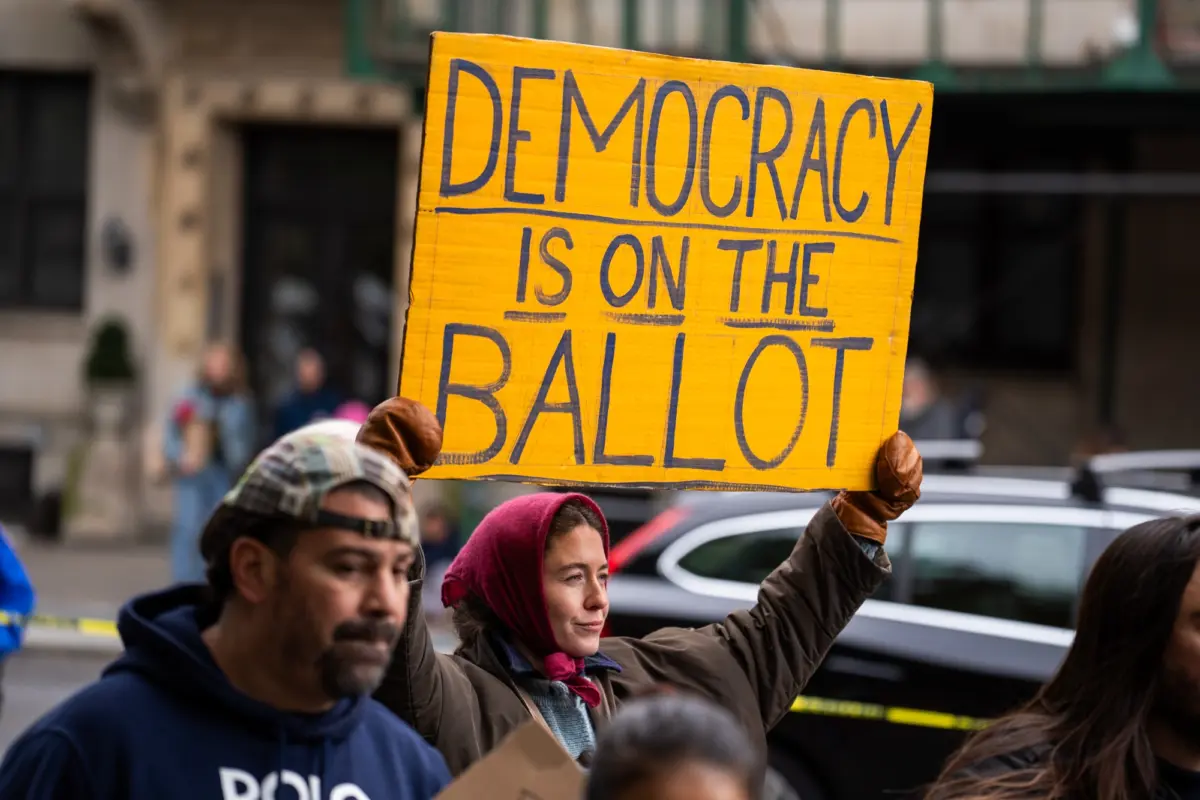
Nationwide rallies organized by the "No Kings" network brought crowds of demonstrators into public spaces across the United States on Saturday, with organizers deploying a coordinated campaign to encourage early voter turnout ahead of the upcoming midterm elections. Spanning thousands of cities and local communities, the widespread weekend events represented a concerted push to convert sustained political activism into direct participation at the ballot box.
Organizers reported that the broader network had planned more than 3,000 separate gatherings across the country as part of the nationwide day of action. Designated under the official mantle "No Kings: Vote Early," the rallies were formally framed as nonpartisan civic initiatives aimed at driving voters to cast their ballots well ahead of Election Day. Despite their nonpartisan framing, the events were deliberately designed to build upon nearly two years of rallies, marches, and public demonstrations spearheaded by citizens voicing discontent with the presidency and policies of United States President Donald Trump.
In official statements released alongside the nationwide push, movement representatives stressed that the overarching focus of the day was to maximize voter engagement across diverse demographics and ensure that eligible citizens understand how to navigate available voting channels in their respective jurisdictions. "It’s a day of nonpartisan voter participation: we are bringing our community together to make a plan to vote early and ensuring every eligible voter understands their options for how to vote and has the opportunity to make their voice heard," organizers stated in an official release detailing the scope of the mobilization.
Beyond simply encouraging civic participation, leaders behind the "No Kings" initiative articulated a distinct strategic rationale for prioritizing early voting options, such as early in-person voting and mail-in balloting. By persuading voters to cast their ballots well in advance of the official election deadline, organizers explained that they hope to mitigate potential voting disruptions, administrative bottlenecks, and procedural challenges that could emerge on Election Day itself. Cutting off the potential for any malfeasance or operational breakdown once the main polling day arrives served as a key motivational factor driving the movement’s core messaging.
The nationwide effort manifested in public parks, municipal squares, and iconic national landmarks across the country. In the nation’s capital, a crowd estimated at a few hundred people gathered on the grounds of the Lincoln Memorial in Washington, D.C., bundled in winter caps and heavy overcoats against a persistent seasonal chill. Despite the frosty weather conditions, the mood among attendees remained lively as a live musical band entertained the audience, prompting many in the crowd to dance in front of the historic monument.
Participants at the Washington gathering held aloft a wide assortment of hand-painted signs and printed placards reflecting the central themes of the mobilization. Prominent among the visual displays were messages reading "VOTE EARLY" alongside defensive rallying cries such as "HANDS OFF MY VOTE!" The signs underscored the dual emphasis of the event: actively encouraging early participation while simultaneously resisting perceived threats to voting access and democratic norms.
Similar scenes unfolded in southern urban centers, where public officials joined grassroots activists on stage to rally attendees. At a high-profile event held in Atlanta, Georgia, local leadership took to the podium to directly connect early voter turnout to individual civic power and constitutional rights. Atlanta City Councilman Michael Julian Bond delivered an impassioned address, urging assembled rallygoers to actively pressure their neighbors, families, and wider community members to cast their ballots ahead of the general election scheduled for November 3.
Framing the act of voting through the lens of fundamental constitutional authority, Councilman Bond directly challenged the audience to recognize the inherent power carried by every single registered voter in the country. "The Constitution gives you one power, right? That is the power to vote. Are you gonna use that power?" Bond told the cheering crowd, emphasizing that democratic rights remain ineffective unless citizens take deliberate action to exercise them at the ballot box.
To drive his point home, Bond drew vivid parallels between democratic franchise and popular cultural figures known for their unyielding abilities, invoking fictional icons to illustrate the absurdity of voluntarily relinquishing political influence. "You don’t see Superman giving up his power," Bond continued during his speech. "You don’t see Black Panther giving up his power. You don’t see Wonder Woman giving up her magic lasso. So why would you give up your right, your power, your obligation to vote? Be a superhero, use your power. Go to the polls and vote."
The widespread public push to accelerate early voter participation occurs against the backdrop of an increasingly contentious national debate surrounding election administration, voting procedures, and ballot security protocols. President Trump has long expressed deep-seated suspicion regarding alternative voting mechanisms, particularly mail-in ballots, frequently characterizing expanded ballot access as vulnerable to systemic exploitation. Over the course of several years, Trump has repeatedly asserted without evidence that widespread voter fraud was responsible for his loss in the 2020 presidential election, a rhetoric that continues to heavily influence federal policy approaches and partisan debates over voting laws.
The political friction over early and mail-in voting escalated significantly in the days leading up to the Saturday rallies through major legal actions initiated by the federal government. On Thursday, the Trump administration officially filed a federal lawsuit against election officials in California. The lawsuit asks a federal judge to issue an order barring state officials from counting mail-in ballots submitted by individuals whom the federal government has identified as "likely" noncitizens, preventing those votes from being tabulated until state authorities can definitively confirm their legal immigration and citizenship status.
The federal legal challenge against California marks a sharp escalation in the administration’s intervention into state-level election operations, raising significant questions regarding the oversight role of federal authorities in state election administration. By targeting specific subsets of mail-in ballots prior to the midterms, the lawsuit has placed additional operational strain on local election boards tasked with managing complex voting procedures under tight statutory deadlines.
Further compounding the tension surrounding election administration, the United States Department of Justice issued a direct warning on Friday aimed at municipal and county election workers across the nation. The Department of Justice cautioned that local election officials who proceed with processing, handling, or tabulating ballots submitted by individuals suspected of being noncitizen voters could be exposing themselves to formal federal criminal investigations and potential legal prosecution.
The Justice Department’s explicit warning sent shockwaves through the election administration community, instilling deep concern among state and local officials responsible for overseeing poll sites and ballot counting centers. Critics of the warning argue that threatening local election personnel with federal criminal liability creates an atmosphere of intimidation that could disrupt standard administrative functions and delay the counting of validly cast ballots.
In immediate response to the administration’s legal actions and law enforcement warnings, prominent Democratic lawmakers in the United States Senate launched a formal countermeasure aimed at curbing potential federal interference in the upcoming midterm results. Earlier on Friday, a group of senior Senate Democrats—including Senator Alex Padilla of California, Senator Sheldon Whitehouse of Rhode Island, and Senator Dick Durbin of Illinois—sent an official letter to United States Attorney General Todd Blanche.
In their formal correspondence to the nation’s top law enforcement official, Senators Padilla, Whitehouse, and Durbin expressed deep concern over the federal government’s recent directives and legal maneuvers regarding state election materials. The three Democratic senators formally demanded that Attorney General Blanche and the Department of Justice commit to not seizing mail-in ballots, voter registration records, or other official election materials prior to the formal certification of the midterm election results by state authorities.
The confrontation between congressional Democrats and the Justice Department underscores the profound rift dividing the nation’s political leadership as millions of Americans prepare to cast their ballots. While grassroots networks like "No Kings" work to maximize turnout through early voting drives, federal legal challenges and warnings from justice officials have introduced unprecedented levels of legal scrutiny and regulatory uncertainty into the voting process.
As the November 3 general election approaches, the dual developments—massive grassroots mobilizations advocating early voting on one hand, and high-stakes legal battles over ballot eligibility and administrative authority on the other—highlight the intense polarization defining the current political landscape. Across the country, organizers behind the "No Kings" events remain focused on converting public mobilization into high voter turnout, encouraging citizens to finalize their voting plans early despite the shifting legal environment surrounding the nation’s election infrastructure.