

On a crisp October evening in Detroit, the political battle lines for Michigan’s high-stakes U.S. Senate race were drawn clearly under the bright lights of the Detroit Economic Club. For an hour, the two major candidates vying to represent the state in Washington—Democrat Abdul El-Sayed and Republican Mike Rogers—faced sharp questions from moderators and local business leaders, offering voters a stark choice on the future of the American economy and environmental policy.
El-Sayed, a Democrat and former gubernatorial candidate who first rose to prominence years ago by forging an undeniable link between public health and the accelerating climate crisis, once made headlines by authoring a fierce, comprehensive defense of the Green New Deal. At the time, he vigorously championed its broad economic, health, and planetary benefits, establishing himself as a stalwart of the progressive climate wing. Yet during the debate last month, El-Sayed noticeably omitted any mention of the Green New Deal by name.
Instead, the only references to the landmark climate resolution came from his Republican opponent. Rogers wielded the term as a pointed political weapon against El-Sayed and the Democratic platform as a whole, seeking to rouse anxieties about federal overreach and economic strain.
"We need to make sure we don’t have the largest tax increase in the history of the country," Rogers cautioned the audience, framing that potential outcome as the inevitable destination of his opponents’ policy agenda. A vote for El-Sayed, Rogers argued, would usher in an era defined by "big government, government control, more rules, more regulation, another Green New Deal."
This line of attack is far from isolated. It has become a standard refrain across the conservative movement since President Donald Trump began spearheading a concerted effort to rebrand the climate movement’s push for sweeping public investments in renewable energy infrastructure as a "Green New Scam."
Despite the partisan friction and the heavy rhetorical targeting, El-Sayed handily won the Senate race just two weeks after the Detroit showdown, cementing a notable victory for the progressive wing in a crucial Midwestern battleground state.
Political analysts and researchers are still dissecting the strategies that propelled El-Sayed and a broader cohort of Democrats to victory in the primary and midterm elections. According to recent analyses from the think tank Climate and Community Institute (CCI), El-Sayed exemplifies a newly emerging class of politicians dubbed "green economic populists." Rather than relying on traditional climate messaging or leaning heavily on the terminology of the past, these candidates are capturing public office by directly connecting the urgent necessity of climate action to tangible, everyday economic pain—specifically soaring utility bills and the perceived hoarding of wealth by a tiny fraction of wealthy individuals and powerful corporations.
Patrick Bigger, research director at the Climate and Community Institute, noted that El-Sayed "clearly gets it." Describing the senator-elect’s policy platform as "really exciting," Bigger pointed to proposals that center on stricter regulatory oversight for power-hungry data centers and major energy utilities. These policy priorities represent promising pathways for climate action—even if politicians choose not to brand them under traditional environmental banners.
For instance, modern voters frequently mobilize against the construction of massive data centers in their backyards for a variety of localized reasons. However, as digitalization accelerates throughout society, these facilities remain a cornerstone of modern technological infrastructure. Progressives now see an opening to hold the corporations behind these data centers accountable, compelling them to commit to significantly reducing their strain on local environments and municipal water supplies.
Similarly, where voters consistently register overwhelming support for initiatives aimed at lowering their monthly utility bills, elected officials now possess a clear mandate to talk openly about investing in cheaper, decentralized renewable energy systems, such as wind and solar power, which offer long-term financial relief alongside ecological benefits.
Bigger recently spearheaded an analytical study that systematically evaluated candidates across the primary and midterm electoral landscape based on three core evaluative questions. First, researchers examined whether a candidate was actively pushing for renewable energy or broader climate mitigation strategies. Second, they assessed whether the candidate explicitly named the rising cost of living as a paramount concern for voters and offered a concrete plan to lower those financial burdens. Finally, they looked for whether the candidate articulated a populist vision by directly blaming wealthy corporations and powerful individuals for driving both the escalating climate crisis and the concurrent affordability crunch.
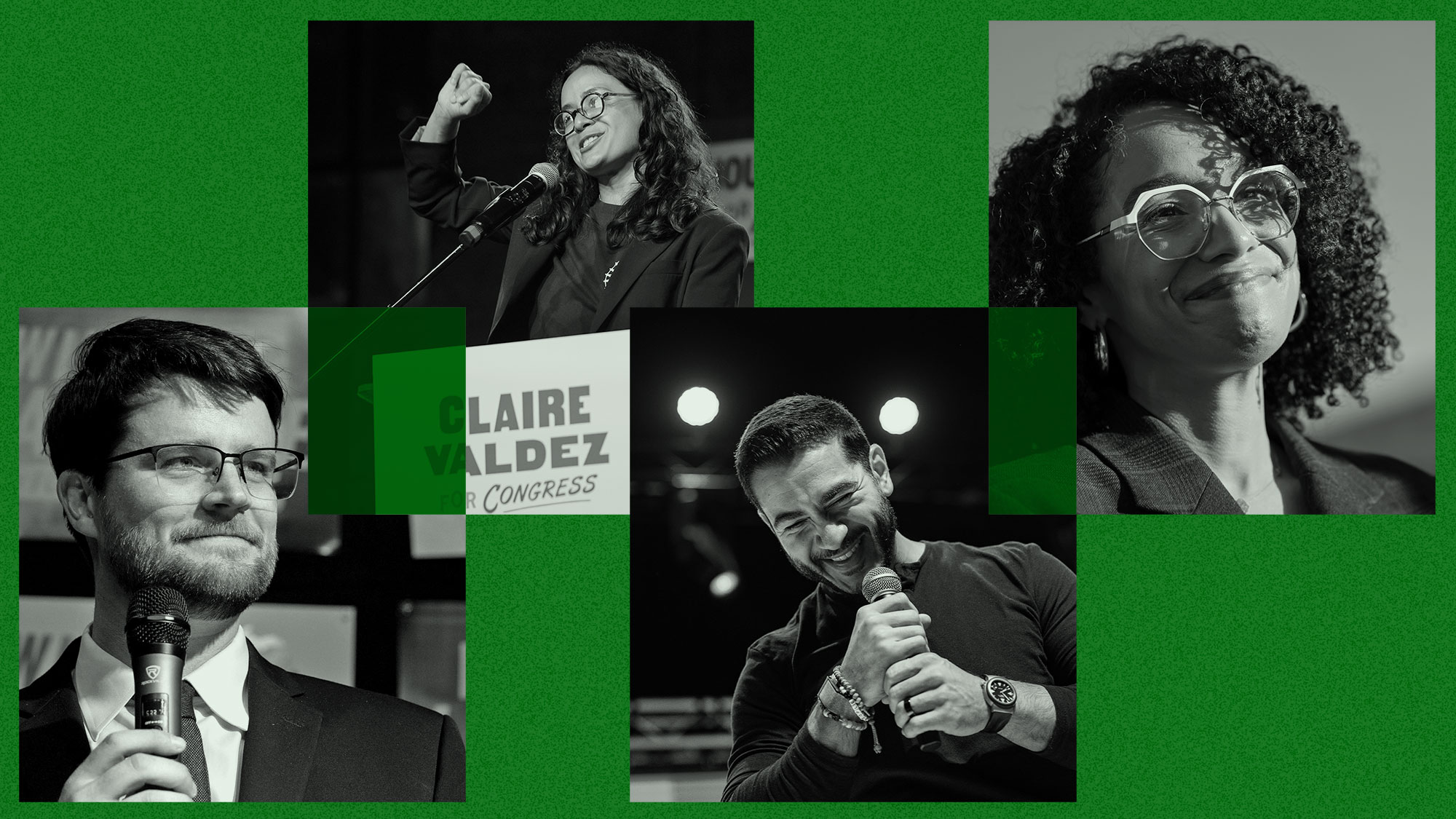
According to CCI’s framework, candidates who successfully check all three boxes represent the modern archetype of climate champions.
Among the other prominent progressives highlighted in the institute’s report is Will Lawrence, a co-founder of the Sunrise Movement—the youth-led climate organization that first thrust the Green New Deal into the national spotlight back in 2018. Lawrence, who is set to represent Michigan’s 7th District in the upcoming session of Congress, makes his deep grassroots climate organizing history a centerpiece of his political identity.
"I will be among the most knowledgeable and dedicated members of Congress on water, climate and energy policy," Lawrence writes on his campaign platform. "I will fight for investment to secure the climate we depend on, adapt to the changes we can’t prevent, and finally drive our electric bills down."
Bigger observed that these "new folks headed to the House and the Senate who are really on board with a robust transformative approach to climate" embody a profound and sweeping shift in how progressive politics operate on the ground.
At the same time, the transition away from traditional climate nomenclature is far from uniform. Not all climate progressives making their way to Washington are entirely hesitant to invoke the Green New Deal by name. Representatives-elect Claire Valdez and Darializa Avila Chevalier, both victors in New York City races, proudly feature the terminology directly on their campaign websites and in media appearances.
Nevertheless, even these candidates are weaving broader, more universal themes into their platforms. The digital profiles for Valdez and Avila Chevalier feature distinct appeals centered on securing "a livable planet for all" and "a livable world for everyone." This diversity in messaging strategies highlights the increasingly fractured and adaptable nature of the broader climate movement, particularly as it operates in an environment where the Trump administration has returned to Washington with a dedicated agenda to systematically roll back Biden-era environmental protections and regulations.
Aru Shiney-Ajay, executive director of the Sunrise Movement, argues that if progressive Democrats have altered their messaging on climate change, it is fundamentally because the political terrain they are fighting on has transformed beneath their feet.
"I think, as the climate crisis gets worse and worse, it’s becoming increasingly clear that the strategy, policy-wise, needs to be incorporating climate change into every single aspect of what we’re doing," Shiney-Ajay said. In her view, climate policy should never be compartmentalized as an isolated environmental niche separate from the broader economy, infrastructure modernization, or foreign policy. Instead, she argues, it must serve as the foundational framework guiding how modern society is managed.
When the Sunrise Movement first burst onto the national political stage in 2018, it did so with a dramatic, high-profile protest staged outside the office of then-House Minority Leader Nancy Pelosi, where championing the Green New Deal served as their singular, defining priority. Just seven years later, members of the organization voted to strategically reorganize their efforts around fighting authoritarianism, placing a particular emphasis on countering the second Trump administration. Shiney-Ajay openly acknowledges that the formal climate movement has faced significant headwinds and setbacks in recent years.
However, she maintains that these organizational shifts do not signal that the American public has grown indifferent or disengaged from the realities of the climate crisis. On the contrary, voters across the entire political spectrum are tuning into the issue more closely than ever before, driven by immediate encounters with extreme weather and economic strain.
"People are actually really hungry for something to do about climate change," Shiney-Ajay said. "I think we will actually see a lot of momentum around stopping the climate crisis. And I certainly hope to build a movement that makes that possible."
As these newly minted climate progressives and green economic populists take their oaths of office and begin their terms, the imperative from groups like the Climate and Community Institute is clear: now is the time to govern. (Adding to the shifting political currents, a petition launched recently asks Representative Alexandria Ocasio-Cortez, who famously stood alongside Sunrise activists outside Pelosi’s office years ago, to launch a presidential run in 2028.) Navigating these challenges and working toward durable solutions will, of course, demand far more than a single legislative cycle or a single presidential term.